In this piece
Hiring a CTO vs a Fractional CTO: US Salary Math
A full-time CTO in the US costs a lot more than the salary on the offer letter. Add benefits, employer taxes, recruiting and equipment to a typical salary and the first year comes to roughly $299,000 before any equity, about $255,000 a year after that. A fractional CTO costs from $900 a month for on-call help up to $10,000–$25,000 a month for an active, hands-on role. So the honest answer to “fractional CTO vs full-time CTO” is arithmetic: fractional is cheaper until you need close to full-time hours, and then a hire wins. This article walks through the annual numbers line by line, shows where they cross, and lists the costs that do not show up on a spreadsheet. If you want help deciding, our fractional CTO service starts with exactly this conversation. For what a fractional CTO is and the general price ranges, read our fractional CTO cost guide first.
We reviewed the external references on 19 November 2026. Salary and benefit figures come from the US Bureau of Labor Statistics; every other number in the model is illustrative, so replace it with your own quotes.
Deciding between a CTO hire and fractional help?
Book a free callWhat does a full-time CTO really cost in the US?
Start with salary. The Bureau of Labor Statistics does not publish a separate figure for CTOs; they sit inside computer and information systems managers, whose median annual wage was $175,140 in May 2025. Startup CTOs in expensive cities, or with a strong track record, are often paid more in cash; very early CTOs are often paid less and given more equity. Use the median as a neutral starting point, not a quote.
Then add benefits. In the BLS Employer Costs for Employee Compensation release for June 2026, benefits made up 30.0% of total compensation costs for private-industry workers, against 70.0% for wages. That is about 43 cents of benefits, insurance and legally required employer taxes for every dollar of pay. The other lines below are illustrative assumptions, not market data:
- Recruiting. An executive search firm or contingency recruiter commonly charges a percentage of first-year salary; we use 25% (illustrative). Hiring yourself costs founder time instead.
- Equipment and tools. Laptop, software seats, conferences and travel: $5,000 a year (illustrative).
- Equity. Not cash, so it is outside the totals, but for an early CTO it is often the largest cost of all. Count it as dilution, separately.
Fractional CTO vs full-time CTO: the annual numbers side by side
Put the pieces together and compare them with the three common fractional arrangements. The full-time totals use the illustrative model above; the fractional market range is the published range from our cost guide, not a quote.
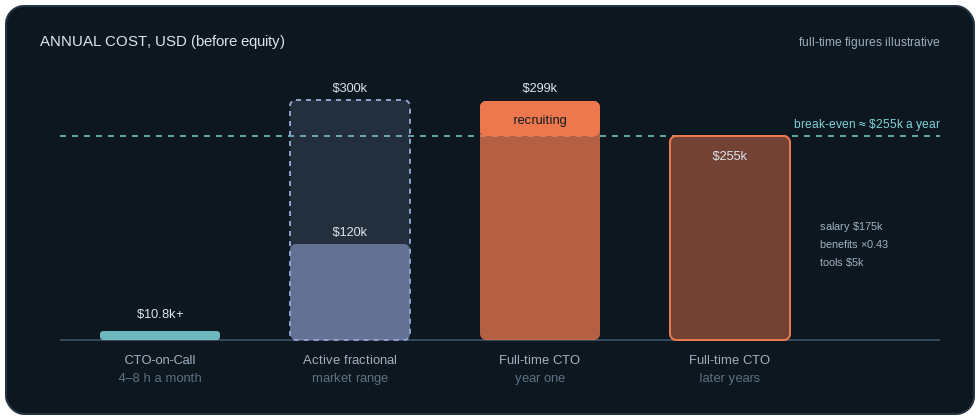
| Option | Time | Per month | Per year |
|---|---|---|---|
| Devoun CTO-on-Call | 4–8 hours a month | from $900 | from about $10,800 |
| Active fractional CTO (market range) | 20–40 hours a month | $10,000–$25,000 | $120,000–$300,000 |
| Full-time CTO, year one (illustrative) | Full-time | about $24,900 | about $299,000 |
| Full-time CTO, later years (illustrative) | Full-time | about $21,300 | about $255,000 |
Two things stand out. First, an on-call arrangement costs less than a month of a full-time hire per year, which is why it suits companies that mainly need decisions reviewed. Second, the top of the active fractional range costs about the same as a hire. If you find yourself paying that for more than a few months, the market is telling you the job has become full-time.
Where is the break-even point?
The cleanest way to compare is an effective hourly cost. Divide the ongoing cost of a hire by the hours they actually spend on productive work, after holidays, vacation, meetings and admin. With 1,800 productive hours a year (illustrative), a full-time CTO costs about $142 an hour. Then ask how many hours your fractional fee buys.
Illustrative model (US, before equity)

Base salary (BLS median, May 2025)         $175,140
Benefits and employer taxes (x 0.43)        $75,300
Laptop, software, travel (illustrative)      $5,000
-------------------------------------------------
Ongoing cost per year                      $255,440   = about $21,300 a month
Recruiting fee, year one (25% of base)      $43,785
-------------------------------------------------
Year-one cost                              $299,225   = about $24,900 a month

Effective hourly cost = $255,440 / 1,800 productive hours = about $142
Break-even: fractional fee per month / $142 = hours a month you could have bought
In this model, fractional is cheaper while your monthly fractional spend stays under about $21,000, and a hire is cheaper above it, once the recruiting fee is paid off. In the first year the line sits nearer $25,000, because the hire carries the recruiting cost. Equity sits on top of all of this: a full-time CTO grant is dilution you pay for years, while a fractional CTO is normally paid in cash only. Change any assumption and the line moves, so run it with your own salary offer, benefits quote and recruiter terms.
What costs don’t show up in the salary math?
The spreadsheet ignores the costs that most often decide the question in practice:
- Time to hire. A senior executive search can take months. A fractional CTO can usually start within days, and every month without technical leadership has its own cost in slow or wrong decisions.
- Cost of a wrong hire. Replacing an executive means another search, a lost quarter and often an equity grant that has already vested in part. A fractional engagement that is not working can end in weeks.
- Stage fit. The CTO who suits a five-person seed company is rarely the one who suits a 50-person engineering team. Fractional help can cover the early stage and help hire the right full-time person later.
- Availability. A full-time CTO is there for the 2 a.m. incident and the daily stand-up. A fractional CTO is not, so you need an engineering lead or agency who handles day-to-day delivery.

"The expensive mistake is rarely the fractional fee or the salary. It is hiring a full-time CTO for the job you have today, when the job you will have in eighteen months needs a different person."
How to decide in practice
- Write down the decisions that need senior technical judgement in the next six months.
- Estimate the hours a month those decisions need. Under about 40 hours, fractional is almost always cheaper.
- Price a hire with your real salary offer, benefits quote and recruiter terms, using the model above.
- Check whether you also need someone in the code every day. If yes, that is a lead engineer, not a CTO.
- Plan the handover: if you go fractional now, agree that part of the job is helping you hire the full-time CTO.
How Devoun can help: our fractional CTO engagements start with CTO-on-Call from $900 a month and scale up when you need more hours. They run week to week with no long notice period, and our money-back guarantee refunds the last paid week if it did not move your product forward. When the numbers say it is time to hire, we help you write the role and screen the candidates.
Frequently Asked Questions
How much does a full-time CTO cost in the US?
The BLS median pay for computer and information systems managers, the group that includes CTOs, was $175,140 in May 2025. With benefits and employer taxes at the private-industry average, plus illustrative recruiting and tooling costs, a first year comes to roughly $299,000 before equity, and about $255,000 a year after that.
When is a full-time CTO cheaper than a fractional CTO?
When you would otherwise buy close to full-time fractional hours. In our illustrative model a hire costs about $21,000 a month once recruiting is paid off, so if your fractional spend would stay above that for a year or more, a hire is usually the better deal.
Should I count equity in the cost of a CTO?
Yes, but separately from cash. Equity does not leave your bank account, but it dilutes every other shareholder and is often the largest single cost of an early CTO. Fractional CTOs are usually paid in cash only.
Can a fractional CTO help me hire a full-time CTO later?
Yes, and it is one of the most useful things they do: writing the role, screening candidates technically, and handing over architecture, vendors and documentation so the new hire starts with context.
Final thoughts
A full-time CTO is worth the money when you need one full-time. Until then, the fully loaded cost of roughly a quarter of a million dollars a year buys a lot of fractional hours. Run the numbers with your own inputs, count equity separately, and revisit the decision every quarter as the work grows.
