In this piece
Case Study: Building QLU’s AI Executive Search Platform
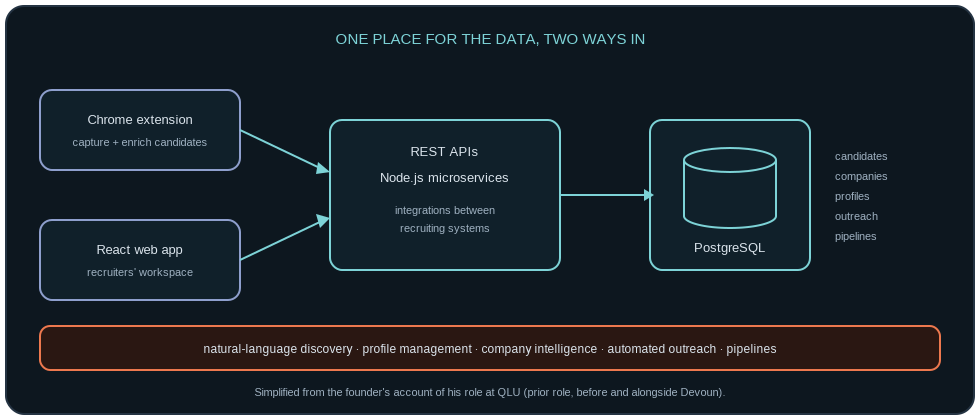
QLU is an AI-powered executive search and recruiting platform, built to replace slow, manual candidate sourcing and a patchwork of disconnected recruiting tools. Before and alongside Devoun, our founder Atta Ur Rehman was one of its Core Founding Engineers, working across the full stack and the AI features. He built the core React front end, the Node.js backend, the PostgreSQL architecture, microservices, REST APIs and a Chrome extension that captures and enriches candidate information. The lesson that carries over to every AI search product is simple: natural-language search is only as good as the data underneath it. This case study covers the problem, how the platform was put together, what made it hard, and what we now apply in our RAG and AI search development work. It describes a prior role, not a Devoun client contract.
We reviewed the external references on 19 November 2026. Project details come from the founder’s own account of his role; we do not publish figures for QLU, because none are part of that account.
Building search over messy, scattered data of your own?
Talk about your AI searchWhat problem was QLU solving?
Executive search depends on finding and qualifying the right people. QLU was designed to replace sourcing work that was slow and manual and spread across disconnected recruitment tools, so candidate data ended up fragmented. QLU set out to bring that work into one AI-driven platform, so that a search firm could identify candidates faster, streamline outreach and run its search operations from one place.
How was the QLU platform built?
As a Core Founding Engineer, Atta worked on both the product foundations and the AI-facing features. Being a founding engineer on a product like this means the early decisions are yours: how the data is modelled, how the services are split, how the front end talks to the backend, and how outside data gets in. Those choices are hard to change later, so they shape everything the product can do. In his own summary of the role, the main pieces were:
| Part of the platform | What it did |
|---|---|
| React front end | The core web application recruiters work in |
| Node.js backend, microservices, REST APIs | Business logic and the integrations between recruiting systems |
| PostgreSQL database architecture | One home for candidate, company and pipeline data |
| Chrome extension | Capturing and enriching candidate information from wherever recruiters find it |
| Natural-language candidate discovery | Describing the person you need in plain language instead of building filters |
| Profiles, company intelligence, outreach, pipelines | Managing candidates, understanding target companies, contacting people and tracking each search |
What made AI candidate search hard?
Three challenges stand out in the founder’s account of the project:
- Fragmented candidate data. Information about the same person arrives from different places, in different shapes, at different times. Search cannot be better than the records it searches.
- Complex search workflows. Executive search is not a single query. Recruiters refine, compare, shortlist and come back, so the product has to support a workflow, not just return a list.
- Integrations between recruiting systems. Firms already use other tools. A platform that replaces disconnected tools still has to exchange data with some of them.
These are the same three problems most AI search products meet, in recruiting and elsewhere. The search feature gets the attention, but it sits on top of data capture, data cleaning and integrations, and it is only as reliable as they are.
The Chrome extension addressed the first problem at the source: instead of recruiters copying details into spreadsheets, candidate information could be captured and enriched as they found it, and flow into the same database the search ran on. Browser extensions are a well-supported way to do this; the Chrome extension platform is designed for exactly this kind of in-context tool.

"Everyone wants the search box that understands plain English. The unglamorous work that makes it useful is getting every record about a person into one clean place first."
What can founders building AI search learn from it?
These are our general lessons for AI search products, drawn from this kind of work. They are not a description of QLU’s internals.
- Fix capture before ranking. Put effort into how data enters the system, such as an extension, imports or integrations, before tuning the model. Clean, de-duplicated records improve every search.
- Keep search close to your data. For many products, PostgreSQL can carry a long way: built-in full-text search for keywords, and extensions such as pgvector for meaning-based search, before you add a separate search service.
- Turn the plain-language request into something you can check. Let the model translate a request into structured criteria the user can see and edit, rather than hiding the logic.
- Design for the workflow, not the query. Shortlists, notes, outreach and pipeline stages are what keep users coming back after the first impressive search.
- Build the evaluation set early. Collect real requests and the results a good recruiter would expect, and run them on every change.
- Treat outreach as part of search. Finding the right person is only useful if the next step, contacting them and tracking the reply, happens in the same place. Each tool you remove from the user’s day is a reason for them to stay.
None of these lessons is specific to recruiting. The same pattern applies to any product where users search for people, companies, documents or deals described in plain language: legal research, sales prospecting, supplier sourcing or internal knowledge. The model makes the search box feel smart. The data model, the capture tools and the workflow around the results decide whether users trust it enough to come back the next day. When we scope an AI search product today, we spend the first conversations on where the records come from, how they are matched and kept current, and who is allowed to see what, before we discuss which model to use.
How Devoun applies this: our RAG development work starts with the data, where it comes from, how it is cleaned and who may see it, before the model. Projects begin with a paid Discovery ($200, credited to the build) and run in fixed-price milestones covered by our money-back guarantee.
Frequently Asked Questions
Was QLU a Devoun client project?
No. QLU was our founder’s prior role, before and alongside Devoun, as a Core Founding Engineer (Full Stack and AI). We describe it because it is the kind of AI search product Devoun now builds for clients.
What did the founder build at QLU?
The core React front end, the Node.js backend, the PostgreSQL database architecture, microservices, REST APIs and a Chrome extension for capturing and enriching candidate information, plus features for natural-language candidate discovery, profile management, company intelligence, automated outreach and centralized recruitment pipelines.
Why use a Chrome extension in a recruiting product?
Recruiters often research candidates on other websites. An extension lets them capture and enrich a profile from wherever they are, so the data lands in one platform instead of in spreadsheets and copied notes.
Can Devoun build a similar AI search product?
Yes. Natural-language search over your own data, with clean records and permissions underneath, is the core of our RAG and AI search work. It starts with a paid Discovery that scopes the data and the search experience.
Final thoughts
QLU shows what AI search looks like when it is built as a product rather than a demo: one place for the data, a way to capture it where users already work, and a workflow around the results. The model matters, but the records, the integrations and the pipeline are what make the search worth using.
