In this piece
Fractional CTO vs CTO-as-a-Service vs Interim CTO
Fractional CTO, CTO-as-a-service and interim CTO are three ways to get CTO-level leadership without a permanent executive hire, and the labels overlap enough to confuse buyers. The short version: a fractional CTO is a named person, part-time, for as long as it helps; CTO-as-a-service is similar work packaged by a firm as a subscription, sometimes with a team behind the lead; and an interim CTO is near full-time for a fixed period, usually three to twelve months, while you hire. In published US ranges, active fractional work runs about $10,000–$25,000 a month and interim roles about $20,000–$40,000 a month, against a median of about $175,000 a year in base pay for a full-time technology manager. This guide compares the three on time, authority, cost and contract, and helps you pick. Devoun offers a founder-led fractional CTO service, so we will also say when it is not the right fit.
We reviewed the external references on 19 November 2026. Market ranges are not quotes; rates vary with seniority, industry and scope.
Not sure which model fits your company right now?
Book a free callWhat is the difference between a fractional CTO, CTO-as-a-service and an interim CTO?
The real differences are time, authority and who you are actually buying. Our glossary has short definitions of CTO-as-a-service and interim CTO; here is how they compare side by side.
| Fractional CTO | CTO-as-a-service | Interim CTO | |
|---|---|---|---|
| Time | Part-time, a few hours to a few days a week | Set by the subscription tier | Near full-time |
| Duration | Open-ended, rolling | Open-ended, rolling | Fixed, often 3–12 months |
| Who you get | One named senior person | A firm’s lead, sometimes backed by a team | One named executive |
| Authority | Owns technical decisions, guides the team | Varies: advisory to hands-on | Runs engineering day to day |
| Typical US cost | Under $5,000 (advisory) to $10,000–$25,000 a month (active) | Often priced like fractional, in tiers | $20,000–$40,000 a month |
| Best for | Startups that need judgement, not 40 hours | Buyers who want a packaged, predictable service | A CTO gap, crisis or major transition |
Fractional and interim ranges are from the A.Team rate guide. There is no reliable public range for CTO-as-a-service as a separate category, because it is mostly a way of packaging the same work.
How much does each option cost?
Monthly price is only half the comparison. A full-time CTO looks cheaper per hour, but the U.S. Bureau of Labor Statistics median of $175,140 a year (May 2025) for computer and information systems managers is base pay only, before equity, benefits, recruiting fees and the months it takes to hire. Fractional and CTO-as-a-service models let you buy the hours you need now; interim buys executive presence for a defined period.
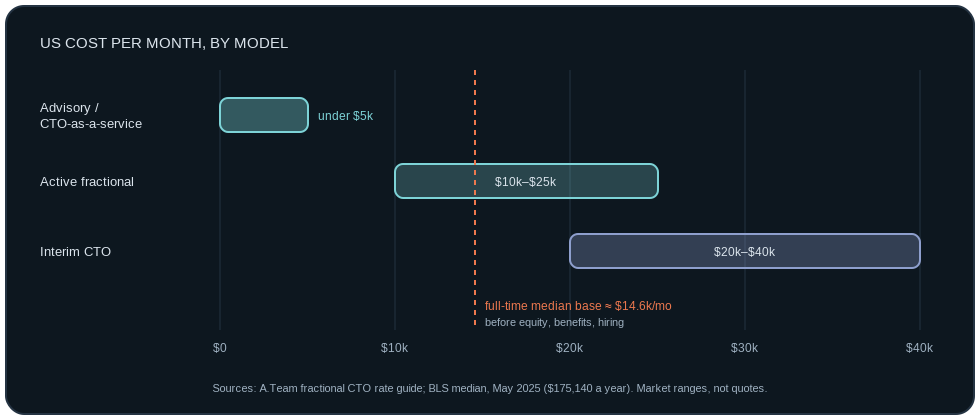
An illustrative example: a seed-stage company that needs architecture decisions, vendor oversight and two hiring panels a month needs perhaps 8–20 hours. Paying an interim rate for that is waste; an advisory or active fractional engagement fits. A company whose CTO resigned mid-migration with ten engineers waiting for direction needs someone there every day, and interim is worth the premium.
What can go wrong with each model?
Each option has a typical failure mode. Knowing it in advance is most of the protection.
- Fractional CTO: too few hours for the problem. Decisions wait for the next call, and the team fills the gap with guesses. Agree response times, and review whether the hours still fit after the first month.
- CTO-as-a-service: the senior person who sold the engagement is not the person doing the work. Name the lead in the contract, and ask what happens if that person leaves the firm.
- Interim CTO: the engagement becomes permanent by accident. The interim runs the team so well that nobody hires the replacement, and you pay interim rates for a year. Set the hiring plan and end date on day one.
- All three: knowledge leaves with the person. Ask for architecture decisions, credentials and plans to be written down in your own tools, not in their heads or their accounts.
Which one should you choose?
- Choose a fractional CTO if you need senior judgement on architecture, vendors, hiring and roadmap, but not full-time management, and you want one accountable person.
- Choose CTO-as-a-service if you prefer a packaged service with defined tiers and are comfortable with a firm deciding who does parts of the work. Ask exactly who leads and whether that can change.
- Choose an interim CTO if you have an urgent leadership gap, a team that needs daily direction, or a transition such as an acquisition or a major migration, and a plan to hire permanently.
- Hire a full-time CTO when the engineering team is large enough that technical leadership is a full-time job, and you can offer the equity and package a strong candidate expects.
For a deeper two-way look at the first and last options, see our fractional vs interim CTO comparison.

"Founders often ask for an interim CTO when what they need is four good decisions a month and someone to check the agency’s work. Buy the hours the problem needs, not the title."
What should the contract cover?
Whatever the label, put these in writing before the first invoice:
- Hours or availability per month, and response times for urgent issues.
- Decision rights: what the CTO can approve alone, and what needs the founder or board.
- Who exactly does the work, and whether substitutes are allowed (important for CTO-as-a-service).
- Deliverables for the first 30 days, so you can judge the engagement on results.
- Notice period and how hours can scale up or down.
- IP assignment, confidentiality and access handover when the engagement ends.
How Devoun works: our fractional CTO engagements are led by our founder. CTO-on-Call starts from $900 a month for 4 to 8 hours, larger scopes are quoted, and the retainer is rolling, so you can stop any week. Under our money-back guarantee, the last paid week is refunded if it did not move your product forward.
Frequently Asked Questions
What is the difference between a fractional CTO and an interim CTO?
A fractional CTO works part-time for as long as it is useful, often alongside other clients. An interim CTO works near full-time for a fixed period, usually three to twelve months, to cover a gap until a permanent CTO starts. Interim costs more per month but gives you daily executive presence.
Is CTO-as-a-service the same as a fractional CTO?
The work is largely the same. CTO-as-a-service is usually how a firm packages it: a subscription with defined tiers, sometimes with a team behind the lead. Ask who exactly will do the work, how many hours are included and whether the person can change.
Which is cheapest?
Advisory fractional or CTO-as-a-service tiers are the cheapest, from under $5,000 a month in published ranges, and Devoun’s CTO-on-Call starts from $900 a month. Active fractional roles run about $10,000–$25,000 a month, and interim roles about $20,000–$40,000.
Can a fractional CTO become an interim or full-time CTO?
Sometimes. Many engagements start fractional and grow, or a fractional CTO steps up to near full-time during a crisis. Agree in the contract how hours can scale up or down and with how much notice.
Final thoughts
The label matters less than three questions: how many hours of senior judgement you need, how much authority the person must have, and for how long. Answer those honestly and the choice between fractional, CTO-as-a-service and interim usually makes itself.
