In this piece
How to Choose a Custom Software Development Company: A US Checklist
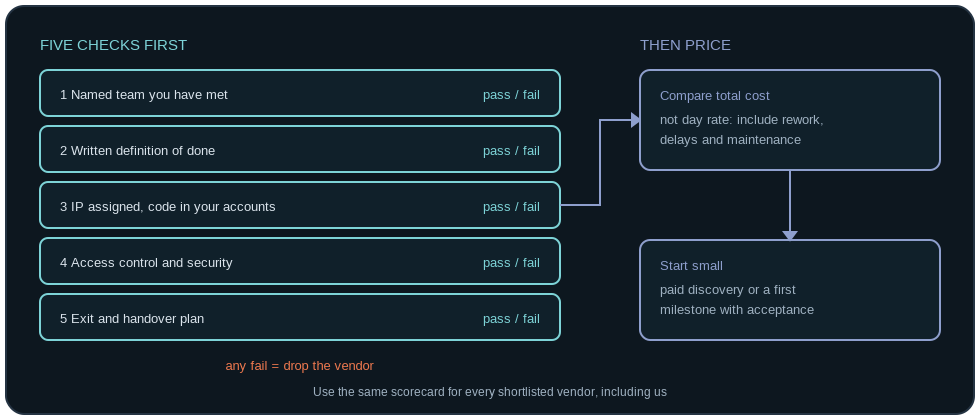
Choosing a custom software development company is less about finding the best portfolio and more about avoiding the vendor who will cost you a year. For US buyers, the reliable approach is to check five things before you compare price: who actually does the work, how “done” is defined, who owns the code, how access and security are handled, and how you leave. Then reduce the risk of the first decision with a paid discovery or a small first milestone, rather than signing a large fixed bid on a vague brief. A good shortlist and two or three well-run calls take two to four weeks. This checklist gives you the questions to ask, the answers to expect, and the red flags that should end the conversation. If you are comparing vendors for custom software development, use it on us too.
We reviewed the external references on 19 November 2026. This is a practical buyer’s guide, not legal advice; have your lawyer review any contract before you sign. For the broader process of building a shortlist, see our guide on how to choose a software agency.
Want to test this checklist on a real proposal?
Book a free callWhat questions should you ask a software development company?
Ask these on the first or second call. The good answers are specific and come with an example; the weak answers are general and come with a sales deck.
| Question | A good answer | Red flag |
|---|---|---|
| Who exactly will work on this, and can I meet them? | Named people, roles and time allocation | “We’ll assign the team after signing” |
| How do you define “done” for a feature? | Written acceptance criteria, tests, deployed to staging | “When the developer finishes it” |
| Who owns the code, and when? | You, by written assignment, as work is paid for | Only on final payment, or a license instead of ownership |
| Where will the code and cloud accounts live? | In your repository and your cloud accounts | In the vendor’s accounts “for convenience” |
| How do you handle scope changes? | A written change process with cost and timeline impact | “We’re flexible” with no process |
| What happens if we stop working together? | A handover plan: docs, credentials, a call with your new team | No answer, or a large exit fee |
| Can I speak to a past client? | Yes, ideally one with a project like yours | Only anonymous logos |
What are the red flags in a software development proposal?
- A precise quote with no questions. If they priced your project without asking about users, data, integrations or edge cases, the number is a guess, and the change requests will come later.
- No named team. Senior people on the sales call and unknown people on the project is the most common bait-and-switch in the industry.
- Everything is “in scope”. A vendor who never says no during sales will not protect your budget during delivery.
- No testing or acceptance step. If the proposal has no line for QA, staging or acceptance testing, you will be the tester.
- Weekly status with no working software. Ask how often you will see a demo of the real product. Every one or two weeks is normal.
- Pressure to sign this week. Discounts that expire on Friday are a sales tactic, not a partnership.
Who owns the code? IP and contract checks for US buyers
Many founders assume that paying for software means owning it. In the US that is not automatic. The U.S. Copyright Office’s Circular 30 on works made for hire explains that work by an independent contractor counts as a work made for hire only if it falls into one of nine specific categories and there is a signed written agreement. Custom software usually does not fit those categories, which is why development contracts include an explicit assignment of intellectual property to the client. Check with your lawyer that the contract:
- Assigns the code, designs and documentation to you, not just a license to use them.
- Says when ownership transfers, ideally as each milestone or invoice is paid.
- Lists open-source and third-party components and their licenses.
- Covers subcontractors: their work must be assigned to you too.
- Includes confidentiality, and a clear termination and handover clause.
How do you check security and process?
Ask how the vendor controls access to your systems: individual accounts, multi-factor authentication, no shared passwords, and removal of access when people leave the project. If you sell to enterprises or handle sensitive data, ask whether they have a SOC 2 report, an independent CPA examination of controls covering security and, optionally, availability, processing integrity, confidentiality and privacy. Many good small vendors do not have one; in that case, ask for their written security practices and make your own requirements part of the contract.
Ask how they use AI coding tools
Most development teams now use AI coding assistants, and that is not a problem in itself. What matters is how the output is checked. Ask whether every change is reviewed by a person before it is merged, whether automated tests run on each change, and how they make sure no secrets or customer data are pasted into third-party tools. A team that answers with a clear process is using AI to go faster. A team that cannot answer may be shipping code nobody has fully read.

"The best question to ask a vendor is what they would not build for you. A team that can say no in the sales call is the team that will protect your budget later."
Start small before you commit
The safest way to choose is to buy a small, useful piece of work first: a paid discovery with a technical plan and fixed price, or a first milestone with clear acceptance criteria. You learn how the team communicates, estimates and tests, at a fraction of the cost of the full project. Compare total cost, not the day rate: a cheap team that needs twice the time and a rebuild is the expensive one.
How Devoun handles this: our custom software development work starts with a Discovery valued at $400, 50% free (you pay $200, credited to the build), which produces the architecture, milestone plan and a fixed-price offer. After that you choose fixed-price milestones, refunded if not accepted, or a weekly retainer from $2k a month that you can stop any week. Both are covered by our money-back guarantee.
Frequently Asked Questions
What questions should I ask a software development company?
Ask who exactly will work on your project, how they define done and test it, who owns the code and when ownership transfers, how they manage access to your systems, how they handle scope changes, and what the handover looks like if you stop working together.
What are the red flags when hiring a software development company?
A fixed quote with no questions about your users or data, no named team, code in the vendor’s own accounts, IP that transfers only on final payment, no written definition of done, and no exit or handover plan. Pressure to sign quickly is another warning sign.
Do I automatically own the code a contractor writes for me in the US?
Not automatically. Under US copyright law, software written by an independent contractor usually does not qualify as a work made for hire, so contracts use an explicit assignment of IP to you. Have your lawyer check the clause.
Should I choose the cheapest software development company?
Not on price alone. Compare total cost, including rework, delays and maintenance, and reduce risk with a paid discovery or small first milestone. Devoun’s Discovery is valued at $400 and you pay $200, credited to the build.
Final thoughts
A good software partner is easy to test if you ask the right questions: who does the work, what done means, who owns the code, how access is controlled and how you leave. Put every shortlisted vendor through the same checklist, start with a small paid step, and let the evidence, not the pitch, make the decision.
