In this piece
What a Software Development Money-Back Guarantee Should Actually Cover
A software development money-back guarantee is worth exactly as much as its fine print. A real one names what gets refunded, how “not good enough” is decided, how quickly you get your money, and what you keep when you leave. If an offer does not answer those questions in writing, it is a slogan. This article sets out what a useful guarantee covers, the red flags to look for, and how we structured Devoun’s money-back guarantee.
We reviewed the external references on 19 November 2026. This is a buyer’s checklist, not legal advice; have your contract reviewed under its governing law.
Why most agency guarantees protect the agency
Most software contracts pay for time, not results. Long retainers, notice periods and change requests keep revenue flowing whatever happens to your product. When a guarantee is added on top, it usually takes one of three weak forms: a free bug-fixing window after launch, a promise of “satisfaction” with no definition, or refunds paid as credits for more work from the same team. None of these returns money when the work itself was not good enough.
Five things a real guarantee must spell out
1. What exactly is refunded
The refund should be tied to a named unit of work: a milestone with its own price, or a specific paid week. “Up to the value of the project” sounds generous and means nothing, because nobody can agree what part failed.
2. How “not good enough” is judged
Every unit of work needs written acceptance criteria agreed before it starts: the tests that must pass, the user journeys that must work, the documents that must be delivered. If the agency alone decides whether the work is acceptable, the guarantee cannot be enforced.
3. How you leave
Look for a notice period and an exit fee. A guarantee is hollow if you still owe a month’s notice or a termination payment. The cleanest version is a weekly engagement you can stop at the end of any week.
4. How fast the money comes back
The clause should say how a refund is requested, what evidence is needed, and where the money goes. Refunds to the original payment method, without a negotiation step, are what you want.
5. What you keep
If you get a refund, you should not lose the code, the documentation or access to your accounts. Work should live in a repository you own from day one.
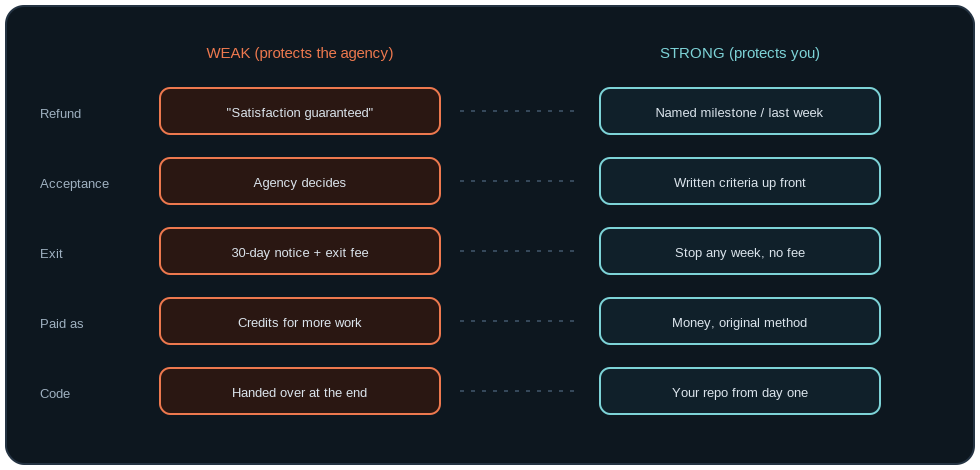
| Clause | Weak version | Strong version |
|---|---|---|
| Refund scope | “Satisfaction guaranteed” | The named milestone or last paid week |
| Acceptance | Agency judgement | Written criteria agreed up front |
| Exit | 30-day notice, exit fee | Stop any week, no fee |
| Refund form | Credits for more work | Money back to the original payment method |
| Code ownership | Transferred on final payment | In your repository from day one |
What a guarantee should not promise
Be suspicious of a guarantee that refunds the entire project no matter what. Nobody can price that honestly, so the cost is hidden somewhere else, usually in a padded quote. A fair guarantee also excludes things the agency does not control: third-party costs such as hosting, API usage and app store fees, and delays caused by missing credentials, data or approvals from the client side.
How Devoun’s guarantee works
We run two models, and each has its own guarantee. On a weekly retainer you can cancel any week, with no notice period, and the last paid week is refunded if it did not move your product forward. On a fixed-price project, scope is set in a Discovery valued at $400, 50% free (you pay $200, credited to the build). Each milestone then has a fixed price and written acceptance criteria, and a milestone that is not accepted is refunded. You keep everything delivered.

"If a week of work did not earn the next one, the client should not pay for it. Putting our fee at risk every week is the simplest way to prove we are aligned with the people we build for."
Questions to ask any agency before you sign
- What exactly is refunded, and is it money or credits?
- Who writes the acceptance criteria, and when?
- Is there a notice period or an exit fee?
- How do I request a refund, and how long does it take?
- Who owns the repository and the accounts while the work is in progress?
Frequently Asked Questions
Do software development companies offer money-back guarantees?
Some do, but the terms vary widely. Many offer a free bug-fix period or a vague satisfaction promise. Fewer refund money against written acceptance criteria. Read the contract clause, not the marketing line.
What should a software money-back guarantee refund?
A specific, named unit of work: the milestone that failed its acceptance tests, or the last paid week of a retainer that did not move the product forward. Avoid guarantees that only offer credits or extra work instead of money.
Is a money-back guarantee better than fixed price?
They solve different problems. Fixed price caps what you pay; a guarantee lets you get money back when the work fails. The strongest combination is a fixed price per milestone with a refund if that milestone is not accepted.
Who decides whether the work is acceptable?
Written acceptance criteria agreed before the work starts. If the decision is left to the agency’s judgement, the guarantee protects the agency, not you.
Final thoughts
A money-back guarantee is not a gimmick when it is written properly. It turns an agency relationship from “trust us” into “judge us against this list, every week”. Ask for the clause, check the five points above, and walk away from any offer that cannot put them in writing.
