In this piece
AI Agent Development Cost in 2027, Line by Line
An AI agent costs money twice: once to build, and every month to run. The build covers discovery, integrations with your systems, guardrails and an evaluation set that proves the agent works. The running cost covers model tokens, hosting, monitoring and maintenance. The surprise for most buyers is that the model is rarely the biggest line. Integrations and evaluation drive the build price, and the number of tasks drives the running cost. This guide walks through each line so you can compare quotes and budget for AI agent development with your eyes open.
We reviewed the external references on 19 November 2026. Model prices change often, so this guide explains the cost structure and links to the official price pages instead of quoting them.
Want a fixed number for your agent instead of a range?
Scope your AI agentWhat makes one AI agent cost more than another?
Four things move the price more than anything else:
- Integrations. Every system the agent reads from or writes to (CRM, ERP, help desk, email, WhatsApp, payment or booking systems) needs authentication, error handling and testing.
- Autonomy. An agent that drafts answers for a human to approve is far cheaper to make safe than one that takes actions on its own, such as refunding orders or changing records.
- Accuracy target. Going from “usually right” to “right often enough to trust without checking” takes most of the evaluation and tuning effort.
- Data. Messy, scattered or permission-sensitive data needs cleaning, retrieval and access control before an agent can use it well.
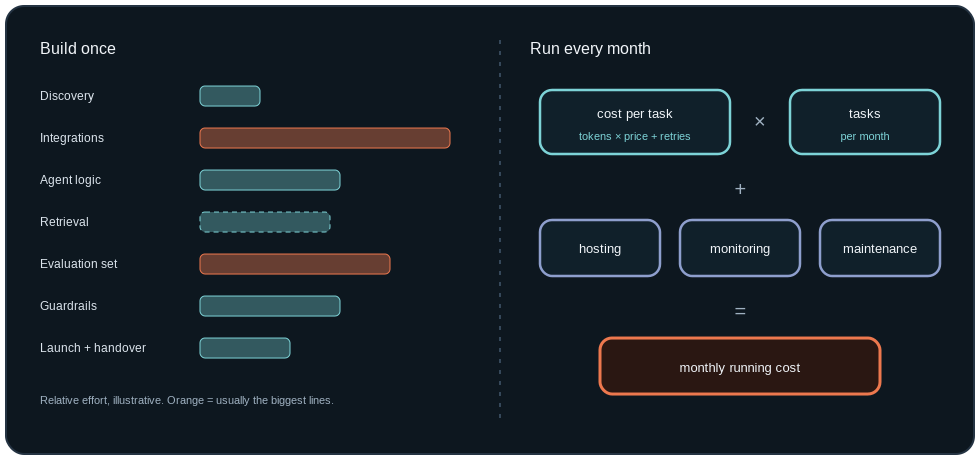
The build cost, line by line
| Line item | What it covers | Share of effort |
|---|---|---|
| Discovery | Process mapping, data audit, success metrics, fixed quote | Small, but it sets every other number |
| Integrations | Connecting the agent to your systems and handling their failures | Often the largest line |
| Agent logic | Prompts, tools, workflows, memory and hand-off to humans | Medium |
| Knowledge and retrieval | Ingesting documents or databases so answers come from your data | Medium; zero if not needed |
| Evaluation set | Real examples with expected outcomes, used to measure and tune | Medium to large |
| Guardrails and security | Permissions, prompt-injection defences, limits on actions, audit logs | Medium |
| Interface and launch | Chat, voice, email or API front end; monitoring; handover | Small to medium |
A useful rule when comparing quotes: if a proposal has no evaluation set and no guardrails line, it is a demo budget, not a production budget. Frameworks such as the NIST AI Risk Management Framework exist because measuring and managing AI behaviour is real work, and it has to be paid for somewhere.
The running cost, and how to estimate it per task
Model providers charge per token, with different prices for input and output and for each model. Prices change often, so always check the official pages, such as Anthropic and OpenAI. The only number that matters for your budget is the cost per task:
cost per task  = (input tokens  × input price per token)
               + (output tokens × output price per token)
               + tool calls and retries

monthly model cost = cost per task × tasks per month
Measure the tokens of a few real tasks during the pilot rather than guessing. Agents that call tools, retry or reason in several steps use many more tokens than a single question and answer. Then add the other running costs:
- Hosting: servers or serverless functions, a vector database if you use retrieval, logs.
- Monitoring: tracing each run, reviewing failures and keeping the evaluation set current.
- Maintenance: prompt and model updates, changes in the systems the agent connects to, and new edge cases.
How to keep the cost down
- Start with one narrow, high-volume task, not a general assistant.
- Keep a human approval step until the evaluation numbers justify removing it.
- Route simple steps to smaller, cheaper models and keep the expensive model for hard steps.
- Cache repeated context and trim what you send to the model.
- Integrate with the two or three systems that matter first; add more once the agent earns it.

"The demo is the cheap part. What you are really paying for is the evaluation set that tells you when the agent is right, and the guardrails that decide what happens when it is not."
How Devoun prices AI agents
Every Devoun agent starts with a Discovery valued at $400, 50% free (you pay $200, credited to the build). It maps the process, checks the data and produces a fixed quote split into milestones. Our development projects typically fall within $200–$20,000, and ongoing work runs on a retainer from $2k a month that you can stop any week. Each milestone has written acceptance criteria, and one that is not accepted is refunded under our money-back guarantee. Model and hosting fees are paid to those providers and are separate.
Questions to ask before you sign an AI agent quote
- Which systems does the agent connect to, and what happens when one is down?
- What can the agent do without a human approving it?
- How will accuracy be measured, and what number counts as done?
- What is the expected cost per task at our volume?
- Who maintains it after launch, and what does that cost?
Frequently Asked Questions
How much does it cost to build an AI agent?
It depends mostly on the number of systems the agent connects to, how much it is allowed to do on its own, and how accurate it has to be. A narrow agent with one or two integrations costs far less than one that takes actions across several business systems. A paid discovery phase is the only reliable way to get a fixed number.
What are the ongoing costs of an AI agent?
Model usage (tokens), hosting, monitoring and maintenance. Model usage scales with the number of tasks and the tokens per task. Maintenance covers prompt and model updates, integration changes and reviewing failures.
Why do AI agent quotes vary so much?
Because quotes often cover different things. Some include only a demo; others include integrations, guardrails, an evaluation set, monitoring and handover. Compare quotes line by line against the list in this article.
How do I estimate the model cost per task?
Measure the input and output tokens of a typical task, multiply each by the provider’s price per token, then add retries and tool calls. Multiply by tasks per month for the monthly cost.
Is it cheaper to build an AI agent in-house?
Only if you already have engineers with production AI experience. Otherwise the cost of learning evaluation, guardrails and monitoring on the job is usually higher than a fixed-price build with a handover.
Final thoughts
Budget for an AI agent the way you would for any production system: pay for discovery, pay for testing, and know your running cost per task before you scale. The quotes that look cheapest usually leave out the evaluation and guardrails, which are exactly the parts that decide whether the agent can be trusted with real work.
