In this piece
AI Receptionist for Small Business: Cost, Setup and ROI
An AI receptionist answers your business phone when nobody else can: it greets callers, answers common questions, books appointments into your calendar and passes urgent calls to a person. For a small business the question is not whether the technology works, but whether it pays for itself. That comes down to what your missed calls are worth, set against a monthly subscription or a custom build. This guide explains the two ways to buy one, what each costs, how to set it up so callers do not hang up, and a simple ROI test you can run with your own call log. It is written for owners and office managers, not engineers, so there is no code beyond one line of arithmetic. If you want one built around your own systems, see our AI voice agent development service.
We reviewed the external references on 19 November 2026. Vendor prices change often, so this guide explains the cost structure and points you to official pages instead of quoting per-minute rates.
Missing calls you could be booking?
Scope your AI receptionistWhat does an AI receptionist actually do?
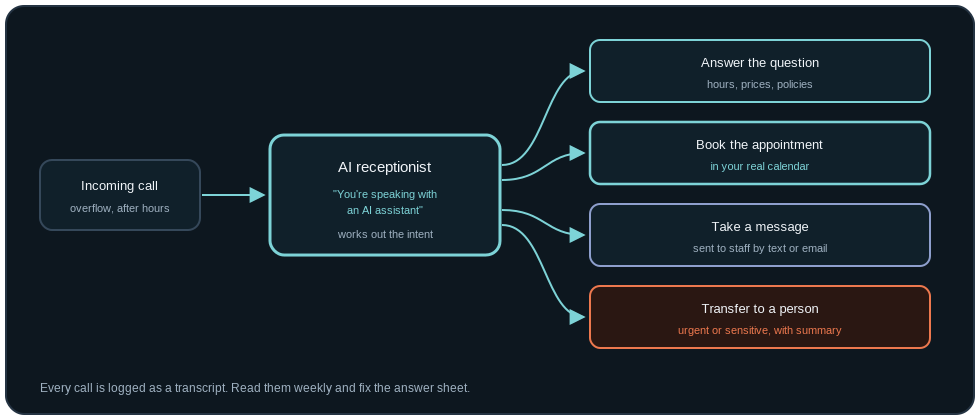
A good one handles the predictable, repetitive calls and gets out of the way for the rest. Typical jobs for a dental practice, salon, law firm, clinic or home-services company:
- Answer questions about hours, location, services, prices and policies from your own information.
- Check availability and book, move or cancel appointments in your calendar or booking system.
- Take a structured message and send it to the right person by text or email.
- Transfer urgent or sensitive calls to a person, with a summary of what the caller needs.
- Cover after-hours, lunch breaks and busy periods when the front desk is already on the phone.
Just as important is what it should not handle, at least at first: complaints, billing disputes, medical or legal questions, anything involving an emergency, and callers who ask for a person. Those calls go straight to your team, or to a message if nobody is available. Drawing that line clearly is what keeps callers and staff on your side.
How much does an AI receptionist cost?
There are two ways to buy one, and they price differently. Subscription products charge a monthly fee, usually tied to a number of minutes or calls, with extra charges above the allowance. A custom AI receptionist, built on your phone number and connected to your systems, has a one-off build cost plus a running cost per minute for the phone line, speech recognition, the language model and the synthetic voice. Always check each vendor’s current pricing page, and ask what happens when you go over the allowance.
| Option | How you pay | Best for | Watch out for |
|---|---|---|---|
| Human receptionist | Salary and overhead | Complex, in-person front desks | Calls missed when busy or closed |
| Answering service | Per minute or per call | Message-taking | Usually cannot book into your systems |
| AI receptionist subscription | Monthly fee, minute or call allowance | Standard booking tools and FAQs | Overage charges, limited integrations, data use terms |
| Custom AI voice agent | Build cost plus per-minute running cost | Your own systems, workflows or languages | Needs testing and someone to maintain it |
For context, the US Bureau of Labor Statistics reports a median pay for receptionists of $38,010 a year (May 2025), before payroll taxes and benefits. An AI receptionist rarely replaces that person outright; it is usually cheaper to treat it as cover for the calls nobody answers today.
Before you sign up for any product, ask the vendor:
- What counts as a billable minute or call, and what happens when we go over the allowance?
- Does it book directly into our calendar or booking system, or only send us a request?
- Can we set our own transfer rules and choose who receives messages?
- Who can read our call recordings and transcripts, and are they used to train models?
- Can we export our data and leave without losing our phone number?
How do you work out the ROI?
Start with your phone system’s call log, not a vendor’s promise. Count the calls that went unanswered or to voicemail in a typical month, estimate how many of those callers would have booked, and multiply by the average value of a booking:
value of missed calls a month
  = missed calls a month
  × share that would have booked
  × average value of a booking

Illustrative: 80 missed calls × 25% × $150 = $3,000 a month
The numbers in the last line are illustrative; use your own. If the value of recovered bookings is several times the monthly cost, the receptionist pays for itself even if it only converts some of those callers. If you rarely miss calls, the case rests on staff time saved instead, which is harder to prove and smaller.

"An AI receptionist that can only take messages is a voicemail with better manners. The value is in booking the appointment while the caller is still on the line."
How do you set one up so callers don’t hang up?
- Pick the calls it handles. Start with after-hours and overflow, and the three or four most common questions.
- Write down your answers. Hours, services, prices, policies and what to do when it does not know. The receptionist is only as good as this sheet.
- Connect the calendar. Booking is where the money is; without it, you have an expensive answering machine.
- Set transfer rules. Decide which words or situations send a call straight to a person, and what happens when nobody picks up.
- Say it is an AI. A one-line disclosure at the start of the call. If calls are recorded, check consent rules for the states you serve with your adviser; some require every party to agree.
- Test with real calls, then read transcripts weekly. Fix the answer sheet wherever it stumbles.
If the receptionist will also make outbound calls, such as reminders or follow-ups, note that the FCC has ruled that AI-generated voices count as artificial voices under the Telephone Consumer Protection Act, so the consent rules for robocalls apply. Confirm your outbound setup with your adviser before you switch it on.
When a subscription product does not fit, because your booking system is unusual, you need several languages, or calls must update your CRM, a custom build is the better route. Devoun builds AI voice agents on your own number and systems. We start with a Discovery valued at $400, 50% free (you pay $200), which ends with a fixed price for the build, and every milestone is covered by our money-back guarantee.
Frequently Asked Questions
How much does an AI receptionist cost for a small business?
Subscription products charge a monthly fee, usually tied to minutes or calls, so check each vendor’s current pricing page. A custom AI receptionist adds a one-off build cost and a per-minute running cost for telephony, speech and the language model. Either way, compare the total with what your missed calls are worth.
Can an AI receptionist book appointments?
Yes, if it is connected to your calendar or booking system. It checks availability, offers times, confirms the booking and sends a confirmation. Without that integration it can only take a message, which removes most of the value.
Should an AI receptionist say it is an AI?
Yes. Telling callers up front builds trust and avoids complaints. Outbound calls with AI-generated voices also fall under US robocall rules, and recording laws vary by state, so check your setup with your adviser.
Will an AI receptionist replace my front desk?
Usually not at first. Most small businesses use it for overflow, after-hours and lunch-hour calls, with urgent or complex calls transferred to a person. Expand its role once you have read real call transcripts and trust its answers.
Final thoughts
An AI receptionist is worth buying when it books real appointments from calls you would otherwise miss. Count those calls first, start with after-hours and overflow, connect the calendar, tell callers they are talking to an AI, and read the transcripts. The numbers will tell you whether to expand it or switch it off.
