In this piece
AI Voice Agent Compliance: Call Recording and Consent in the US
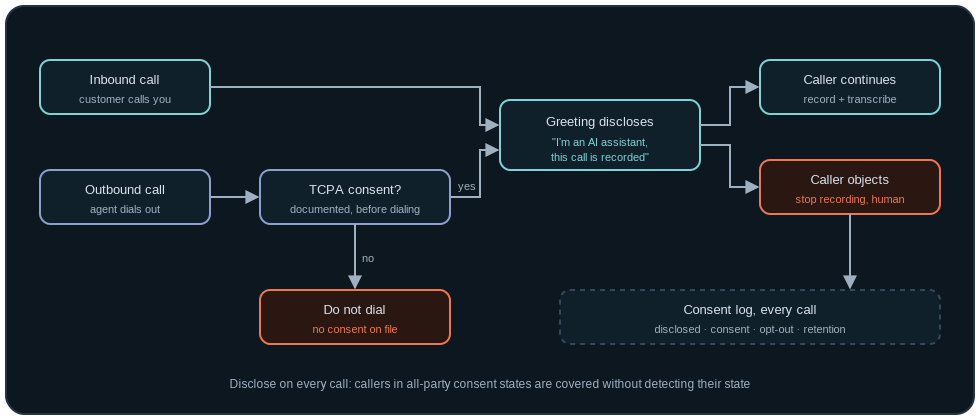
AI voice agent compliance in the US comes down to two separate sets of rules, and a voice agent usually touches both. The first is call recording consent: federal law and most states let you record if one party agrees, but about a dozen states require everyone on the call to agree. The second is the Telephone Consumer Protection Act (TCPA): since February 2024 the FCC treats AI-generated voices as “artificial” voices, so outbound AI calls need the same prior consent as robocalls. Add state rules on bots disclosing themselves, and the practical answer for most businesses is the same: say it is an AI, say the call is recorded, give callers a way out, and log it. This guide explains each rule and how we design AI voice agents around them.
We reviewed the external references on 19 November 2026. This is a practical guide, not legal advice: state laws differ and change, so check your call flows with your adviser.
Planning a voice agent and want consent built in from the first call?
Plan a compliant voice agentIs it legal to record calls with an AI voice agent?
Usually yes, if you follow the consent rule that applies. At the federal level, the Wiretap Act allows a party to a call to record it, or a third party to record it with one party’s consent (18 U.S.C. § 2511(2)(d)). Your business is a party to calls your voice agent answers, so federal law is rarely the problem. State law is. Most states follow the same one-party model, but a group of states require all parties to consent. Law-firm and reference surveys such as Kilpatrick Townsend’s wiretap chart and Justia’s 50-state survey list them slightly differently, because some states have exceptions or treat phone calls and in-person conversations differently.
| Consent model | States (commonly listed) | What it means for a voice agent |
|---|---|---|
| All-party consent | California, Delaware, Florida, Illinois, Maryland, Massachusetts, Montana, Nevada, New Hampshire, Pennsylvania, Washington | Every caller must be told and agree, usually by continuing after a clear notice |
| Listed with caveats | Connecticut, Oregon, Michigan | Rules differ by context or court reading; treat as all-party to be safe |
| One-party consent | Most other states, and federal law | Your business’s consent is enough, but a notice is still good practice |
Callers do not stay inside one state, and you often cannot tell where a caller is from the number. When a call crosses states, the stricter rule is generally treated as the one to follow. That is why most businesses disclose recording on every call instead of trying to detect the caller’s state.
What did the FCC’s 2024 ruling on AI voices change?
In February 2024 the FCC issued a declaratory ruling that the TCPA’s restrictions on calls using an “artificial or prerecorded voice” cover current AI technologies that generate human voices (FCC announcement). The headline said AI voices in robocalls became illegal; as Cooley’s summary explains, the practical effect is that outbound AI voice calls need the same prior express consent as any artificial or prerecorded voice call, with written consent for telemarketing, and the same identification and opt-out rules. It also gave state attorneys general a clearer route to act against unlawful AI calls.
For an inbound AI receptionist, where the customer calls you, the TCPA’s outbound consent rules are usually not the issue. They matter as soon as the agent places calls: appointment reminders, lead follow-up, win-back campaigns or callbacks the customer did not request. Keep a record of how and when each person consented.
What about the AI vendor that hears the call?
A voice agent rarely runs on your own servers alone. Speech recognition, the language model and the voice are usually supplied by outside vendors, and that raises a newer question: is the vendor a third party listening in? In February 2025 a federal court in California let a class action against Google’s contact-center AI continue, on the theory that an AI provider able to use call data for its own purposes can count as a third-party eavesdropper under the California Invasion of Privacy Act (Goodwin summary). That was an early-stage ruling, and later decisions may narrow it, but the practical lessons are cheap to apply: read each vendor’s data-use terms, prefer settings where call data is not used to train the vendor’s models, and make your disclosure cover the fact that technology partners process the call on your behalf.
Does an AI voice agent have to say it is an AI?
There is no single federal rule that covers every call, but several pressures point the same way. California’s bot disclosure law makes it unlawful to use a bot online to mislead people about its artificial identity in order to sell something or influence a vote, unless the bot discloses itself (Cal. Bus. & Prof. Code § 17941); whether it reaches a given phone flow is a question for your adviser. Other states have added or proposed AI disclosure rules, and consumer protection law already covers deceptive practices. A voice that pretends to be a person is also bad for trust: callers who find out later feel misled. We disclose by default.
How do you design a compliant AI voice agent?
- Disclose the AI and the recording in the first sentence, before asking for any personal details.
- Give an easy way out: “say ‘no recording’” or “press 0 for a person”, and honor it for the rest of the call.
- For outbound calls, check documented consent before dialing, and stop calling anyone who opts out.
- Log disclosure, consent and opt-outs per call, so you can show what happened.
- Set retention for recordings and transcripts, and restrict who can access them.
- Be careful with sensitive data: health, payment and identity details may bring in other rules, such as HIPAA or PCI DSS.
A greeting that covers the AI, the recording and the opt-out in under ten seconds (illustrative):
Greeting (first thing the agent says, before any question):
"Hi, you've reached Brightside Dental. I'm an AI assistant, and this call
is recorded and transcribed to help us serve you. If you'd rather not be
recorded, say 'no recording' and I'll connect you with a person."

If the caller objects:
  -> stop recording and transcription for the rest of the call
  -> log: consent=declined, timestamp, call_id
  -> transfer to a human or offer a callback
And the record each call should leave behind (illustrative fields):
{
  "call_id": "c_8f21",
  "direction": "inbound",
  "ai_disclosed": true,
  "recording_disclosed_at": "00:00:04",
  "recording_consent": "continued_after_notice",
  "caller_state_hint": "CA",
  "retention_days": 90
}
"Compliance on a voice agent is mostly a design decision made in week one. Adding a disclosure line and a consent log at the start costs almost nothing; retrofitting them after launch means re-testing every call flow."
How Devoun builds compliant voice agents
Our AI voice agent projects start by mapping every call flow, inbound and outbound, against the consent and disclosure points above, then building the greeting, the opt-out path, the consent log and the retention settings into the agent from the first milestone. You review the flows with your own adviser before launch. Each milestone has written acceptance criteria and is covered by our money-back guarantee.
Frequently Asked Questions
Do I need consent to record calls with an AI voice agent?
Federal law and most states allow recording when one party consents, and your business is a party. About a dozen states require everyone on the call to agree, and callers can be anywhere. Most businesses announce the recording at the start of every call so the strictest rule is covered. Check the details with your adviser.
Which US states require all-party consent for call recording?
Lists differ slightly by source, but they consistently include California, Delaware, Florida, Illinois, Maryland, Massachusetts, Montana, Nevada, New Hampshire, Pennsylvania and Washington. Some lists add Connecticut, Oregon or Michigan with caveats. Check the current statute for the states your callers are in.
Does the TCPA apply to AI voice agents?
For outbound calls, yes. In February 2024 the FCC confirmed that AI-generated voices count as “artificial” voices under the TCPA, so calls using them need the same prior consent as other artificial or prerecorded voice calls. Inbound calls that a customer places to you are a different situation.
Does an AI receptionist have to say it is an AI?
There is no single federal rule for every call, but some state laws require bots to disclose themselves in certain situations, and hiding it creates deception risk. Saying it plainly in the greeting costs nothing and protects trust, so it is the practice we recommend.
Final thoughts
The rules for AI voice agents look complicated because they come from different laws, but the safe design is simple: tell people they are talking to an AI, tell them the call is recorded, give them a way out, and keep a record. Get consent before any outbound AI call. Then let your adviser check the edge cases for your states and your industry.
