In this piece
Technical Due Diligence Before You Buy or Invest in an AI-Built App
Technical due diligence on an app built with Lovable, Bolt, Replit or Cursor asks the same question as any software deal, what exactly are you buying, but the answer hides in different places. The demo will work. The risk sits in the six layers a demo never shows: who owns the code and accounts, whether the database keeps one customer’s data away from another, where the secrets are, whether anyone can deploy a change without the original builder, what the app costs to run per user, and how much of the code a human understands. This checklist is for acquirers, angels and funds looking at a vibe-coded product from the outside. If you are buying, the findings become price, conditions or a fix plan; our vibe coding rescue team turns them into a fixed-price plan.
We reviewed the external references on 19 November 2026. This is an engineering checklist, not legal, tax or investment advice; check deal terms with your adviser.
Signing soon and want an independent look at the code first?
Scope a pre-deal reviewWhy is due diligence on an AI-built app different?
A hand-written codebase usually comes with people who understand it. An AI-built one often comes with a founder who described features in a chat window and accepted whatever the builder produced. That is not a reason to walk away; many of these apps have real users and real revenue. It does change where you look. Security research gives a sense of scale: Veracode’s 2025 study found that AI models introduced a known security weakness in 45% of the coding tasks it tested. Builders also default to a hosted backend such as Supabase, where data safety depends on access policies most sellers have never read.
If you are the founder preparing for a raise, read our due diligence checklist for AI MVPs before funding instead. This article looks from the other side of the table.
What should you check before buying a vibe-coded app?
Work through the layers in this order. The first two can stop a deal; the rest usually change the price.
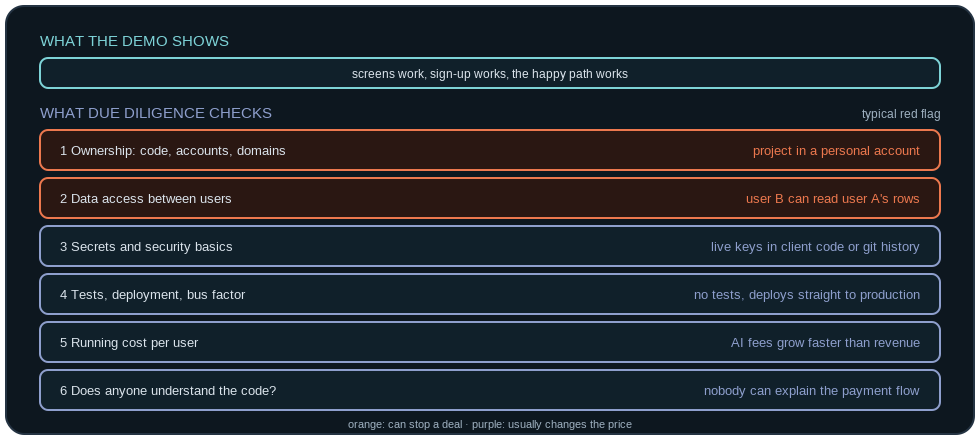
1. Ownership: code, accounts and domains
Confirm that the seller’s company, not a founder’s personal email or a freelancer, owns the builder project, the code repository, the hosting account, the database, the domain, the app store listings and the payment provider. Ask for contractor agreements that assign IP, and for a list of open-source package licenses. Your lawyer confirms the transfer terms; your technical reviewer confirms that every account on the list actually exists and can be moved.
2. Data access: can one user read another’s data?
This is the most common serious finding in AI-built apps. In a Supabase backend, the Row Level Security policies decide who sees which rows, and builders often write them broad enough to make errors disappear. Ask the reviewer to sign in as two test users and try to read and change each other’s records directly through the API. Our Supabase RLS mistakes post lists what to look for. If customer data has already been exposed, that is a question for your lawyer, not only your engineers.
3. Secrets and security basics
Look for API keys in client code and in the git history, admin keys used in the browser, and payment webhooks that do not verify signatures. Tools such as GitHub secret scanning catch many leaked keys; a reviewer then checks the OWASP Top 10 risks by hand on the flows that handle money and personal data. Every live key found should be rotated at closing, whatever else you decide.
4. Tests, deployment and the bus factor
Can someone other than the founder change the app and ship it safely? Check for automated tests on the critical journeys, a separate staging environment, a written deploy process and database migrations under version control. Many vibe-coded apps deploy straight from the builder to production, with no way to roll back.
5. Running cost per user
Ask for three months of invoices from hosting, database, AI model providers and any paid APIs, and divide by active users. AI features can make the margin worse as usage grows, not better. Check the model providers’ current pricing pages yourself rather than trusting a spreadsheet, because those prices change often.
6. Comprehension: does anyone understand the code?
Ask the seller to walk through one core flow in the code, not the app. If nobody can explain how a payment becomes an order, budget for a new team to spend weeks learning it, or for parts to be rewritten.
Which red flags are deal breakers, and which are price?
| Finding | Usually means | Typical deal response |
|---|---|---|
| Seller cannot transfer the code, domain or key accounts | You may not get what you pay for | Condition of closing; walk away if it cannot be fixed |
| Users can read each other’s data | A live security and legal exposure | Fix before closing; ask your lawyer about past exposure |
| Secrets in client code or git history | Anyone with the code may hold live keys | Rotate at closing; price the clean-up |
| No tests, no staging, deploy from the builder | Every change is a risk | Price a hardening phase into the plan |
| Running cost rises faster than revenue per user | The margin story does not hold | Revisit valuation or earn-out terms |
| Nobody can explain the core flows | Knowledge leaves with the seller | Handover period in the agreement, or rebuild budget |
How do you run the review in a week?
- Agree the question in writing: buy or not, at what price, and what must be fixed first.
- Get read access to the repository with full history, the database, hosting, the builder project and vendor billing.
- Run quick automated checks for secrets, outdated packages and tests (below), then read the critical flows by hand.
- Test data access as two users, and test sign-up, payment and deletion end to end.
- Write up findings by severity, each with evidence, a fix and a rough cost range, so they can go straight into the deal.
# Run against a read-only clone the seller gives you
git log --format='%an' | sort | uniq -c | sort -rn   # who actually wrote it
git log --oneline | wc -l                            # how many changes, over how long
grep -rnE "service_role|sk_live_|SECRET|PRIVATE_KEY" --include=*.{ts,tsx,js,env} .
find . -path ./node_modules -prune -o \( -name "*.test.*" -o -name "*.spec.*" \) -print | wc -l   # any tests?
npm audit --omit=dev                                 # known-vulnerable packages
These commands are a first pass, not a verdict. A clean result means the obvious problems are absent; it does not mean the access policies or payment flows are right. For larger deals, our technical due diligence service covers architecture, team and delivery process as well.

"With an AI-built app, the code is rarely the asset. The users, the data and the distribution are. Due diligence is about making sure the code does not quietly put those at risk after you have paid for them."
How Devoun helps buyers and investors
Devoun reviews AI-built apps before a purchase or investment: ownership, data access, secrets, tests, deployment and running cost, written up as findings you can put into the deal. If you go ahead, our vibe coding rescue turns the findings into fixed-price fixes, each with written acceptance criteria and covered by our money-back guarantee. The review has an agreed fee and stands on its own, so you are not committed to the fixes.
Frequently Asked Questions
Is an AI-built app worth less than a hand-written one?
Not automatically. Users and revenue are worth the same however the code was written. What changes is the risk: AI-built apps more often have open data access rules, exposed keys and no tests, and those cost money to fix. Price the fixes into the deal instead of walking away by default.
What access should a seller give for technical due diligence?
Read access to the code repository with its full history, the database schema and access policies, the hosting and deployment settings, the builder platform project, and the billing pages of the main vendors. Screenshots and a demo are not enough to judge the code or the data.
How long does technical due diligence on a small AI-built app take?
For a single app with one database, a focused review usually takes days, not weeks. The time depends on how much access the seller gives and how many systems are involved, so agree the scope and the questions first.
Who owns code generated by an AI builder?
It depends on the builder’s terms, the seller’s contracts with any freelancers and the licenses of the packages used. Ask for the account ownership, contractor agreements and a dependency license list, and have your lawyer confirm the transfer. This article is not legal advice.
Final thoughts
An AI-built app can be a good acquisition. Its users, data and revenue are real, and many of its technical problems are cheap to fix once you know about them. The expensive outcome is finding them after closing. Ask for access, not screenshots, test the data rules yourself, and let the findings set the price.
