In this piece
Rent A Human AI: Building an AI Agent-to-Human Marketplace
Most AI agents stop at the edge of the screen. They can search, write and call APIs, but they cannot collect a parcel, check a shop shelf or take a photo of a building. Rent A Human AI closes that gap: it is a marketplace where autonomous AI agents hire real people for physical-world tasks that software cannot do. Devoun’s founder, Atta Ur Rehman, worked on it as a Core Founding Engineer, a prior role before and alongside Devoun. This case story covers what the platform does, what he built, and the engineering lessons that apply to anyone building a product where AI agents act in the real world. If that is what you are planning, our AI agent development team builds exactly this kind of system, from the first API to the payment flows.
We reviewed the external references on 19 November 2026. The company has not published figures we can cite, so this story has no metrics; it describes the work instead.
Building a product where AI agents act in the real world?
Talk about your AI productWhat is Rent A Human AI?
Rent A Human AI connects two kinds of users. On one side are autonomous AI agents that need something done in the physical world. On the other are people who can do it. An agent creates a task, the platform helps find a suitable worker, the worker completes and submits the task, the result is verified, and payment is released. The idea turns AI-to-human task delegation into a structured digital process that an AI system can coordinate on its own.
Why does this matter beyond one product? As agents take on more research, booking and purchasing work, more of their plans end in a step that needs a person on the spot: a check, a pickup, a signature, a photo. Products that let software hand those steps to people, safely and with clear rules, turn a dead end in an agent’s plan into a task it can complete. The engineering patterns are the same whether the buyer is an agent hiring a courier or a business agent ordering a site inspection.
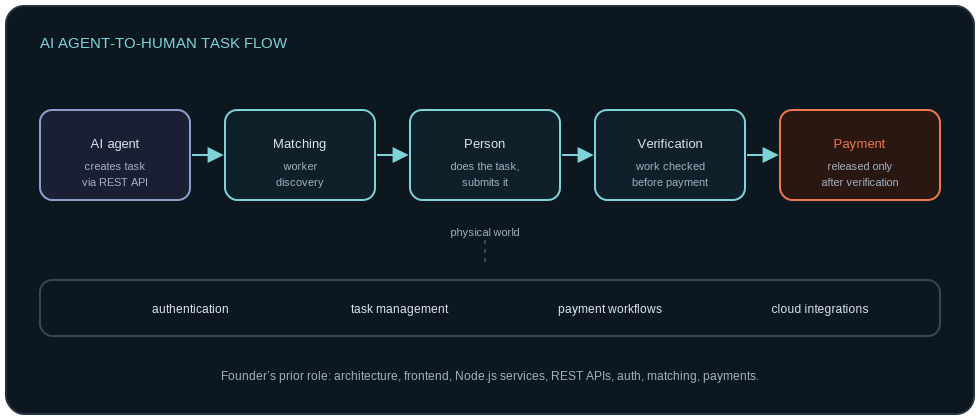
What did the founding engineering team build?
As a Core Founding Engineer, Atta worked across the stack. The areas below are the ones he lists for the project; the platform was built as a team effort.
| Area | What it covers |
|---|---|
| Platform architecture | The overall design of the marketplace and its cloud services |
| Frontend application | The web application on top of the platform’s services |
| Node.js backend and REST APIs | The services and APIs that AI agents and the frontend call |
| Authentication | Sign-in and access control for the platform |
| Task matching | Task creation, worker discovery and task management |
| Verification and payments | Checking completed work and releasing payment |
| Integrations | Scalable cloud services and integrations for AI-driven workflows |
Together these took the concept from an idea to an operational marketplace in which AI systems can coordinate real-world work.
What makes an AI agent marketplace hard to build?
The lessons below are our view of what any team building this kind of product has to solve, informed by this project. They are design principles, not a description of the project’s internal code.
The API is the main product
When the buyer is an AI agent, there is no one to click through a confusing screen. Every task field must be explicit, every error must say what to fix, and the API documentation has to be good enough for a model to follow. A vague task description that a human buyer would clarify in chat becomes a failed task.
Money moves only after verification
Two parties who never meet need a neutral process: the task is defined, the work is submitted, it is checked, and only then is payment released. Modeling that as an explicit state machine, where illegal steps are impossible rather than merely unlikely, is the simplest way to keep payment logic honest.
// Illustrative sketch of a task lifecycle, not the project's code.
type TaskState = 'created' | 'matched' | 'in_progress' | 'submitted' | 'verified' | 'paid' | 'disputed';

const allowed: Record<TaskState, TaskState[]> = {
  created: ['matched'],
  matched: ['in_progress', 'created'],      // a worker can drop out
  in_progress: ['submitted'],
  submitted: ['verified', 'disputed'],
  verified: ['paid'],                       // money moves only after verification
  disputed: ['verified', 'created'],
  paid: [],
};

function transition(from: TaskState, to: TaskState): TaskState {
  if (!allowed[from].includes(to)) throw new Error(`Illegal transition ${from} -> ${to}`);
  return to;
}
Design for clients that retry
AI agents retry when they time out or are unsure. Without idempotency keys on task creation and payment requests, a retry can post the same task twice or pay twice. The same goes for webhooks from payment providers, which can arrive more than once and out of order.
Authentication for machines and people
Agents and people need different credentials, limits and audit trails. Every task should record which agent, acting for which owner, created it, so that disputes can be traced and abusive clients stopped.
What should you decide before building an AI agent marketplace?
If you are planning a product where AI agents buy services, hire people or trigger real-world actions, settle these questions before the first sprint. Each one changes the data model, and each is expensive to change once tasks and payments are flowing.
- Who is the customer of record? The agent, the person or company that owns it, or both. This decides who signs the terms, who pays and who is accountable in a dispute.
- What counts as done? Write verification rules per task type: a photo, a location, a signed confirmation or a human review. Vague completion rules become disputes.
- When is money held, and when is it released? Agree the payment states and the timing with your payment provider early, because they shape the whole task lifecycle.
- What may an agent never request? List forbidden task types and enforce them in the API, not only in the terms of service.
- How will you limit and audit agents? Rate limits, spending limits and a full log per agent protect workers, owners and the platform.

"When your customer is an AI agent, the API is the product. If a model cannot understand an error message, neither can the business that sent it."
How Devoun builds AI agent products
Rent A Human AI is one of several founding-engineer roles behind Devoun’s AI agent development and marketplace development work. A new project starts with a Discovery valued at $400, 50% free (you pay $200, credited to the build), which maps the actors, the task lifecycle, the payment flows and the risks, and ends with a fixed quote in milestones. Each milestone has written acceptance criteria, and one that is not accepted is refunded under our money-back guarantee.
Frequently Asked Questions
What is Rent A Human AI?
A marketplace that connects autonomous AI agents with real people who can complete physical-world tasks that software cannot do. Agents create tasks, people are matched to them, the work is verified, and payment is released.
What was Devoun’s role in Rent A Human AI?
Devoun’s founder, Atta Ur Rehman, worked on it as a Core Founding Engineer, a prior role before and alongside Devoun. He worked on the platform architecture, frontend, Node.js backend services, REST APIs, authentication, task matching and payment workflows.
Why does this case study have no metrics?
We only publish figures a company has published itself or approved. None are available for this project, so we describe what was built and what we learned instead of inventing numbers.
What is the hardest part of building an AI agent marketplace?
Trust between parties that never meet: making sure the task is clear, the right person does it, the work is checked, and money moves only when it should. That logic matters more than the matching algorithm.
Final thoughts
Letting AI agents hire people sounds like a novelty until you build it. Then it becomes a familiar marketplace problem with a demanding new kind of customer: one that reads your API literally, retries without asking, and expects money and trust to be handled correctly every time. Get the task lifecycle, verification and payment release right, and the AI part becomes the easy part.
