In this piece
Custom Software vs Off-the-Shelf SaaS for US Small Businesses: The 3-Year Cost
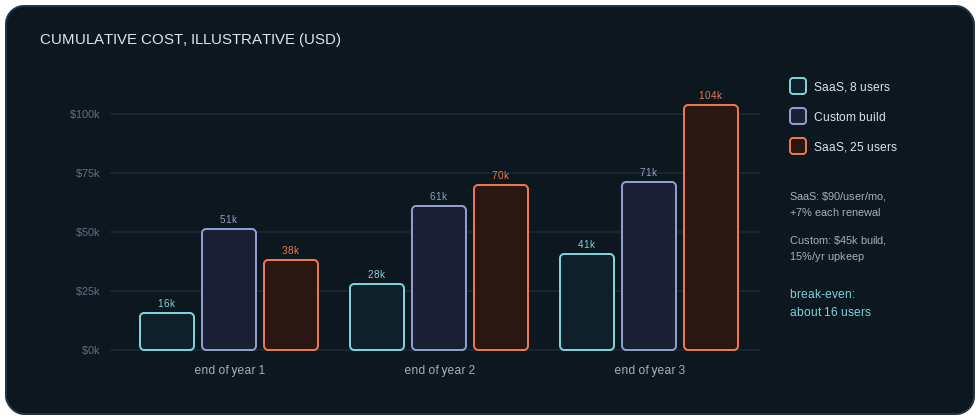
Custom software vs off-the-shelf SaaS is usually argued on features. For a US small business, the money question is simpler: what does each option cost over three years, all in? SaaS starts cheap and grows with every user and every renewal. Custom software costs more up front, then mostly hosting and maintenance. That means headcount decides more than features do. In the illustrative example below, SaaS wins clearly at 8 users, custom software wins at 25, and the break-even sits around 16. This article walks through the full three-year model so you can put your own quotes in it, and shows how our custom software development team prices the build side. For the wider decision, including when not to build at all, see our guide to custom software vs off-the-shelf.
We reviewed the external references on 19 November 2026. The worked example uses illustrative numbers, not quotes; tax points are general information, so check them with your CPA.
Want the three-year comparison done with your real numbers?
Compare your optionsWhat goes into the 3-year cost of SaaS?
The subscription is the visible part. Over three years, a realistic SaaS budget includes:
- Seats: every user who needs to log in, including occasional ones.
- Price increases at renewal. Many vendors raise prices or move features to higher tiers.
- Setup: onboarding, data migration and configuration, often by a partner.
- Add-ons and integration tools to connect it to your accounting, CRM or payment systems.
- Workarounds: staff time on spreadsheets and double entry where the product does not fit your process.
- Exit: exporting data and retraining staff if you ever switch.
What goes into the 3-year cost of custom software?
- The build, ideally at a fixed price per milestone, so the biggest number is known before you start.
- Hosting, email, monitoring and any paid APIs, which grow with usage but rarely with headcount.
- Maintenance: security updates, fixes and small changes. A common planning figure is 15–20% of the build a year.
- Your own time on requirements and testing during the build.
- Exit: if the code, accounts and documentation are yours, switching developers is a handover, not a migration.
What does the 3-year comparison look like for a real business?
Take an illustrative 25-person home-services company that needs scheduling, job tracking, quotes and invoicing. All numbers below are illustrative assumptions, chosen to be plausible, not quotes from any vendor or from Devoun:
- SaaS: $90 per user a month, a 7% price increase at each renewal, $3,000 a year in add-ons and integration tools, and $8,000 setup ($4,000 for a smaller team).
- Custom: a $45,000 build, $3,000 a year for hosting and services, and maintenance at 15% of the build a year, starting halfway through year one.
| Illustrative cost | SaaS, 8 users | SaaS, 25 users | Custom (any headcount) |
|---|---|---|---|
| Year 1 | $15,640 | $38,000 | $51,375 |
| Year 2 | $12,245 | $31,890 | $9,750 |
| Year 3 | $12,892 | $33,912 | $9,750 |
| 3-year total | $40,777 | $103,802 | $70,875 |
At 8 users, SaaS costs about $30,000 less over three years. At 25 users, custom software costs about $33,000 less, and from year four the gap widens because there is no build cost left to pay. With these inputs the break-even is about 16 users. Staff time on workarounds is left out of both columns; if the SaaS product forces double entry for a few hours a week, add that to the SaaS side.
What moves the break-even?
The break-even is sensitive to a few inputs. Changing one at a time in the same illustrative model:
- A bigger build. At $70,000 instead of $45,000, the custom side rises to about $105,000 over three years and the break-even moves to about 25 users.
- Faster SaaS price increases. At 10% a renewal instead of 7%, the break-even drops slightly, to about 15 users.
- Workarounds. If the SaaS product costs three hours a week of manual work at $30 an hour, that is about $14,000 over three years, and the break-even falls to about 12 users.
- A longer horizon. Over five years, the custom build’s up-front cost is spread further and the break-even falls again, as long as maintenance stays near plan.
The point is not the exact numbers, which are illustrative, but the shape: SaaS cost is driven by people and renewals, custom cost by the size of the build. Know which of those you expect to grow.
The same model as a formula, so you can swap in your own quotes:
# 3-year cost model (illustrative inputs, replace with your quotes)
saas_3y   = setup + addons_per_year * 3
          + seat_price * 12 * users * (1 + (1 + uplift) + (1 + uplift)^2)
custom_3y = build + hosting_per_year * 3
          + maintenance_rate * build * 2.5      # half a year in year 1
break_even_users = (custom_3y - setup - addons_per_year * 3)
                 / (seat_price * 12 * (1 + (1 + uplift) + (1 + uplift)^2))
When is SaaS still the better choice?
Even when the three-year numbers favor a build, buy when:
- The process is standard (payroll, accounting, email) and you gain nothing from doing it differently.
- You need it working next month, not next quarter.
- Nobody on your side has time to own requirements and testing during a build.
- The vendor carries compliance work you would otherwise own, such as payment card handling.
Build when the software is how you compete, when per-seat pricing punishes growth, or when you are paying for three tools and gluing them together by hand. A middle path often works best: keep SaaS for the commodity parts and build only the workflow that makes your business different, connected through APIs.
One US tax point can also change the math. From tax years beginning after 2024, new Section 174A lets businesses deduct domestic software development costs immediately, with an option to amortize, according to PwC’s summary and the IRS guidance in Rev. Proc. 2025-28. Research performed outside the US is still amortized over a longer period, so where the work is done can matter. Ask your CPA how it applies to your build.

"The honest answer to build or buy is often both. Pay for the boring parts, and spend your build budget only on the workflow your customers would notice if it disappeared."
How Devoun prices the custom side
Devoun starts with a paid Discovery, $200 (full value $400), that maps your process and existing tools, and ends in a fixed-price build offer split into milestones. That gives you the real number for the custom column instead of an estimate, and if SaaS is the better answer we say so. The fee is credited to the build if you go ahead, and every milestone is covered by our money-back guarantee. See how our custom software development projects run.
Frequently Asked Questions
Is custom software cheaper than SaaS?
Rarely in year one, sometimes over three years. SaaS cost grows with users and price increases; custom software cost is mostly up front, then hosting and maintenance. For a small team SaaS usually wins; as headcount grows, a custom build can overtake it. Compare both over the same three-year period with your own quotes.
How much should I budget for maintaining custom software?
A common planning assumption is 15–20% of the build cost a year for fixes, updates and small changes, plus hosting. Our worked example uses 15%, and it is illustrative. The real figure depends on how much the software changes and how many systems it connects to.
What hidden costs does SaaS have?
Price increases at renewal, add-on modules, integration tools, per-seat charges for occasional users, staff time on workarounds where the product does not fit, and the cost of exporting data and retraining staff if you ever leave.
Can I deduct custom software development costs in the US?
Often, yes: from tax years beginning after 2024, Section 174A allows domestic research and experimental costs, including software development, to be deducted immediately, with an option to amortize. Work done outside the US is treated differently. Check how it applies to you with your CPA.
Final thoughts
Comparing a monthly subscription with a one-off build is comparing two different shapes of cost. Put both on the same three-year line, include price increases, maintenance and exit, and the decision usually becomes obvious. For most small teams it is SaaS; for a growing team with a process that sets it apart, a focused custom build can pay for itself well inside three years.
