In this piece
Fixed-Price MVP vs Time and Materials: Real USD Numbers
Fixed price and time and materials are two ways to share one risk: who pays when the work takes longer than planned. Under a fixed price the vendor carries that risk, so you get one number per milestone. Under time and materials you carry it, so you pay for the hours used but can change direction any week. For an MVP, the right choice depends on one question: is the scope clear yet? This article compares both with a worked USD example and explains how we run fixed-price MVP development.
We reviewed this article on 19 November 2026. It is a commercial guide, not legal advice; how your contract treats estimates and overruns depends on its governing law.
Want a fixed number for your MVP instead of an hourly estimate?
Scope your MVPHow the two models differ
| Fixed price | Time and materials | |
|---|---|---|
| You pay for | A defined result per milestone | Hours or weeks actually worked |
| Overrun risk | Vendor | You |
| Changing scope | Change request, priced separately | Re-prioritise next week |
| Needs up front | Clear scope and acceptance criteria | A budget cap and weekly priorities |
| Best for | A scoped MVP after discovery | Early exploration, ongoing product work |
A worked example in US dollars
The numbers below are illustrative, to show how the risk moves, not a quote. Imagine an MVP that a vendor estimates at 10 weeks of work at $3,000 a week.
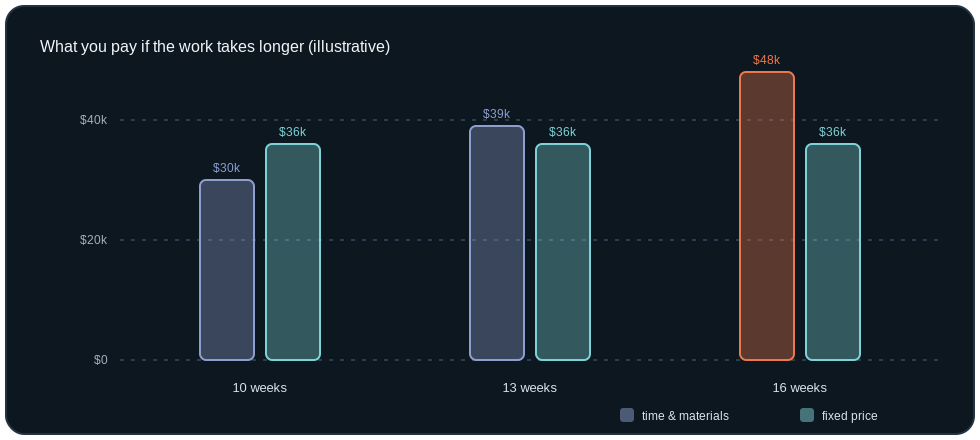
- Time and materials: if the work takes 10 weeks you pay $30,000. If it takes 13 weeks you pay $39,000, and at 16 weeks, $48,000. You keep the savings when things go well and pay the overrun when they do not.
- Fixed price: the vendor adds a buffer for the risk, say 20%, and quotes $36,000. You pay $36,000 whether the work takes 10 weeks or 16. You pay a little more when things go well, and a lot less when they do not.
The buffer is the price of certainty. It is small when the scope is clear and large when it is not, which is why a fixed price on a vague idea is either padded, or renegotiated halfway through.
Why scope decides everything
A fixed price is only as good as the scope behind it. “A marketplace like Airbnb, but for X” cannot be priced honestly. A scope with user journeys, screens, integrations, acceptance criteria and a clear out-of-scope list can. That is the job of a discovery phase: it turns the idea into something two parties can agree on and test against. Our minimum credible product article covers how to cut that scope down to what the next decision actually needs.

"A fixed price on an unclear scope is a guess dressed up as a guarantee. Pay a little to make the scope clear, then hold us to a number."
How Devoun prices an MVP
We combine the two models. Every MVP starts with a Discovery valued at $400, 50% free: you pay $200, and that amount is credited to the build. Discovery produces the architecture, the milestone plan and a fixed quote per milestone. Each milestone has written acceptance criteria, and one that is not accepted is refunded under our money-back guarantee. When scope genuinely cannot be known yet, we run a weekly retainer from $2k a month instead, which you can stop any week.
Which one should you choose?
- Choose fixed price when you can describe what “done” looks like and need one number for a budget or an investor.
- Choose time and materials when you are still testing what to build and expect to change direction often.
- Choose discovery, then fixed-price milestones when you have a clear goal but not yet a clear scope, which is most founders.
Frequently Asked Questions
Is fixed-price MVP development cheaper than time and materials?
Not automatically. A fixed price includes a buffer for the vendor’s risk. When the scope is clear the buffer is small and fixed price is often cheaper overall. When the scope is unclear the buffer is large, or the price gets renegotiated.
What happens if I change my mind during a fixed-price MVP?
Changes go through a change request with its own price and timeline. That protects both sides, but it makes frequent pivots slow. If you expect to change direction often, a weekly time-and-materials retainer fits better.
Why start with a discovery phase?
Discovery turns an idea into a scope, an architecture and acceptance criteria. Only then can anyone quote an honest fixed price. Devoun’s Discovery is valued at $400, 50% free ($200), and the fee is credited to the build.
Can I combine fixed price and time and materials?
Yes, and it is often the best option: fixed-price milestones for the parts with a clear scope, and a capped time-and-materials budget for unknowns such as an undocumented third-party integration.
Final thoughts
The contract model is a decision about risk, not price. Pay for clarity first, then put the risk on the vendor with fixed-price milestones you can test. If the scope is still moving, pay for time, but cap it and review it every week.
