In this piece
How Much Does It Cost to Fix a Vibe-Coded App?
The cost to fix a vibe-coded app depends on what is broken, not on how many screens it has. Two apps built with Lovable, Bolt, Replit or Cursor can look identical and need very different work: one only needs its database access rules tightened, the other has keys in the browser, payments that can be faked and no way to deploy without the builder. That is why a flat price before anyone reads the code is a guess, and guesses get padded. The reliable route is a scoped audit at an agreed fee, then a fixed price for each fix you choose. This article explains the six things that drive the cost, what tends to be quick or slow to fix, and how our vibe coding rescue turns an open-ended problem into fixed numbers.
We reviewed the external references on 19 November 2026. Effort figures in this article are illustrative, not quotes.
Want a real number for your app instead of a range?
Scope an auditWhy is there no flat price to fix a vibe-coded app?
AI builders are good at screens and weak at the parts users never see. Security research shows how uneven the result can be: Veracode’s 2025 study found that AI models introduced a known security weakness in 45% of the coding tasks it tested. Whether your app landed on the right or wrong side of that line in the places that matter decides most of the bill. Size matters far less than people expect: a large app with clean access rules can be cheaper to fix than a small one with payments wired straight to the browser.
What drives the cost of fixing an AI-built app?
Six factors account for most of the difference between a small and a large fix:
| Cost driver | Cheaper when… | More expensive when… |
|---|---|---|
| Data access and security | Access rules exist and only need tightening | Open tables, keys in client code, data already exposed |
| Integrations | One payment provider, standard email | Payments, webhooks, CRM, calendars and custom APIs all hand-wired |
| Code structure | Logic lives in a few clear places | The same rule is copied across dozens of files |
| Tests | Critical journeys can be tested as they are | Nothing can be tested without first restructuring |
| Deployment | Code is in git and deploys to your own hosting | The app only runs inside the builder, with no staging |
| Deadline | Fixes can be ordered by risk | Everything must land before a launch or investor date |
Which fixes are usually quick, and which take longer?
As an illustrative guide to relative effort, not a quote:
- Usually quick (hours to a couple of days): rotating exposed keys, moving secrets to the server, tightening database access policies, fixing auth redirects and environment variables, adding signature checks to webhooks.
- Medium (days to a week or two): adding tests to critical journeys, setting up staging and a deploy pipeline, moving off the builder’s hosting, making payment flows safe to retry.
- Longer (weeks): untangling business logic that is copied everywhere, redesigning the data model, or replacing a part that cannot be fixed without breaking something else.
Our Lovable production fixes and Supabase RLS mistakes posts cover many of the quick ones, if you want to try them yourself first.
When is a rebuild cheaper than a fix?
Less often than founders assume. An AI-built app usually has screens, a data model and user flows that work, and a full rebuild pays for all of them a second time while the business waits. A partial rebuild makes sense when one area meets most of these conditions:
- Every fix in that area breaks something else, and nobody can say why.
- The data model cannot represent what the business now needs without migrating most of the data.
- The area depends on a builder feature or service you have to leave anyway.
- Rewriting it is smaller than the list of fixes it would need.
A good audit answers this part by part, with a keep, fix or replace call for each, instead of one verdict for the whole app. The expensive mistake is usually the opposite one: rebuilding everything because one part is tangled, then rediscovering the edge cases the original app had already handled.
Costs that continue after the fix
Budget separately for what keeps running: hosting and database plans that fit real traffic, AI model usage if the app calls a model (check the provider’s current pricing page, as these prices change often), monitoring, and a small amount of ongoing maintenance so new features do not reopen old gaps.
What does it cost to leave it unfixed?
The comparison that matters is not the fix against zero; it is the fix against what happens if a gap is found by someone else. IBM’s Cost of a Data Breach Report 2025 put the average breach in the US at $10.22 million. Most small apps would never see a number like that, but the direction holds: lost customers, emergency work and legal advice after an incident cost far more than closing the gap beforehand. That is why security and money flows go first in any fix plan.
How do you get a fixed price for the fixes?
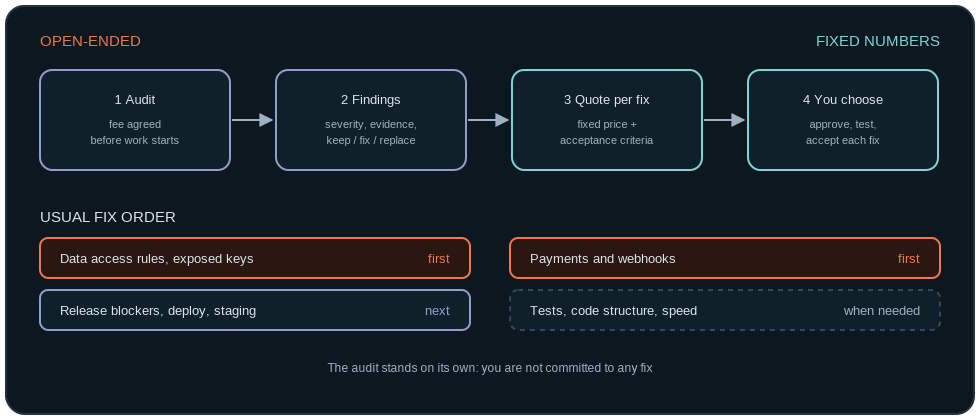
- Agree the audit scope and its fee before work starts: which app, which journeys, which questions.
- Receive prioritized findings, each with severity, evidence, the fix and a keep, fix or replace recommendation.
- Get a fixed-price quote for each fix, with written acceptance criteria.
- Choose which fixes to do now and which can wait. Nothing starts without your approval.
- Each fix is tested against its criteria before you accept and pay for it.
A single finding, written so it can be priced and accepted (illustrative):
Finding  F-03  Payment webhook does not verify signatures
Severity high: anyone can mark an order as paid
Evidence POST /api/stripe-webhook accepts unsigned payloads (test log #12)
Fix      verify signature, make handler idempotent, add 3 tests
Accept   unsigned request rejected; replayed event creates no duplicate order
Price    fixed, quoted per finding; starts only with your approval
"Founders usually ask what the whole fix costs. The better question is what the first three fixes cost, because those are the ones protecting your users and your revenue. The rest can wait for evidence."
How Devoun prices a vibe coding rescue
Our vibe coding rescue starts with a scoped, paid audit at a fee agreed for your app before any work begins; it stands on its own, so you are not committed to the fixes. Each fix you choose is then quoted at a fixed price with written acceptance criteria. No hours are tracked, and fixed-price work that is not accepted is refunded under our money-back guarantee.
Frequently Asked Questions
Why won’t agencies give a flat price to fix my vibe-coded app?
Because two apps with the same screens can need very different work. One may only need its database access rules tightened; another may have keys in the browser, broken payments and no way to deploy. A short paid audit finds out which, and then each fix can be priced exactly.
Is it cheaper to rebuild a vibe-coded app from scratch?
Usually not. Most AI-built apps have useful screens, data models and flows worth keeping, and a rebuild repeats work you already paid for. Rebuilding a part makes sense when that part is so tangled that every fix breaks something else. An audit should recommend keep, fix or replace for each part.
What should I fix first in a vibe-coded app?
Anything that exposes customer data or money: database access rules, exposed keys and payment webhooks. Then whatever blocks your next release. Code tidiness and performance come after, unless they are causing outages.
Does Devoun publish a price for the audit?
No. The audit fee is agreed up front for your app’s scope before any work starts, so you know the cost before you commit. The fixes that follow are quoted at a fixed price each, and you choose which to do.
Final thoughts
Fixing a vibe-coded app is rarely as expensive as founders fear, and rarely as cheap as a flat-rate offer suggests. The cost sits in a handful of specific gaps. Find them first, price each one, fix what protects users and money, and keep the code that already works.
