In this piece
Fractional CTO for US Seed-Stage Startups: What to Expect and What It Costs
A US seed-stage startup usually needs a fractional CTO at two moments: in the months before the raise, so the product and its technical story survive investor questions, and in the months after it, when the money has to become a roadmap and the first engineering hires. In both, you are buying senior judgement for a few hours a week, not a full-time executive. Published US rates run from about $4,000 a month for advisory hours to $25,000 a month for an active role, and a useful engagement should produce written results within the first month. This guide covers what to expect at each stage, what it costs, and how to tell whether it is working. Devoun’s founder runs fractional CTO engagements for US startups from $900 a month.
We reviewed the external references on 19 November 2026. Rate guides are market snapshots, not quotes, and equity questions belong with your lawyer.
Raising soon, or just closed a round?
Book a free callWhen does a seed-stage startup need a fractional CTO?
If you are new to the role itself, start with our guide to what a fractional CTO is and what one costs. At seed, the need shows up in a few recognizable situations:
- A non-technical founding team with a prototype built by an agency, a freelancer or an AI app builder.
- A technical founder who is now spending their week on sales and fundraising, not architecture.
- A lead investor who has asked for a technical review, or who will after the first partner meeting.
- A fresh round that funds three to five engineering hires, and nobody who has hired engineers before.
The work, and the hours, change across the round:
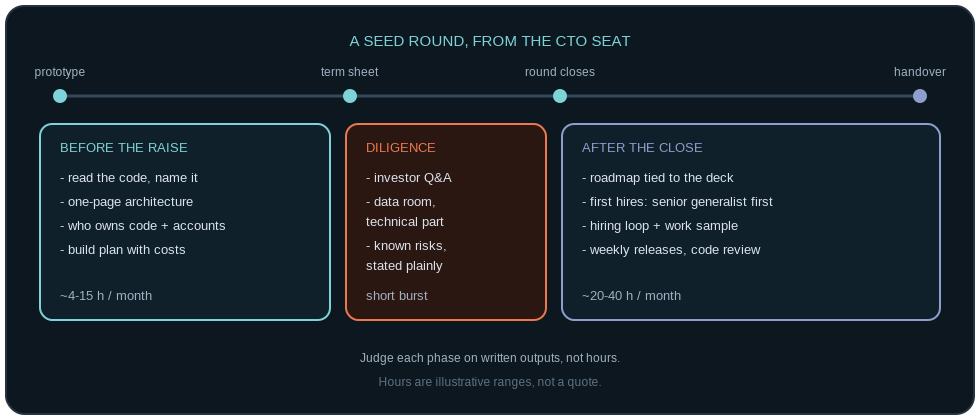
| Stage | Main job | Typical time | What you should have at the end |
|---|---|---|---|
| Before the raise | Make the product and its story credible | 4–15 hours a month | Architecture note, risk list, build plan with costs |
| During diligence | Answer technical questions with evidence | A focused burst over a few weeks | A technical section of the data room that holds up |
| After the close | Roadmap, first hires, delivery rhythm | 20–40 hours a month | Hired engineers, a working release process, a plan to hand over |
Hours are typical ranges from engagements of this kind and are illustrative, not a quote.
What does a fractional CTO do before you raise?
Seed investors rarely run a full technical audit, but they ask pointed questions, and a vague answer from a founder costs more credibility than a known weakness stated plainly. Before the raise, a fractional CTO should:
- Read the code and say what it is. A prototype, a real product, or something in between. If it was built with an AI builder, say so and say what it would take to harden it.
- Write a one-page architecture note. What runs where, which third parties hold your data, and what breaks first if usage grows ten times.
- Check ownership. Code, domains, cloud accounts and app store listings should belong to the company, and contractors should have signed IP assignments. Your lawyer confirms the documents; the CTO finds the gaps.
- Turn the deck’s promises into a build plan. If the round funds 18 months, the plan should show what gets built, by whom, and roughly what it costs. That is the slide investors probe hardest.
If your product uses AI, investors will also ask about evaluation, model costs and data rights. Our technical due diligence checklist for AI MVPs lists the evidence they look for.
What changes after the round closes?
After the close, the job moves from explaining the product to building the team that builds it. This is where most seed money is spent, and where a part-time CTO saves the most:
- The order of hires. Usually a senior generalist first, someone who can own the product end to end, before specialists. A first hire who needs daily direction will not get it from a part-time CTO.
- Hire or contract. Some work, such as a mobile app or a data pipeline, may be cheaper as a fixed-scope contract than as a permanent role.
- The hiring loop. A short, realistic work sample and a technical interview run by the CTO, so the founders are not judging code they cannot read.
- A delivery rhythm. Weekly releases, code review and a simple way to see progress against the plan you showed investors.
For the week-by-week version of this period, see our fractional CTO 30/60/90-day plan; we will not repeat it here.
How much does a fractional CTO cost for a seed startup?
There is no official survey of fractional CTO pay. An A.Team rate guide lists $4,000–$10,000 a month for 10–15 advisory hours, $10,000–$25,000 for an active 20–40 hour role, and $20,000–$40,000 for near-full-time interim work. It also notes that full-time startup CTOs are typically offered 1 to 3 percent equity vesting over four years. For the cash side of a full-time hire, the U.S. Bureau of Labor Statistics puts the median annual wage for computer and information systems managers at $175,140 (May 2025).
| Option | Time | Typical US cost | Fits a seed startup when… |
|---|---|---|---|
| Devoun CTO-on-Call | 4–8 hours a month | from $900 a month | You need decisions and reviews before the raise |
| Advisory fractional CTO (market) | 10–15 hours a month | $4,000–$10,000 a month | Diligence prep and a build plan |
| Active fractional CTO (market) | 20–40 hours a month | $10,000–$25,000 a month | You are hiring and shipping after the close |
| Full-time CTO | Full-time | ~$175,000 base plus 1–3% equity | Technology is the bet and there is a team to lead |
Seen against a seed budget, the useful comparison is not the monthly fee but what a wrong first hire or a rebuild of the prototype would cost you in runway. As an illustrative example, six months of an active fractional CTO at $12,000 a month is $72,000, less than half a year of a full-time CTO’s cash cost, with no equity and no notice period.

"At seed, the most expensive technical decision is usually the first hire, not the framework. Get a senior person who can own the product, and most of the other choices get easier."
How do you know it is working?
- By the end of the first month you have something written: a risk list, an architecture note, a plan.
- Investor technical questions get answered by the CTO, with documents, within days.
- Engineering hires happen on the timeline in the plan, and the founders can explain why each one was chosen.
- The CTO is working to make themselves less necessary, with a clear point to hand over or hire full-time.
And the warning signs that it is not:
- Months of calls and opinions, but nothing written that an investor or a new hire could read.
- A push to rebuild the product from scratch before anyone has measured what is actually wrong.
- Hiring decisions that keep slipping because the CTO is never available for interviews.
- Fees that grow with hours instead of with agreed outputs.
How Devoun works with seed teams: our founder has been a core founding engineer at several early-stage companies, including a venture studio building multiple MVPs (prior roles, before and alongside Devoun). Our fractional CTO service for US startups starts with CTO-on-Call from $900 a month, runs on a rolling contract you can stop any week, and is covered by our money-back guarantee: the last paid week is refunded if it did not move your product forward.
Frequently Asked Questions
Does a seed-stage startup need a CTO?
It needs someone who owns technical decisions and can answer investor questions about the product. That can be a technical co-founder, a fractional CTO, or a strong senior engineer with a fractional CTO behind them. A full-time CTO hire usually makes sense later, when there is a team to lead.
How much does a fractional CTO cost for a seed startup?
Published US rates are about $4,000–$10,000 a month for 10–15 advisory hours and $10,000–$25,000 a month for an active 20–40 hour role. Devoun’s CTO-on-Call starts from $900 a month for 4–8 hours.
Should a fractional CTO get equity?
Usually not, or only a small advisor grant, because they are paid in cash and work part-time. Full-time startup CTOs are typically offered 1–3% vesting over four years. If you do grant equity, use a standard advisor agreement and check it with your lawyer.
When should we replace a fractional CTO with a full-time hire?
When the engineering team is large enough that leading it is a full-time job, or when technology is the main thing investors are betting on. A good fractional CTO helps you hire that person and hands over cleanly.
Final thoughts
A seed-stage fractional CTO earns their fee twice: once by making your technical story credible before the raise, and again by spending the round on the right first hires. Agree what written results you expect in the first month, and judge the engagement on those, not on hours.
