In this piece
MVP Development Timeline by App Type
A typical MVP takes 6 to 12 weeks of build for a focused web product, after 2 to 3 weeks of discovery. Internal tools can be faster, at around 3 to 6 weeks. Two-sided marketplaces, mobile apps and AI products usually take longer, and regulated health or finance products can run to 24 weeks or more. These are typical, illustrative ranges rather than promises: the biggest factors are how much the first release tries to do, how many outside systems it must talk to, and how quickly someone on your side makes decisions. A clear scope and fast feedback can take weeks off the top of a range; late changes add them back. This guide gives the range for each app type, the phases inside it and the habits that shorten it, so you can judge any timeline you are quoted for MVP development.
We reviewed the external references on 19 November 2026. App-store rules change, so check Apple’s and Google’s pages before you plan a launch date around them.
Want a timeline for your MVP, not a typical one?
Plan your MVPHow long does an MVP take, by app type?
The ranges below are build time after discovery, for a small senior team on a first release with a tight scope. They are illustrative, drawn from the shape of typical projects, not from a guarantee.
| App type | Typical build range | What usually sets the length |
|---|---|---|
| Internal tool or dashboard | 3–6 weeks | Number of data sources and user roles |
| B2B SaaS web app | 6–12 weeks | Billing, multi-tenancy and the core workflow |
| AI feature or agent MVP | 4–10 weeks | Building the evaluation set and the guardrails |
| Mobile app (cross-platform) | 8–16 weeks | Two platforms, device testing and store review |
| Two-sided marketplace | 10–16 weeks | Two user journeys, payouts and trust features |
| Regulated (health, finance) | 12–24+ weeks | Compliance work, audits and partner approvals |
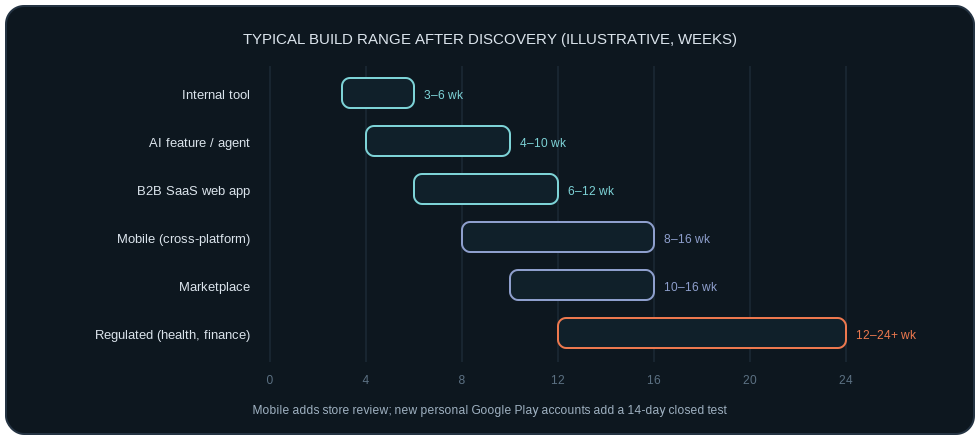
If you are building a SaaS product, the platform layer (tenancy, billing, roles and admin) explains much of the gap between an internal tool and a SaaS MVP; our SaaS development cost guide breaks it down.
What are the phases of an MVP timeline?
- Discovery, 2–3 weeks. Users, the one job the first release must do, acceptance criteria, architecture and a milestone plan.
- Design, often overlapping the build. Key screens and flows first; the rest is designed a step ahead of development.
- Build in short cycles. Working software every one or two weeks, shown to you, not described to you. Basecamp’s Shape Up method uses six-week cycles with a two-week cool-down, which is a useful outer limit for a first slice.
- Hardening and acceptance, 1–2 weeks. Testing against the acceptance criteria, security basics, monitoring and data backups.
- Launch. For web apps, a deploy. For mobile apps, store review comes first.
How long do app stores add to a mobile MVP?
Apple says App Review typically handles at least half of submissions in under 24 hours and 90% in under 48 hours, though incomplete submissions take longer or are rejected. Google Play has a step many first-time founders miss: new personal developer accounts must run a closed test with at least 12 testers for 14 days in a row before they can apply for production access. Plan those two weeks into the timeline, or publish under an organization account if that fits your situation.
What makes an MVP faster, or slower?
Technology choices matter less than people expect. The things that move a timeline most are on the client’s side of the table:
- A written scope with a “not in this release” list. Every item that moves out of the first release saves more time than any framework.
- One decision-maker who answers within a day. A week waiting for feedback is a week added to the end.
- Standard building blocks. Hosted sign-in, a payment provider and an off-the-shelf admin panel instead of custom ones.
- Integrations started early. Third-party APIs that need approval, keys or sandbox accounts are the most common hidden delay.
- Real content and data. Waiting for copy, prices or sample data stalls testing.
Acceptance criteria written in plain language help both sides know when a milestone is done:
Must have (in the first release):
  - A sales rep can create a quote from a template in under 5 minutes
  - The customer can accept the quote by email link, without an account
Not in this release:
  - Multiple currencies, e-signature, CRM sync
When you are quoted a timeline, test it with a few questions. A credible plan can answer all of them; a number without answers is an estimate of optimism, not of work:
- Which features are in the first release, and which are explicitly out?
- What will I see working at the end of each week or two, and how do I give feedback?
- Which third-party accounts, approvals or data do you need from me, and by when?
- How much time is set aside for testing, fixes and store review before launch?
- What happens to the date if I add a feature halfway through?
The last question matters most. Scope will change once real users see the product, and that is healthy. A good plan says what gets swapped out when something new comes in, so the date holds or moves by an amount both sides agreed in advance, rather than drifting a week at a time. That is also the main reason we prefer milestones with written acceptance criteria to a single launch date: each milestone is small enough to estimate honestly, and the plan is re-checked at every one.

"An MVP timeline is mostly a list of things you agreed not to build yet. If that list is empty, the timeline is a guess."
How Devoun plans MVP timelines
Our founder has worked as a founding engineer on several MVPs before and alongside Devoun, including multiple MVP platforms at the Northbound VC venture studio. Every Devoun MVP starts with a Discovery valued at $400, 50% free (you pay $200, credited to the build), which ends with a milestone plan, a timeline range and a fixed price per milestone. Each milestone has written acceptance criteria, and one that is not accepted is refunded under our money-back guarantee.
Frequently Asked Questions
How long does it take to build an MVP?
Typically between 6 and 12 weeks of build for a focused web product, plus 2 to 3 weeks of discovery first. Internal tools can be faster; marketplaces, mobile apps and regulated products take longer. Treat any number as a range until the scope is written down.
Can an MVP be built in four weeks?
Yes, if it does one job for one type of user, uses standard sign-in and payments, and the decisions are made quickly. Four weeks is rarely enough for a two-sided marketplace or anything that needs regulatory review.
Does a mobile MVP take longer than a web MVP?
Usually, yes. You build for two platforms or a cross-platform framework, and you wait for store review. New personal Google Play developer accounts must also run a closed test with at least 12 testers for 14 days before applying for production.
What delays MVP projects most?
Slow decisions and late scope changes, more than technology. Unclear acceptance criteria, third-party integrations that need approvals, and missing content or data are the next most common causes.
Final thoughts
Treat any MVP timeline, including the ranges here, as a hypothesis until the scope is written down and the decision-maker is named. The fastest projects are not the ones with the cleverest stack; they are the ones where the first release does one job and everyone agrees what done looks like.
