In this piece
SaaS Web App Development Cost in 2027
A SaaS web app costs more than an ordinary web app with the same screens, because it needs a platform layer before the first feature can be sold. Every customer is a tenant that must be kept apart from the others, pays on a recurring plan, invites colleagues with different roles and expects someone to help when things go wrong. That means sign-up and roles, tenant isolation, subscription billing, an admin back office and production operations. In our illustrative model that layer is about 4–7 weeks of work for a simple SaaS MVP and 8–14 weeks for a growth-stage product, before your core features. This guide breaks the layer down so you can read quotes for SaaS web app development line by line. For the general cost drivers of any software project, see our software development cost guide.
We reviewed the external references on 19 November 2026. The week and dollar ranges in this article are illustrative, to show proportions, not a quote.
Want a fixed number for your SaaS instead of a range?
Scope your SaaS appWhat makes SaaS development cost more than a regular web app?
A web app built for one company has one set of users, one owner of the data and one invoice. A SaaS product has hundreds of each. Four pieces of work follow from that, and none of them is visible in a demo:
- Multi-tenancy. Every query must be scoped to the right customer. AWS’s SaaS guidance calls tenant isolation foundational, because one tenant seeing another’s data can be an unrecoverable event for the business.
- Auth and roles. Sign-up, invitations, password reset, owner and member roles, and later single sign-on for larger customers.
- Billing. Plans, trials, upgrades, failed payments and cancellation, all kept in step with what each tenant is allowed to use.
- Admin. A back office where your team can find a tenant, see their plan, fix their data and help them, with a record of what staff did.
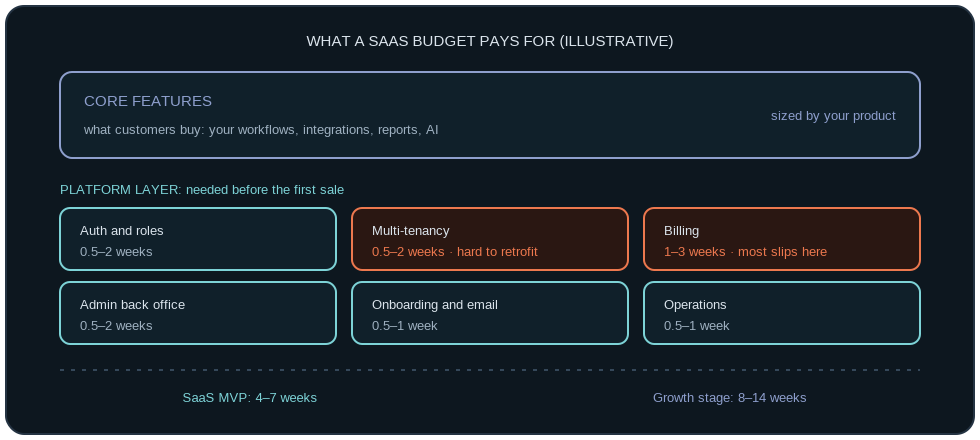
How much does each part of the SaaS platform layer cost?
The ranges below assume a small senior team and an illustrative $3,000 a week, the same assumption we used in our fixed-price MVP example. Your real numbers depend on scope, stack and team.
| Part | What it covers | Illustrative weeks |
|---|---|---|
| Auth and roles | Sign-up, invitations, reset, owner/member roles | 0.5–2 (SSO and user provisioning: +2–4) |
| Multi-tenancy | Tenant model, scoped queries, isolation tests | 0.5–2 |
| Billing | Plans, trials, webhooks, entitlements, failed payments | 1–3 (usage-based billing: +2–4) |
| Admin back office | Tenant search, plan overrides, support tools, staff audit log | 0.5–2 |
| Onboarding and email | First-run flow, transactional email, notifications | 0.5–1 |
| Operations | Environments, CI/CD, backups, monitoring, error tracking | 0.5–1 |
Billing is where SaaS budgets most often slip. A provider such as Stripe Billing generates invoices, retries failed payments and moves each subscription through states such as trialing, active, past_due and canceled, as its subscription documentation describes. Your code still has to verify and handle the webhooks, decide what a past-due tenant may still do, and keep plans in step with features. Payment processing fees are separate from the build; check Stripe’s pricing page or your provider’s for current rates.
What does a SaaS cost at each stage?
Adding the parts up gives three illustrative stages for the platform layer alone:
| Stage | Platform layer includes | Illustrative weeks | Illustrative USD |
|---|---|---|---|
| SaaS MVP | Email sign-up, one or two roles, pooled tenancy, one paid plan, basic admin | 4–7 | $12,000–$21,000 |
| Growth | Teams and invitations, several plans, usage limits, support tools, staff audit log | 8–14 | $24,000–$42,000 |
| Enterprise-ready (added) | SSO, user provisioning, tenant-level audit log, stronger isolation options, security reviews | +8–16 | +$24,000–$48,000 |
Your core features sit on top of these numbers and are usually the larger share. A narrow product with one main workflow can be smaller than its platform layer; a product with complex workflows, integrations or AI features will be several times larger.
Which SaaS decisions are expensive to change later?
Most SaaS features can be added when customers ask for them. A few decisions are cheap at the start and expensive to change once there are paying tenants:
- A tenant ID on every tenant-owned row. Even if you start with one shared database, put the tenant key in place from the first table, and index it.
- Entitlements separate from plans. Check “may this tenant use exports?”, not “is this tenant on Pro?”, so pricing changes do not mean code changes.
- Users who can belong to more than one tenant. Consultants and agencies will ask for it, and retrofitting it touches auth, roles and billing.
- An audit log for staff actions. The day support changes a customer’s data, you will want to know who did it and when.
-- Every tenant-owned table carries tenant_id from day one
create table public.projects (
  id         uuid primary key default gen_random_uuid(),
  tenant_id  uuid not null references public.tenants (id),
  name       text not null,
  created_at timestamptz not null default now()
);

create index projects_tenant_id_idx on public.projects (tenant_id);
Running costs come on top of the build: hosting and databases, email delivery, monitoring, payment fees, and the maintenance time that keeps dependencies and integrations current. For a SaaS product they grow with the number of tenants, so ask for an estimate at your expected customer count, not only at launch.
When two SaaS quotes differ by a factor of two, the gap is usually in this layer. Put them side by side and ask each vendor the same questions: how is one tenant’s data kept from another’s, and how is that tested? What happens in the app when a card payment fails? Can my support team see and fix a customer’s account without a developer? Who is alerted when something breaks at night? A vendor who answers each one concretely has priced the platform layer; one who answers “we will handle that” has not.

"Founders budget for the features their customers will see. The SaaS budget is decided by the parts they will never see: the tenant boundary, the billing states and the admin screen support uses at midnight."
How Devoun prices SaaS web apps
Our founder has built SaaS products as a core founding engineer before and alongside Devoun, including the Pencilit scheduling platform and the HealthHavenRx pharmacy platform with its patient, partner and admin portals. Every Devoun web app starts with a Discovery valued at $400, 50% free (you pay $200, credited to the build), which sizes the platform layer and your core features and ends with a fixed quote split into milestones. Ongoing work runs on a retainer from $2k a month that you can stop any week, and a milestone that is not accepted is refunded under our money-back guarantee.
Frequently Asked Questions
Why does a SaaS app cost more than a regular web app?
Because every customer is a tenant that must be kept apart from every other, pays on a recurring plan and needs to be supported. Tenant isolation, subscription billing, roles and an admin back office are work a single-company web app does not need.
Can I launch a SaaS MVP without multi-tenancy?
You can launch with a simple pooled model, where all tenants share one database and every row carries a tenant ID. What you should not do is skip the tenant ID, because adding it later means touching every table and query.
Should I build billing myself or use Stripe Billing?
Use a billing provider. Stripe Billing and similar products handle invoices, retries and subscription states. Your code still has to listen to their webhooks and turn the subscription status into what each customer may use.
When do I need SSO and audit logs?
Usually when you start selling to larger companies, whose security reviews ask for single sign-on, user provisioning and a record of who did what. Plan for them in the data model early, and build them when a real deal needs them.
Final thoughts
When you compare SaaS quotes, look for the platform layer first. A quote that lists features but not tenant isolation, billing states and admin tools is pricing a web app, not a SaaS product, and the difference will arrive later as change requests.
