In this piece
PDPL Checklist for AI Projects in Saudi Arabia
Saudi Arabia’s Personal Data Protection Law (PDPL) applies to AI projects the moment they touch personal data, and most do: customer messages, documents in a retrieval index, call recordings, prompts and logs. The law is overseen by the Saudi Data and Artificial Intelligence Authority (SDAIA) and has been fully enforceable since 14 September 2024. This is a technical checklist for the people building the system: where personal data hides in an AI stack, and what to design in before launch so PDPL AI compliance is a property of the architecture, not a document written afterwards. It covers chatbots, agents and retrieval systems, in Arabic or English, whether you host them yourself or call a model provider. We use it when we build AI agents for Saudi companies. It is not legal advice; the legal calls belong to your adviser.
We reviewed the external references on 19 November 2026. SDAIA continues to issue and update regulations and guidance, so check the current text with your adviser before relying on any point here.
Planning an AI agent that handles Saudi customer data?
Book a free callWhat does the PDPL require from an AI project?
The PDPL regulates personal data, not technology, so an AI system inherits every obligation of the data it processes. SDAIA issued the Implementing Regulations and the Personal Data Transfer Regulations in September 2023, and the grace period ended on 14 September 2024, according to CMS’s one-year review. The same review reports administrative fines of up to SAR 5 million (about $1.33 million at the 3.75 peg), doubled for repeat offences, and prison terms for unlawful disclosure of sensitive data.
For an AI system, the obligations land in five places: knowing what personal data flows where, having a purpose and legal basis for it, controlling transfers outside the Kingdom, honoring data subject rights in every copy, and handling assessments, records and breaches. The diagram shows where each check sits in a typical retrieval-augmented agent.
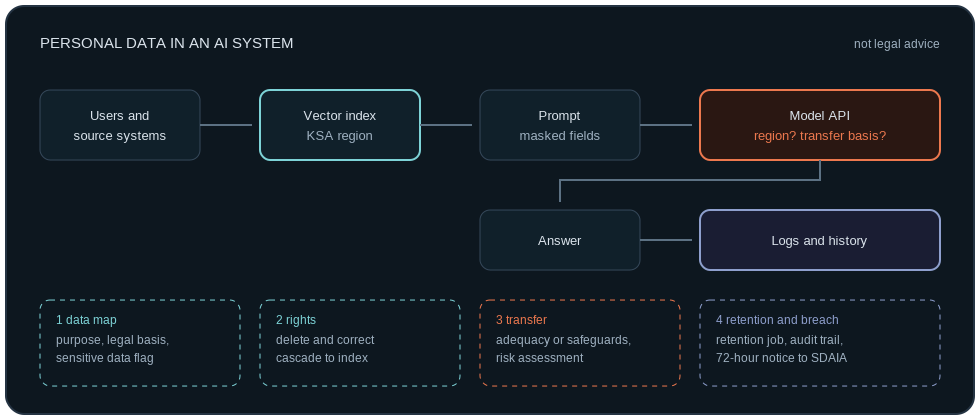
Which data and legal-basis checks come first?
Start with a data map. AI systems copy data more than ordinary apps: into embeddings, caches, prompt logs, evaluation sets and sometimes fine-tuning data. Every copy needs an owner, a purpose and a retention period. One record per flow is enough to start:
{
  "flow": "customer-support-agent",
  "personal_data": ["name", "phone", "order history", "free-text messages"],
  "sensitive_data": "possible (health or financial details in messages)",
  "purpose": "answer order and delivery questions",
  "legal_basis": "<confirm with adviser>",
  "stored_in": ["orders DB (KSA region)", "vector index (KSA region)", "chat logs (90 days)"],
  "sent_to": [{ "vendor": "<model provider>", "region": "<region>", "transfer_basis": "<adequacy or SCCs>" }],
  "retention": "chat logs 90 days, index synced to source",
  "rights_handling": "delete by customer_id across DB, index, logs",
  "dpia": "required: new technology, possible sensitive data"
}- List every input that may contain personal data, including free text, uploads and voice.
- Flag sensitive data (for example health, financial or biometric details) and decide whether the system needs it at all.
- Record the purpose and the legal basis for each flow, and have your adviser confirm the basis.
- Minimize: strip or mask personal data before it reaches the model when the task does not need it.
- Set retention for logs and conversation history, and enforce it with a job, not a policy line.
- Update your privacy notice so people know an AI system processes their data, and for what.
Can personal data leave Saudi Arabia for an AI model?
Calling a model API hosted abroad with personal data in the prompt is a transfer outside the Kingdom. As summarized by Clyde & Co, the Transfer Regulations allow transfers to countries SDAIA assesses as adequate, or under safeguards such as binding corporate rules, standard contractual clauses or certification, with a risk assessment required in some cases, including continuous or large-scale transfers of sensitive data. Law-firm reviews report that SDAIA has since issued standard contractual clauses, while a published adequacy list was still pending at the time of their writing. Technically, that leaves you three options, and many projects combine them:
| Option | What it means technically | Trade-off |
|---|---|---|
| Keep it in the Kingdom | Host the database, index and model in a Saudi cloud region or on premises | Fewer model choices; simplest transfer story |
| Minimize before the call | Mask names, numbers and IDs before the prompt; re-insert them after the answer | Extra engineering; some tasks need the raw data |
| Transfer with safeguards | Use a provider abroad under a transfer basis your adviser confirms, with a risk assessment | Widest model choice; most paperwork and vendor review |
Whatever you choose, record it per vendor: which data, which region, which basis. Check model providers’ data retention and training terms too, and turn off any use of your data for training where the provider allows it.
The same applies to every other vendor in the stack, not only the model. A typical AI agent also touches a vector database, a speech-to-text service for voice, a messaging platform such as WhatsApp, an observability tool that stores prompts and answers, and sometimes an evaluation or labeling service. Each one is a place personal data is processed, possibly outside the Kingdom. For each vendor, record what data it receives, where it stores it, how long it keeps it, whether it uses it to train its own models, and how you would delete one person’s data from it. Have your adviser review the contract terms with each processor. The observability tool is the one teams forget most often: full prompt logging is useful for debugging, and it is also a complete copy of every conversation.
How do data subject rights work in an AI system?
The PDPL gives people rights to be informed, to access their data and obtain a copy, to have it corrected, and to have it destroyed when it is no longer needed, within limits set by the law. The Implementing Regulations set a 30-day response period, extendable by a further 30 days in limited cases, according to Addleshaw Goddard. In an AI system, that means:
- Tag every chunk, log line and conversation with the person or customer ID it relates to, so you can find it.
- Make deletion cascade from the source system to the vector index, caches, conversation history and evaluation sets.
- Make corrections re-embed the affected documents, so the assistant stops repeating the old value.
- Keep personal data out of fine-tuning sets wherever possible; removing it from a trained model is hard.
- Make withdrawing consent as easy as giving it, and stop the related processing when it happens.

"Most PDPL problems in AI projects are not legal puzzles, they are copies nobody tracked. If you cannot delete one customer from your index, your logs and your evaluation set in a single job, you are not ready to launch."
What about impact assessments, records and breaches?
- Impact assessment. The Implementing Regulations require a data protection impact assessment for, among other things, sensitive data, new technologies, automated decision-making and continuous monitoring. Most AI projects meet at least one trigger, so plan for one.
- Records of processing. Keep records of processing activities for the processing period plus five years after it ends, including the technical measures taken.
- Data protection officer. Required for some controllers, for example those whose core activities involve sensitive data or regular monitoring. Ask your adviser whether it applies to you.
- Breach notice. Notify SDAIA within 72 hours of becoming aware of a breach that may cause harm, and inform affected people without undue delay. That needs audit logs that show what was retrieved and sent where, and an incident runbook someone has rehearsed.
Devoun’s founder worked on large Gulf platforms before and alongside Devoun, including backend engineering for Nice One, one of Saudi Arabia’s leading beauty e-commerce platforms, and the bilingual DCAA IIAN investigation app for the Dubai Civil Aviation Authority. Our AI agent development in Saudi Arabia builds this checklist into the first milestone, with a presence in Riyadh, and is covered by our money-back guarantee.
Frequently Asked Questions
Does the Saudi PDPL apply to AI chatbots and agents?
Yes, whenever they process personal data about people in the Kingdom: customer names and messages, phone numbers, documents in a retrieval index, call recordings or logs. The PDPL regulates the personal data, whatever technology processes it. Confirm the scope for your case with your adviser.
Can I use a model API hosted outside Saudi Arabia?
Possibly, but sending personal data to it is a transfer outside the Kingdom, which the Personal Data Transfer Regulations govern through adequacy decisions or safeguards such as standard contractual clauses, with a risk assessment in some cases. Many teams minimize or remove personal data before the call, or use in-Kingdom hosting. Check the current rules with your adviser.
How fast must a data breach be reported under the PDPL?
Law-firm summaries of the Implementing Regulations say the controller must notify SDAIA within 72 hours of becoming aware of a breach that may cause harm, and inform affected people without undue delay. Plan your logging and incident process so you can meet that window.
How do I delete someone’s data from an AI system?
Delete or update it everywhere it was copied: the source database, the vector index, caches, conversation history, logs and evaluation sets, with backups handled under your retention policy. Keep personal data out of fine-tuning data where you can, because removing it from a trained model is hard.
Final thoughts
The PDPL does not stop Saudi companies from using AI; it asks them to know where personal data goes and to prove they control it. Map the flows, decide hosting and transfers deliberately, make rights and deletion work across every copy, and keep the logs that let you answer SDAIA in 72 hours. Then have your adviser check the legal calls.
