In this piece
MCP Server Development Cost and Timeline
A Model Context Protocol (MCP) server lets AI agents such as Claude, ChatGPT or Cursor use your product or your internal tools. The protocol itself is the cheap part. MCP server development cost is driven by five things: how many tools you expose, whether the server runs locally or remotely, how users sign in, how clean the API behind it is, and how many tenants it serves. A small internal server is days of work; a public, multi-tenant server for a SaaS product is weeks. This guide breaks the cost into line items, with illustrative effort for three common server types, a realistic timeline and the running costs that follow launch, so you can compare quotes on the same basis. It is the same breakdown we use when we scope MCP server development for clients.
We reviewed the external references on 19 November 2026. The effort figures below are illustrative, not quotes: multiply the days by your own team’s or vendor’s day rate to get a budget.
Want a line-item estimate for your own MCP server?
Scope your MCP serverWhat drives MCP server development cost?
If you are new to the protocol, our MCP glossary entry covers the basics and our guide on how to build an MCP server walks through the code. For budgeting, these are the decisions that move the number:
- Number and shape of tools. Each tool needs a name, a description an agent can act on, an input schema, error messages and tests. Ten well-designed tools cost more than ten endpoint wrappers, and work far better.
- Transport. The spec defines two standard transports: stdio, where the client runs the server as a local process, and Streamable HTTP, where the server is a hosted service. A remote server adds hosting, sessions, origin checks and scaling.
- Authorization. For HTTP servers, the MCP authorization spec builds on OAuth 2.1, with protected resource metadata, PKCE and tokens bound to your server. Local stdio servers take credentials from the environment instead, which is far cheaper.
- The API behind it. A documented, consistent API makes tools quick to build. Missing endpoints, inconsistent errors or no sandbox environment can double the tool budget.
- Tenants and permissions. A server used by one team is simple. A server used by your customers must keep each tenant’s data apart and respect each user’s role on every call.
Tool design deserves its own line. Agents choose tools by reading their descriptions, so a task-shaped tool with clear limits saves failed calls and support tickets later:
{
  "name": "create_invoice_draft",
  "description": "Create a draft invoice for an existing customer. Does not send it. Returns the draft id and a review link.",
  "inputSchema": {
    "type": "object",
    "properties": {
      "customer_id": { "type": "string", "description": "From find_customer" },
      "lines": {
        "type": "array",
        "items": {
          "type": "object",
          "properties": {
            "description": { "type": "string" },
            "quantity": { "type": "number" },
            "unit_price_usd": { "type": "number" }
          },
          "required": ["description", "quantity", "unit_price_usd"]
        }
      }
    },
    "required": ["customer_id", "lines"]
  }
}
How much does each line item cost?
The table shows illustrative effort in working days for three typical servers: an internal server over stdio with about 5 tools, a remote server for one product with about 10 tools and OAuth, and a public, multi-tenant server for a SaaS product with about 20 tools. These are planning numbers from the shape of the work, not market data; your API and scope will move them.
| Line item (illustrative days) | Internal, stdio | Remote, one product | Public, multi-tenant |
|---|---|---|---|
| Tool design and descriptions | 1 | 2 | 3 |
| Tool implementation | 2.5 | 5 | 8 |
| Authorization (OAuth 2.1, scopes, consent) | 0 (environment credentials) | 4 | 7 |
| Tenant isolation and per-user permissions | 0 | 1 | 4 |
| Testing with real clients and an eval set | 1 | 3 | 5 |
| Transport, hosting and deployment | 0.5 | 2 | 3 |
| Logging, monitoring and rate limits | 0.5 | 2 | 3 |
| Security review and documentation | 0.5 | 1 | 3 |
| Total (illustrative) | about 6 days | about 20 days | about 36 days |
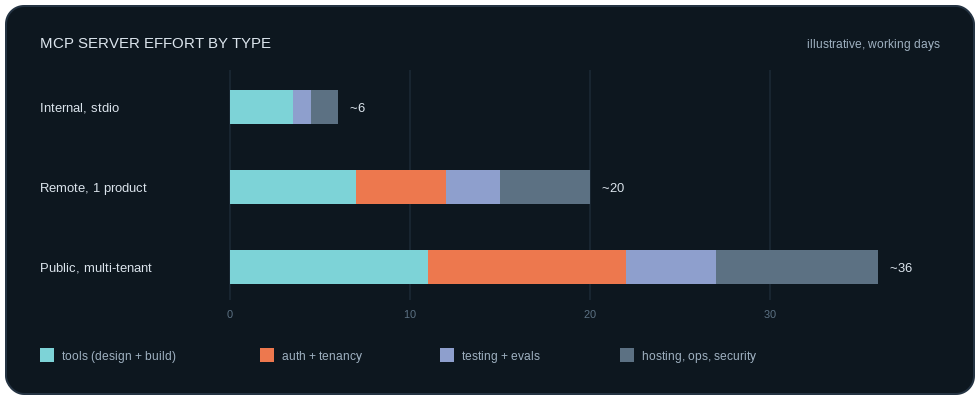
Two patterns stand out. Authorization and tenancy grow fastest as a server goes from internal to public, and the tools themselves become a smaller share of the total. The MCP security best practices explain why: token passthrough is explicitly forbidden, proxy servers need per-client consent to avoid confused-deputy attacks, and scopes should start minimal. None of that is optional on a public server, so budget for it from the start rather than discovering it in review.
To turn the table into a budget, multiply each column’s days by the day rate of whoever builds it, then add a contingency for the API line if your API is undocumented or lacks a test environment. If a quote is far below that total, check which lines it leaves out: authorization, testing in real clients and monitoring are the usual casualties.
How long does an MCP server take to build?
Calendar time is longer than effort, because access, credentials and client testing involve other people. An illustrative plan for the remote, one-product server:
- Week 1: scope and tool design. Pick the jobs agents should do, design the tools, agree scopes and acceptance tests.
- Weeks 2 and 3: build. Tools, authorization, hosting, logging.
- Week 4: test and harden. Run the eval set in the clients your users actually use, fix tool descriptions that confuse the model, review security, write the docs.
The internal stdio server usually fits in one to two weeks of calendar time; the public multi-tenant server in about two months, often longer if your identity provider or API needs changes first.
After launch, budget for running costs as their own lines. A local stdio server has no hosting cost, because it runs on the user’s machine. A remote server needs hosting, an identity provider or authorization server, log storage and monitoring, which are usually modest next to the build. The larger ongoing line is maintenance: the protocol is versioned (the current specification is dated 2025-11-25), popular clients do not all support the same features at the same time, and every change to your own API can break a tool. A small monthly allowance for updates, plus re-running the eval set whenever the API or a major client changes, costs far less than discovering a broken tool from a customer’s support ticket. When you compare quotes, ask each vendor what is included after launch and for how long.

"The cheapest MCP server is the one with fewer, better tools. Every tool you expose is something an agent can misuse, something you must secure, and something you must keep working when your API changes."
How do you keep MCP server costs down?
- Start with read-only tools. They need narrower scopes, simpler consent and less review. Add write tools once you have seen how agents use the read ones.
- Start local if your users allow it. A stdio server for internal teams avoids the whole OAuth line and proves which tools are worth publishing.
- Reuse your identity provider. Building an authorization server from scratch is rarely worth it; an existing provider that supports the required OAuth flows shortens the longest line item.
- Write the eval set first. Twenty realistic requests with expected tool calls will tell you when you are done, which is the line that most often runs over.
- Budget for maintenance. The spec, the clients and your own API all change. A small monthly allowance is cheaper than an emergency rewrite.
At Devoun, MCP server development starts with a Discovery valued at $400, 50% free (you pay $200, credited to the build), which produces the tool list, the auth design and a fixed price per milestone. Ongoing work runs on a retainer from $2k a month. Both are covered by our money-back guarantee: a milestone that is not accepted is refunded.
Frequently Asked Questions
How long does it take to build an MCP server?
A small local server over stdio with a handful of tools on a clean API can be built and tested in about a week. A remote server with OAuth for one product takes a few weeks. A public, multi-tenant server for a SaaS product, with security review and monitoring, usually takes one to two months. These are illustrative ranges; your API and scope decide the real number.
What is the most expensive part of an MCP server?
For remote servers it is usually authorization and multi-tenancy, not the tools themselves. The MCP spec builds on OAuth 2.1 for HTTP transports, and getting tokens, scopes, consent and tenant isolation right takes more time than wrapping API endpoints.
Can I just wrap my existing REST API as MCP tools?
You can, but it rarely works well. Agents do better with a few task-shaped tools that have clear names, small inputs and helpful errors than with one tool per endpoint. Designing those tools is a real line item and pays for itself in fewer failed calls.
What does an MCP server cost to run?
A local stdio server costs nothing to host because it runs on the user’s machine. A remote server needs hosting, an authorization server or identity provider, logging and monitoring. The bigger running cost is maintenance: keeping up with spec changes, client differences and your own API changes.
Final thoughts
An MCP server is a small piece of software with an outsized security surface. Price the tools honestly, but spend most of your attention on the lines that grow with exposure: authorization, tenancy, testing with real clients and operations. Start narrow, prove the tools agents actually use, and widen from there.
