In this piece
Offshore vs Nearshore vs US Agency: The True Cost for US Startups
US startups usually compare software vendors on the hourly rate, and the rate is the part that surprises them least. Offshore teams are cheapest per hour, nearshore teams trade some of that saving for time-zone overlap, and US agencies cost the most per hour but need the least coordination. The true cost is rate plus management overhead, rework and delay, and those hidden lines depend more on seniority, process and overlapping hours than on the country. This comparison of offshore vs nearshore software development vs a US agency shows where each model’s money goes, with an illustrative total-cost model you can fill in with real quotes. Devoun is itself an offshore, founder-led software development company, so we also say plainly where our model fits and where it does not, so you can judge us by the same test.
We reviewed the external references on 19 November 2026. The only market figures here come from the US Bureau of Labor Statistics; everything else is an illustrative model, labelled as such.
Comparing quotes and want a second opinion?
Book a free callWhat is the difference between offshore, nearshore and a US agency?
The labels describe distance in time zones, not quality. Nearshoring means working with a team in a nearby time zone, for US companies typically Latin America or Canada. Offshore means a distant time zone, typically South Asia, with a few overlapping hours at best. A US agency works your hours and your legal system.
The benchmark everyone compares against is a US hire. The Bureau of Labor Statistics reports a median annual wage of $135,980 for software developers in May 2025. Wages are not the whole employer cost: across private industry, wages and salaries were 70.0 percent of total compensation in June 2026, according to the BLS employer cost survey. Applying that average share to the median wage gives an illustrative fully loaded cost of about $194,000 a year for one mid-career developer, before recruiting, equipment and management time.
Which hidden costs decide the total?
Four lines decide what software really costs, whichever model you choose:
- Rate. The visible line. It reflects local salaries, seniority and the vendor’s margin.
- Management overhead. Your time writing specs, answering questions, reviewing work and chasing status. It grows when the team is junior, the scope is vague or nobody overlaps your day.
- Rework. Work redone because a requirement was misunderstood, quality was low or the architecture did not hold. It is driven by seniority and acceptance criteria, not geography.
- Delay. A question asked at 5 p.m. your time and answered the next morning costs a day. A dozen of those a month push a launch back by weeks, and a late launch has its own cost.
| Factor | Offshore | Nearshore | US agency |
|---|---|---|---|
| Hourly rate | Lowest | Middle | Highest |
| Overlap with US hours | Few hours, by arrangement | Most of the day | Full day |
| Management overhead | High unless senior-led | Medium | Low |
| Rework risk | Depends on seniority and process | Depends on seniority and process | Depends on seniority and process |
| Contracts and IP | Foreign law unless agreed | Foreign law unless agreed | US law |
| Best for | Clear scope, written process | Fast iteration, many meetings | Regulated or on-site work |
What does each model really cost a US startup?
The chart below is an illustrative model, not market data. It sets a US agency’s hourly rate to 100 and adds management overhead, rework and delay as plausible shares for each model, so you can see how the hidden lines change the order. Replace the numbers with your own quotes and your own estimate of the time you will spend managing each vendor.
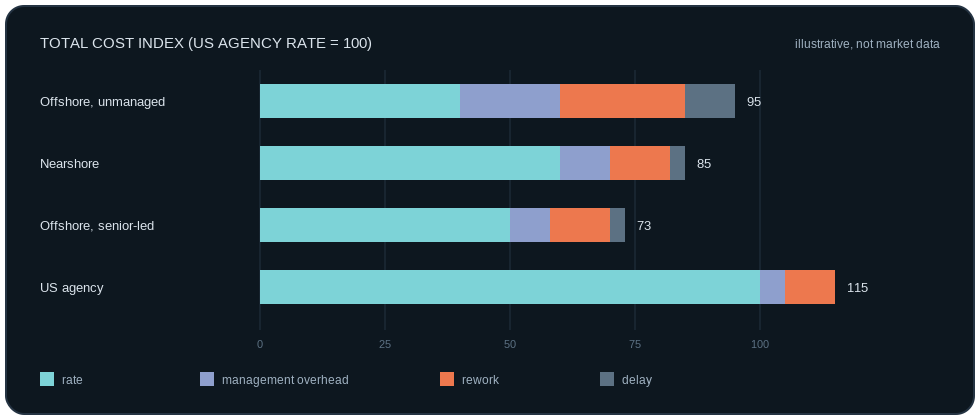
In this illustration an unmanaged offshore team, with the lowest rate of 40, ends at a total of 95, close to the nearshore team’s 85, because overhead, rework and delay add 55 points. A senior-led offshore team with agreed overlap hours keeps most of the rate advantage and ends at 73. The US agency is the most expensive at 115, but needs the least of your time. Your numbers will differ; the order often does not.
The model also leaves out costs that are real but harder to put on a chart. With a foreign vendor, the contract may sit under foreign law unless you agree otherwise, so make sure it assigns intellectual property to you, keeps code in repositories you own from day one, and sets a jurisdiction you can live with. Payments across borders add bank fees and sometimes delays. Holidays and working weeks differ by country, which matters for launch dates. And the cost of switching vendors halfway is high whichever model you choose, which is why a cheap exit, such as a weekly engagement with no notice period, is worth more than it looks when you sign.
One more hidden line deserves attention: your own time. A founder who spends ten hours a week managing a vendor is not spending those hours on customers or fundraising. Price that time honestly when you compare quotes, because it is often the difference between a vendor that looks cheap and one that is.

"Geography is the wrong question. Ask who will make the technical decisions, which hours they share with you, and what happens to your money if a milestone fails. Those three answers predict the total cost better than any rate card."
How do you choose, and where does Devoun fit?
- Write the scope and acceptance criteria first, so every vendor quotes the same thing.
- Ask each vendor for a fixed price or a capped budget per milestone, not just an hourly rate.
- Ask who leads the work, how senior they are, and whether you can talk to them directly.
- Get the overlapping hours in writing, and check them against your own calendar.
- Add your own management time to each quote, at what your time is worth.
- Prefer vendors who put money at risk if a milestone is not accepted.
Devoun is a founder-led company registered in Pakistan, with an office in Lahore and a presence in Riyadh, working for clients in six countries including the USA and Canada. Lahore is 9 to 10 hours ahead of US Eastern time, so we are an offshore option, not a nearshore one. What we offer against the hidden lines is founder-level involvement, a Discovery valued at $400, 50% free (you pay $200), that fixes scope and acceptance criteria, fixed-price milestones, and retainers from $2k a month. If you need a team in your office every day, a US agency is the better fit. If you can work from written scope and a few shared hours, our software development service is built for that, and it is covered by our money-back guarantee.
Frequently Asked Questions
What is the difference between offshore and nearshore software development?
Offshore means a team in a distant time zone, for a US company typically in South Asia. Nearshore means a team in a nearby time zone, for a US company typically in Latin America or Canada. Nearshore usually costs more per hour than offshore and less than a US agency, in exchange for more overlapping working hours.
Is offshore development really cheaper?
Per hour, usually yes. In total, only if the team is senior enough to work from written requirements, overlaps with your working day for at least a few hours, and has a process that keeps rework low. Without those, management time, rework and delay can eat most of the saving.
How much does a US software developer cost?
The US Bureau of Labor Statistics reports a median annual wage of $135,980 for software developers in May 2025. Employer costs are higher than wages: across private industry, wages were 70.0 percent of total compensation in June 2026, the rest being benefits.
How do I compare quotes from offshore, nearshore and US vendors?
Ask each for a fixed price or a capped budget against the same written scope and acceptance criteria, the hours that overlap with yours, who leads the work, and what happens if a milestone is not accepted. Then add your own management time to each quote.
Final thoughts
The cheapest hourly rate rarely produces the cheapest product. Compare vendors on total cost to an accepted result: rate, your management time, rework and delay. Seniority, clear acceptance criteria and agreed overlap hours shrink the hidden lines in every model, offshore, nearshore or local.
