In this piece
Escape the Feature Trap with Evidence
Shipping a lot of features is no guarantee that the result you care about will move. Going the other way is risky too: a small release is not useful, viable, secure, or production-ready just because it is small. What works in practice is tying every significant investment to four things: a problem a user has, an objective for the product, an assumption you can test, and evidence capable of changing what you decide next.
Building a Software Product?
Book Free ConsultationHow to recognize a feature trap
You are in a feature trap once shipped output is the main way success gets measured. The roadmap becomes a queue of solutions somebody asked for, teams earn credit for finishing, and almost nobody checks if the shipped work changed how users behave or how the business performs. That points to how decisions are governed; it does not prove any single feature is a mistake.
Signs to watch for:
- a request shows up with no written user problem and no expected result;
- what gets done first depends mostly on who asked, how hard sales is pushing, or what came in last;
- new items keep piling onto the backlog and old ones almost never leave it;
- shipping counts as done, and nobody owns or measures the work once it is live;
- the decision ignores what maintenance, support, privacy, security, migration, and eventual retirement will cost;
- nobody on the team can say which evidence would halt or undo the work.
Begin with what users need, not the solution someone prefers
Good research separates the need from the feature someone has proposed for it. You learn what people are trying to get done, and where today's journey breaks, from interviews, watching them work, support tickets, analytics, search logs, sales conversations, and operational data. What customers, executives, or engineers believe is worth hearing, yet it stays an assumption until relevant evidence backs it up.
Describe the problem by naming who is affected, in what situation, what blocks them, and what they want to happen. Next, say what improvement would look like. For one product that is more tasks completed; for another it is fewer errors, quicker time to value, fewer support requests, better retention, less operational work, or a risk brought under control. Numbers with no decision attached tend to become a reporting ritual, so write down which result would make the team keep going, change course, stop, or dig deeper.

"An experiment is small enough when it is still able to change a real product decision."
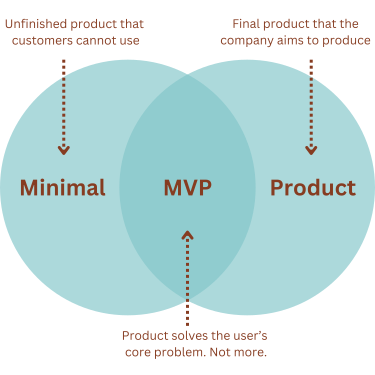
An MVP marks the edge of an experiment, not a number of features
A minimum viable product gets its scope from what the team has to learn or deliver; there is no standard count of screens or features. A clickable prototype can be all you need to see whether people understand the idea. A concierge service, run by hand, can check demand before anything is automated. In a regulated or safety-critical workflow, serious controls may have to exist before putting it in front of outside users is a responsible step.
Answer four questions before you pick what to build:
- Decision: What exact decision is this evidence meant to feed?
- Risk: If it turned out wrong, which assumption would hurt most?
- Method: What is the cheapest test that is still valid with the right users or system?
- Gate: Which evidence lets you expand, forces a revision, or ends the work?
Launching publicly is just one of the options. You can cut uncertainty with internal prototypes, small pilots, delivering the service by hand, technical spikes, and usability tests, all without putting a production audience at risk. When to release is decided by market learning and also by what security, privacy, accessibility, legal, reliability, support, and rollback demand.
Rank the work using criteria you state openly
There is no prioritization formula that is right everywhere. A score can give a discussion some shape, yet multiplying shaky inputs does not turn them into objective ones. At a minimum, a review should put these dimensions on the table:
| Dimension | Question | Useful evidence |
|---|---|---|
| User outcome | What confirmed need or obstacle does it tackle? | Research findings, task data, support records |
| Product goal | In what way does it move the current objective forward? | The goal, an outcome metric, a decision rule |
| Risk reduction | What significant unknown or control gap does it close? | Risk register, experiment outcome, threat model |
| Complete cost | What does it take to deliver, run, support, keep compliant, and later retire? | How the estimate was made, dependencies, an owner |
| Urgency | Does a legal, contractual, safety, or market deadline apply? | The primary source and the date it takes effect |
| Reversibility | How hard is it for the team to change direction? | Rollback, migration, and exit plans |
Dependencies and must-do work can reshuffle the order, even when their direct effect on the product is hard to weigh against other items. Write down why, and look at it again whenever the evidence shifts. Putting something on the backlog does not commit anyone to building it.
Keep the product goal from becoming a slogan
In the Scrum Guide, the Product Goal is a future state the team plans toward, and the Product Backlog is an ordered list, always changing, of what the product needs in order to improve. That setup helps a team stay focused; picking the right strategy is still up to the team, not the framework. A goal also has to come with evidence, a time frame, clear decision rights, and outcomes you can observe.
In a good review, three questions come up: does this work push the current goal forward, would a smaller experiment answer the same question, and what already planned work should be dropped or postponed? If every item stays a priority, the team's capacity gets split between rival objectives and finishing anything gets more expensive.
Plan for everything that happens after launch
Anything running in production is something you now have to operate. It can bring new permissions, data processing, dependencies, docs, monitoring, support routes, analytics, migrations, and compatibility work down the road. Extra code does not automatically produce extra bugs, yet every added behavior is one more thing the team has to understand, test, run, and sooner or later change or remove.
So before you commit, name who will own it over time, the service level, the security and privacy duties, the instrumentation, how support will handle it, how to roll it back, and when it would be retired. If a feature promises little value and costs something to run forever, it can deserve a lower rank than maintenance or simplification, however easy it is to build.
A decision record you can reuse
When a backlog item really matters, write down:
- which users are affected and what their problem is;
- the product goal, plus the outcome you expect;
- what evidence you already have, and where it falls short;
- the assumptions carrying the most risk;
- the smallest experiment or increment that is still valid;
- the gates for security, privacy, accessibility, legal, and operations;
- cost ranges for delivery and for the full lifecycle, with their assumptions;
- who owns it, how long you will measure, and the criteria to continue, revise, or stop.
Judgment is still needed with this record in place. What changes is that others can review the judgment, and the team learns something whenever reality turns out different from the case it started with.
Sources
- GOV.UK Service Manual: Learning about users and their needs
- GOV.UK Service Manual: Deciding on priorities
- The Scrum Guide
Final thoughts
Getting out of the feature trap is not about building the bare minimum. It is about putting money into the smallest responsible step that moves a product goal forward or shrinks a real uncertainty. Link every piece of work to evidence from users, its full lifecycle cost, launch gates that are spelled out, and an outcome able to change what you decide next.
