In this piece
A Measurable Road to Product-Market Fit
Product-market fit (PMF) is a handy label, yet no single agreed test certifies it. Evidence only means something once the team has pinned down the customer segment, the problem, the product, the use case, the price, the channel, and how long it will observe. A product can fit one segment well and another poorly, and that fit can shift whenever the product or the market shifts.
The questions PMF evidence has to answer
A workable case for PMF covers four questions:
- Problem: Is there a specific group facing a serious problem, in a setting the team actually understands?
- Value: Does the product get that group to an outcome that matters to them?
- Repeated behavior: Do the right customers keep using it, renew, buy again, expand, or in some other way come back for the value?
- Viability: Is the company able to win, serve, support, and keep those customers with economics and operations it can live with?
The right signal depends on the product. For subscription software, look at retention and renewal by cohort. For a marketplace, judge both sides plus liquidity. For a workflow people use rarely, weekly usage matters less than repeat eligibility, referrals, completed tasks, and willingness to pay. For a product that leans on services, the economics have to count the cost and capacity of the people delivering it.
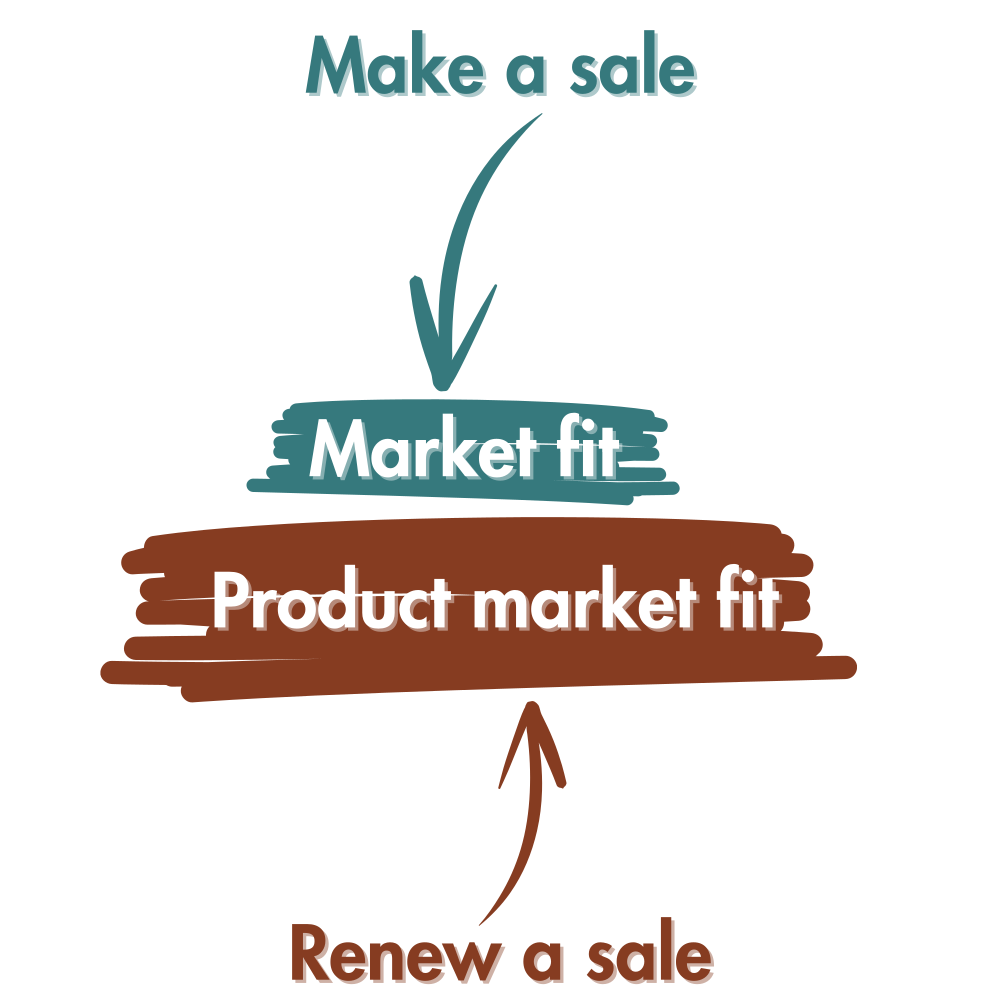
A sale helps, but it does not settle the question
Money paid beats a compliment as evidence, but the payment may come from a relationship with the founder, a budget that exists once, a custom promise, a steep discount, or a problem that will not come back. On the other side, renewal is not the only meaningful signal when a product is transactional or used rarely. Read what customers do in light of how the product is meant to be used and why they picked it, used it, and stayed.
Keep revenue under contract apart from evidence that the product sells repeatably. Log custom work, hands-on support, concessions, procurement effort, implementation cost, activations that failed, refunds, the reasons customers churned, and the customers who would have said no to the standard offer. That way a total revenue figure cannot mask a segment that is weak or will not repeat.

"Product-market fit is a case you build from evidence for one segment; it is not who the founder is or one number on a dashboard."
Swap founder stereotypes for work you can test
No dependable rule says that first-time founders obsess over product, second-timers over distribution, third-timers over people, and that only by the fourth company does someone grasp PMF. Experience may sharpen judgment, widen networks, and open doors to capital, yet how many companies a founder has started tells you nothing about what a particular market needs.
Look at the work itself:
- Who exactly are the target segment, the buyer, the user, and the person who benefits?
- What problem, and what current workaround, has the team actually seen?
- What has to happen before a user gets any value at all?
- In this product category, which behavior proves value keeps coming back?
- Which price and buying process were tested with no concessions hidden in the deal?
- Which way of acquiring customers can be repeated, and at what cost?
- How much support, reliability, privacy, security, and delivery work does it take?
Put the evidence for each segment in a table
| Evidence area | Questions | Common distortion |
|---|---|---|
| Problem | Does it happen often, cost a lot, carry risk, or matter strategically? | Talking only to people who already like you |
| Activation | Using the workflow as designed, does the segment get to first value? | Treating sign-ups as if they were successful use |
| Repeated value | Does the behavior that matters last over a fitting period? | Blending fresh cohorts with mature ones |
| Willingness to pay | Does the buyer say yes to the standard scope and price? | Concessions from the founder or customization nobody mentions |
| Acquisition | Is there a repeatable channel that gets the team to qualified buyers? | Crediting sales from the founder's network to a channel that scales |
| Economics | Do revenue and value cover the full cost of delivery and service? | Leaving out onboarding, support, infrastructure, and deals that fell through |
| Operations | Do quality and reliability survive as volume increases? | Treating heroic manual effort as the normal process |
Look at cohorts, not just totals
A total growth figure can blend segments, channels, prices, product versions, and customers of different ages. Cohorts pull those apart so you can see them. Split customers along a dimension that matters for the decision, then line up activation, retained behavior, revenue, support load, and churn across the same relative time window.
Be exact about the event you count. "Active" could stand for a workflow that completed successfully, a process a team runs again and again, a renewal someone paid for, or marketplace supply that led to a transaction. For a product meant to run in the background, login counts can tell you nothing. Track the leading behavior and also the customer outcome it is meant to forecast.
After everyone agrees on the cohort definition, our Claude Dashboards and Motion workflow for product KPI videos walks through checking a single activation result and bringing its denominator, observation window and data cutoff into a brief update for the team.
Agree on decision rules before you look at results
No retention curve, survey percentage, growth rate, or revenue level proves PMF for every product. Derive your thresholds from how often the product is used, its risk, its margin, the buying cycle, and the strategy. Write down where the data comes from, the denominator, what is excluded, the segment, when the cohort starts, how long you observe, and how uncertain the numbers are.
A few example decision rules:
- keep the pilot going when the target segment hits the agreed outcome with no unplanned manual help;
- rework onboarding when qualified users drop out before they see first value;
- tighten the segment when retention varies a lot between use cases;
- drop a channel when the qualified customers it brings cannot pay for full contribution economics;
- hold off on scaling when the evidence on reliability, support, security, or compliance falls short of the launch gate.
Testing a Product Direction?
Book Free ConsultationCombine qualitative and quantitative evidence
Usage data tells you where people stall, come back, pay, or quit. Research tells you why, and surfaces needs your tracking never caught. Do not use either one to dress up a decision you have already taken. Recruit the right participants, bring in users who failed or churned, note where findings contradict each other, and keep what you saw separate from what you think it means.
What customers ask for feeds the roadmap; it does not become the roadmap by default. Work out the job behind each request, the constraint, and the outcome expected, then check whether others besides the person asking share the pattern. That ties PMF work to the evidence-based way of prioritizing described in Escape the Feature Trap.
Recognize when it is too early to scale
Pour money into acquisition before the product delivers value consistently, and you multiply churn, support load, and damage to your reputation. Grow engineering before the target segment and workflow settle, and assumptions get baked into the architecture. Still, holding out for complete certainty is not realistic either. Commit in stages, each one behind a clearly stated evidence gate.
Before PMF, a team can need leadership across product, customers, commercial, technical, and domain areas, in varying mixes. A fractional co-founder or fractional CTO is one way to staff that, yet no rule says either role is needed before or after PMF. Set the mandate from the real gap in decisions, the authority involved, how available the person is, and the evidence you need.
Check fit again after anything significant changes
Fit does not last forever. Go back over the evidence whenever the segment, buyer, use case, price, packaging, channel, regulation, competition, product experience, or service model changes. A product may keep its fit with the segment it already serves while a move into a new one has yet to be proven.
Sources
- GOV.UK Service Manual: Learning about users and their needs
- GOV.UK Service Manual: Using performance data to improve a service
- Stripe: What product-market fit means for startups
- Y Combinator: The Real Product Market Fit
Final thoughts
Think of product-market fit as an evidence case for one segment, true as of a given date. Pin down the market and the value you mean to deliver, track activation and repeat behavior cohort by cohort, test willingness to pay and acquisition, count the full economics of serving customers, and fix your decision rules before you read the data. Solid evidence justifies the next commitment; it never makes fit permanent.
