In this piece
Software Development Cost in Saudi Arabia and the UAE
Software development cost in Saudi Arabia and the UAE is set by the same things as anywhere else, scope and team, plus a few that are specific to the Gulf: Arabic and English from day one, data-protection and hosting rules, and integrations with local payment and government systems. The single biggest lever is how clearly the scope is written before anyone quotes. Both currencies are pegged to the US dollar, so a USD quote converts cleanly: at 3.75 riyals and 3.6725 dirhams to the dollar, Devoun’s paid Discovery of $200 is about SAR 750 or AED 735, and software development retainers from $2k a month are about SAR 7,500 or AED 7,345. This guide covers the cost drivers, the engagement models, whether to hire locally or remotely, and how to get quotes you can actually compare.
We reviewed the external references on 19 November 2026. Data-protection and tax rules change; this is a practical guide, not legal or tax advice, so check the details with your adviser.
Want a fixed price for your project in riyals or dirhams?
Get a fixed-price quoteWhat drives software development cost in Saudi Arabia and the UAE?
Our general software development cost guide covers the universal drivers: number of screens and user roles, integrations, platforms and quality bar. In the Gulf, five more come up in almost every project:
- Arabic and English. Right-to-left layouts, translated content, Arabic search and testing in both languages. Planned from the first design, it is a modest addition; retrofitted, it touches every screen.
- Data protection and hosting. Saudi Arabia’s Personal Data Protection Law has been enforceable since September 2024, and the UAE has its own federal data-protection rules plus free-zone regimes. Where data is hosted and which vendors process it affects architecture and cloud cost; confirm your obligations with your adviser.
- Local integrations. Local payment methods, national identity and government portals, and local SMS and messaging providers each add integration and testing time.
- Stakeholders and approvals. Family groups, holding companies and government entities often have several decision makers. More review rounds mean more calendar time, and more cost on hourly contracts.
- Procurement requirements. Some buyers need local registration, specific contract terms or on-site presence, which narrows the supplier list.
How much does it cost, in SAR and AED?
The Saudi central bank has committed to the official rate of 3.75 riyals to the dollar, and the dirham has been pegged at 3.6725 to the dollar since 1997. We do not publish market rate tables, because they vary too much by team and scope to be useful. Here are Devoun’s own published prices, converted at the pegs:
| Devoun offer | USD | SAR (at 3.75) | AED (at 3.6725) |
|---|---|---|---|
| Discovery (full value $400, 50% off) | $200 | about 750 | about 735 |
| Development retainer, per month | from $2k | from about 7,500 | from about 7,345 |
| CTO-on-Call, per month | from $900 | from about 3,375 | from about 3,305 |
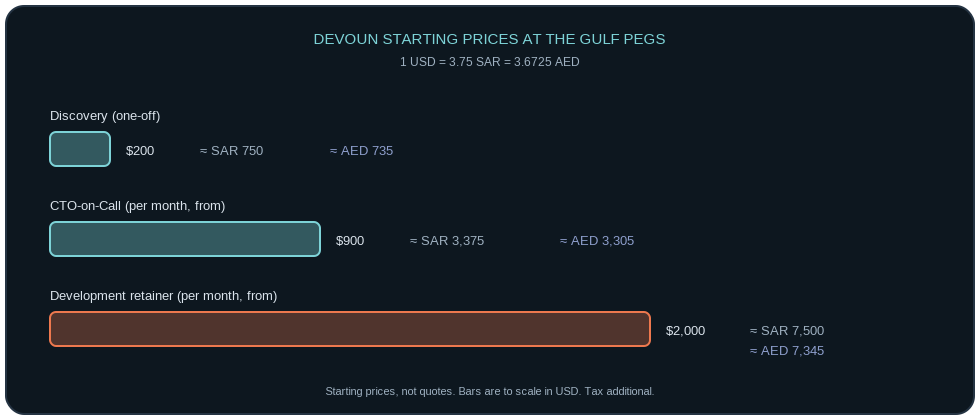
Illustrative example: a three-month build on the entry retainer would be 3 × $2k = $6,000, about SAR 22,500 or AED 22,035, plus the Discovery. This is arithmetic on a starting price, not a quote; a larger scope means a larger team or a longer build, and the Discovery is where the real number comes from. The Discovery fee is credited to the build invoice if you go ahead.
Which engagement model fits a Gulf project?
| Model | How you pay | Fits when |
|---|---|---|
| Fixed price per milestone | Agreed price for each accepted deliverable | Scope is clear and you need budget certainty for approvals |
| Retainer | Monthly or weekly, for a team’s time | Scope will change as you learn, or the product is live |
| Dedicated team | Monthly per engineer | Long programme, you want to manage the team yourself |
| Discovery first | Small fixed fee before any build | You need a scope, architecture and a firm price to take to your board |
Gulf buyers often need a fixed number for an internal approval, which suits a Discovery followed by fixed-price milestones. For the trade-offs in more depth, see fixed price vs time and materials.

"In the Gulf the expensive surprise is rarely the code. It is the Arabic version, the hosting decision or the extra approval round that nobody priced in at the start."
Should you hire a local or a remote development team?
Most companies end up with a mix. The trade-offs:
- Local team in Riyadh or Dubai: easy on-site workshops, familiarity with local procurement and stakeholders, and often a requirement for government work. Usually the highest cost per hour.
- Remote team: lower cost per hour and a larger talent pool. Time zones matter less than people expect: Riyadh is on UTC+3, Dubai on UTC+4, and Pakistan on UTC+5, so working days overlap almost completely.
- Hybrid: a local lead or fractional CTO for stakeholders and decisions, remote engineers for most of the build. It suits many mid-sized projects.
Whichever you choose, judge suppliers on total cost to a working, accepted product, not on the hourly rate. A cheap team that needs three rework rounds is the expensive option.
How to get quotes you can compare
Quotes from different suppliers are rarely comparable, because each one fills the gaps in your brief with its own assumptions. Send every supplier the same written brief, and ask each one to answer the same questions:
- Which features are in the price, and which are explicitly out?
- Is Arabic included, and does that cover right-to-left layouts, translation and testing in both languages?
- Where will the application and its data be hosted, and who owns the cloud accounts?
- Which integrations are included, and who pays for third-party fees?
- How many review rounds are included, and what happens to the price if scope changes?
- What does acceptance look like for each milestone, and what happens if a milestone is not accepted?
- Is VAT included, and in which currency will you be invoiced?
A supplier that answers these clearly is usually a supplier that will deliver clearly. One that cannot is telling you where the extra invoices will come from.
How Devoun works in the Gulf: Devoun has an office in Lahore and a presence in Riyadh, and the founder has worked on large Gulf platforms, including backend engineering for Nice One in Saudi Arabia and work on TAMM Abu Dhabi (prior roles, before and alongside Devoun). Our software development projects start with the Discovery and run in fixed-price milestones or a cancel-any-week retainer, covered by our money-back guarantee.
Frequently Asked Questions
How much does software development cost in Saudi Arabia?
It depends on scope, integrations, Arabic support and who builds it, so any single number is a guess until the scope is written down. As a reference point, Devoun’s paid Discovery is $200 (about SAR 750) and development retainers start from $2k a month (about SAR 7,500).
Is it cheaper to hire a remote team than a local agency in Riyadh or Dubai?
Remote teams usually charge less per hour, but the total depends on quality, communication and how much rework you pay for. Many Gulf companies combine both: local presence for workshops and stakeholders, remote engineers for most of the build.
Should I pay in USD, SAR or AED?
Because the riyal and the dirham are pegged to the dollar, the currency matters less than in most markets. Agree the invoicing currency, payment terms and how VAT is handled in the contract, and confirm the tax treatment with your accountant.
Does Arabic support add to the cost?
Yes. A bilingual product needs right-to-left layouts, translated content, Arabic search and testing in both languages. It is much cheaper to plan for it from the first design than to add it later.
Final thoughts
In Saudi Arabia and the UAE, the pegs make pricing simple; the scope is what makes it hard. Write down the Arabic, hosting, integration and approval requirements before you ask for quotes, compare suppliers on the cost of an accepted product, and insist on a fixed price once the scope is clear.
