In this piece
Lovable vs Bolt vs Replit vs Cursor for Founders
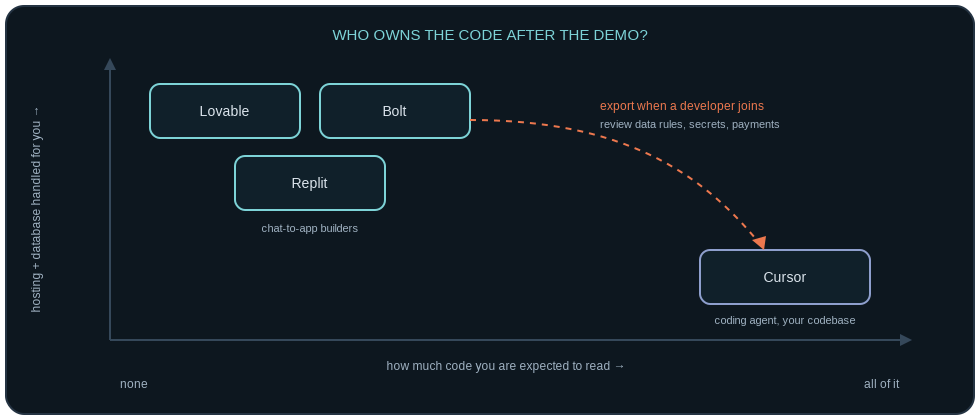
Lovable, Bolt and Replit let you build an app by describing it in chat, with hosting and a database handled for you. Cursor is different: it is a coding agent for people who work in a real codebase. So the honest answer to “Lovable vs Bolt vs Replit” is that the right tool depends on who will own the code after the demo. If no one on the team reads code, pick one of the three chat-to-app builders and try the same small brief in each. If a developer owns the product, Cursor fits how they already work. All four can get you to a working demo in days. None of them checks, on its own, whether your data rules, secrets and payments are safe for real users, which is the gap our vibe coding rescue work closes. Below is how the four compare, based on what each company says about its own product.
We reviewed the external references on 19 November 2026. These products change monthly; check each official site, and each pricing page, before you decide.
Already built something and not sure it is ready for real users?
Get a production reviewWhat is the difference between Lovable, Bolt, Replit and Cursor?
In their own words, roughly:
- Lovable calls itself a full-stack AI development platform for building and deploying web apps in natural language, with the code syncable to GitHub, GitLab or Bitbucket. For the backend you can use its built-in option or connect a Supabase project that you own.
- Bolt, from StackBlitz, invites you to create apps and websites by chatting with AI. Its help center covers a built-in database, publishing to a live site and connecting your own domain.
- Replit pitches turning ideas into apps with no coding needed. Its Agent sets up the project, configures databases, checks its own work and publishes when you are ready, all inside the Replit workspace.
- Cursor describes itself as a coding agent for building ambitious software. It ships as a desktop app, a CLI and cloud agents, and its docs focus on understanding a codebase, planning features, fixing bugs and reviewing changes.
Lovable vs Bolt vs Replit vs Cursor: side by side
| Lovable | Bolt | Replit | Cursor | |
|---|---|---|---|---|
| Main way of working | Chat to app | Chat to app | Chat to app, plus a full workspace | Coding agent in your codebase |
| Best fit | Web apps with a managed backend | Web apps and sites, fast iteration | Apps where agent, database and hosting sit together | Teams with someone who reads code |
| Backend and data | Built-in, or your own Supabase project | Built-in database | Databases set up by the Agent | Whatever your codebase uses |
| Getting the code out | Git sync | Check current export options | Code lives in the workspace | Code is already yours |
| Pricing | lovable.dev/pricing | bolt.new/pricing | replit.com/pricing | cursor.com/pricing |
We deliberately do not quote plan prices. Plans and usage limits change often, and in practice your cost depends on how much you build and change each month, so compare the current pricing pages against your own usage, not the headline monthly number.
Which AI app builder should a founder choose?
Ask four questions before you pick, in this order:
- Who will change the app in six months? If it is you, through chat, choose Lovable, Bolt or Replit. If it is a developer, start in Cursor, or plan to move there.
- Where should your data live? If you want the database in an account you control, Lovable’s Supabase option makes that explicit. With a built-in database, find out how you would export it.
- Is it mostly a web front end, or a backend-heavy app? Chat-to-app builders shine on screens and simple data. Complex background jobs, integrations and permissions are where a codebase you can read pays off.
- How will you leave, if you need to? Try it on day one: sync or download the code and run it somewhere else. A ten-minute test now saves weeks later.
A practical approach many founders use: build the first version in a chat-to-app builder to test the idea with users, then bring in a developer with Cursor or a similar tool once the product has to carry real data and money.
Two quick scenarios show how the questions play out. A solo, non-technical founder testing a booking idea with twenty pilot customers needs speed and a link to share, so any of the three chat builders is a sensible start; the deciding factor is which one produces screens and data the founder can follow. A two-person team where one founder is an engineer, building a product that will integrate with customers’ systems, will usually be happier in Cursor from the start, because the codebase is the product and the engineer will want to review every change. In between sits the most common case: a founder who starts in a chat builder, gets traction, and hires a developer. Plan for that hand-off early by keeping the code in Git, the database in an account you own, and a short list of every secret and integration the app uses.

"Founders ask which tool is best. The better question is which tool leaves you with code and data you can still understand when the first serious customer asks how their data is protected."
What breaks when these apps go to production?
The tool matters less than you think here. The same handful of problems shows up whichever builder made the app, because they come from what the founder did not ask for:
- Database access rules that let any signed-in user read other users’ rows.
- Secrets and API keys in front-end code, or in a public repository.
- Payment webhooks that are not verified, or that fail silently.
- No error monitoring, no backups and no staging copy to test changes on.
- Authentication redirects and email settings still pointing at the preview URL.
We have written tool-specific checklists for each: why a Lovable app breaks in production and the twelve fixes, how to take a Bolt.new app to production, and how to move a Replit app to AWS or Vercel when you outgrow the built-in hosting.
How Devoun helps: whichever tool you used, our vibe coding rescue starts with a review of data access, secrets, payments and deployment, then fixes what matters at a fixed price per milestone. Every milestone is covered by our money-back guarantee: if it is not accepted, it is refunded.
Frequently Asked Questions
Which is best for a non-technical founder: Lovable, Bolt or Replit?
All three are built for people who describe the app in chat. Lovable and Bolt focus on web apps with a managed backend; Replit puts the agent, database and hosting in one workspace. Try the same small brief in each and keep the one whose output you can understand and change.
Is Cursor an alternative to Lovable?
Only if someone on the team is comfortable reading code. Cursor is a coding agent that works in a real codebase on your machine or in the cloud. Many teams start in Lovable or Bolt and move the exported code into Cursor once a developer joins.
Can I move my app off Lovable, Bolt or Replit later?
Usually yes, because each lets you get the code out, for example through Git sync. The work is in the parts around the code: the database, authentication, secrets, file storage and domain. Plan that move before you have many users.
Are apps built with these tools ready for production?
They can be, but not by default. Before real users, review access rules on your data, where secrets live, payment webhooks, error monitoring and backups. The tool builds what you ask for; it does not know what you forgot to ask.
Final thoughts
Lovable, Bolt and Replit are all good at turning an idea into something people can click, and Cursor is good at helping developers move faster in a real codebase. Pick by who will own the code, test the exit on day one, and budget a proper review before the first real user signs up.
