In this piece
Switching Software Agencies: The Handover Checklist
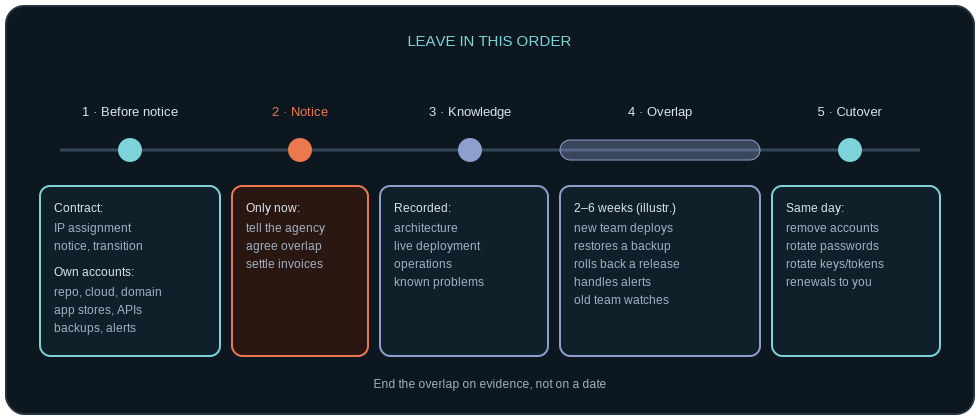
Switching software development agencies is safe when you control your own systems before you give notice. Most painful switches happen the other way round: the client tells the agency it is leaving, and only then discovers that the code repository, the cloud account, the domain or the App Store listing is registered to the agency. Even a friendly agency moves more slowly once it has lost the work. The safe order is simple: read the contract, move every critical account into your company’s name, then give notice, run an overlap in which the new team proves it can deploy and recover the system, and finally remove the old agency’s access and rotate every secret. This article is about that exit. For the list of what a finished handover should contain, see our software handover checklist. If you want the new team to run the whole switch, that is our software takeover service.
We reviewed the external references on 19 November 2026. Contracts differ, and nothing here is legal advice: check ownership and termination terms with your lawyer before you act.
Planning to leave your current agency?
Plan my switchWhat should you check in the contract before switching agencies?
Read four clauses before anyone says the word “switching” out loud:
- Ownership of the code. Under US copyright law, software written by an outside company is generally not a “work made for hire”, which needs both a qualifying category and a signed agreement (see the Copyright Office’s Circular 30). What usually gives you ownership is a written assignment of rights. Check that your contract has one, and whether it only takes effect once invoices are paid.
- Notice and termination. How much notice you must give, and what you still owe for work in progress.
- Transition help. Whether the agency must support a handover, for how long, and at what rate. If there is nothing, plan to pay for the overlap.
- Their own components. Agencies often reuse internal libraries or templates and license them to you rather than assign them. Know which parts those are.
If invoices are disputed, settle or document the dispute first. An unpaid invoice is the most common reason an agency slows down a transfer, and in some contracts it delays the assignment of rights.
Which accounts must you own before you give notice?
Every system the product needs to run, in your company’s name, with at least two people on your side as owners. Ask for transfers as routine housekeeping while the relationship is normal. On GitHub, for example, an owner can transfer a repository to your organization with its issues and history intact.
| Asset | Should be owned by | How to check |
|---|---|---|
| Code repositories | Your organization | You are an owner; full history and all branches are there |
| Cloud and hosting accounts | Your company, your billing | Root or owner login is yours; invoices come to you |
| Domain and DNS | Your company | Registrar account and renewal emails are yours |
| App Store and Google Play | Your developer accounts | Apps are listed under your company name |
| Third-party services (payments, email, maps, AI APIs) | Your accounts | API keys were issued by accounts you own |
| Backups and monitoring | Your accounts | You can restore a backup and you receive alerts |
Then prove the code you hold is complete. A repository can look fine and still be missing the branch that is actually deployed, or a configuration file that only exists on someone’s laptop:
# Prove the code you were given is the code that runs in production.
git clone --mirror https://github.com/your-company/app.git app-mirror
cd app-mirror
git branch -a          # every branch, not just main
git tag                # release tags, if the agency used them
git log -1 --date=iso  # does the last commit match the last release?

# Then, from a clean machine with only the README:
git clone https://github.com/your-company/app.git && cd app
cp .env.example .env   # every variable listed and explained?
npm ci && npm test && npm run build
How do you get the knowledge out of the old agency?
Code and access are the easy half. The hard half is what the old team knows and never wrote down: why the nightly job sometimes fails, which customer has a special configuration, which library cannot be upgraded. Plan three to five recorded sessions, each with a clear agenda:
- Architecture: the main parts, how data flows, and what talks to what.
- Deployment: a live release to production, start to finish, done by the old team while the new team watches.
- Operations: alerts, common incidents, backups, and how to restore one.
- Known problems: open bugs, technical debt, and anything they would “never touch”.
- Questions from the new team after they have read the code.
Recordings matter more than polished documents. A two-hour recording of a real deployment is worth more than a wiki page written in a hurry during the notice period.

"The handover is not done when the old agency says so. It is done when the new team has deployed, broken something, and fixed it without picking up the phone."
How long should the old and new agency overlap?
As an illustrative guide, two weeks for a small web app and four to six weeks for a platform with several services, mobile apps or integrations. Do not end the overlap on a date; end it on evidence:
- The new team has shipped at least one production release on its own.
- The new team has restored a backup to a test environment and rolled back a release.
- Every alert goes to the new team, and they have handled at least one.
- Your list of open questions for the old team is empty.
On the day the overlap ends, remove the old agency’s user accounts from every system in the table above and rotate every password, API key, token and certificate they could have seen. This is not a sign of distrust; it is the same hygiene you would apply when any employee leaves. Check that domain renewals, cloud billing and security notices now go to people on your side.
What if the agency will not cooperate?
Most agencies hand over professionally; it is their reputation too. When one does not, stay calm and keep it in writing:
- Send one clear, written request that lists every asset and account you need, quotes the contract clauses that cover them, and gives a reasonable date.
- Separate the money from the handover. If there is a disputed invoice, offer to pay the undisputed part now and resolve the rest separately, so the transfer is not held hostage.
- Recover what you can yourself. Where an account was opened in your company’s name or paid with your card, the provider’s own account recovery process, with proof of billing or company documents, is often faster than waiting.
- Check what the new team can rebuild. If you hold the code and the database, a missing build script or configuration file is a few days of work, not a crisis.
- Bring in your lawyer early if code ownership, the domain or customer data are at stake.
The best protection is still the order at the top of this article. Accounts you already own cannot be held back, which is why we ask every client to move them before notice, even when the relationship is good.
How Devoun can help: in a software takeover, we run this process for you, from the account audit to the overlap and the credential rotation, and take over development once it is done. Takeovers start with a Discovery (valued at $400, you pay $200), ongoing work runs from $2k a month, and every engagement is covered by our money-back guarantee.
Frequently Asked Questions
When should I tell my current agency that I am switching?
After you have read the contract and moved the critical accounts (code, cloud, domain, app stores) into your company’s name, but before the new team starts changing anything. Asking for account transfers is easier while the relationship is still normal.
Do I own the code my agency wrote?
Not automatically. Under US copyright law, software written by an outside contractor is generally not a work made for hire, so you need a written assignment of rights in your contract. Check your contract and confirm with your lawyer before you give notice.
How long should the old and new agency overlap?
Usually two to six weeks, depending on the size of the system. The overlap is over when the new team has deployed to production, handled an incident or a rollback, and can explain the system without asking the old team.
What should I do right after the old agency leaves?
Remove their user accounts everywhere and rotate every password, API key, token and certificate they could have seen. Then check that backups, monitoring alerts and domain renewals point to people on your side.
Final thoughts
Leaving an agency is rarely dramatic if you do it in the right order. Own your accounts first, give notice second, and let the new team prove it can run the system before the old one walks away. The few weeks of overlap cost far less than rebuilding knowledge, or a domain, that you discover you never controlled.
