In this piece
Case Study: Stabilizing CoreMax Cloud, a Surgical EHR in Production
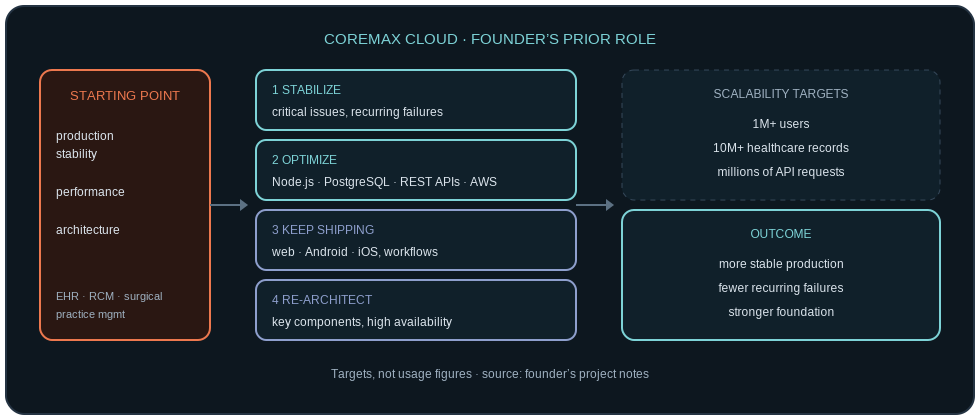
Taking over a live platform that is already failing is one of the hardest jobs in software: users depend on it every day, the original authors may be gone, and every fix risks breaking something else. Before and alongside Devoun, our founder, Atta Ur Rehman, did exactly that as Lead Full Stack Engineer on CoreMax Cloud, an all-in-one surgical EHR, revenue cycle management and practice management platform. He took over active development while the platform faced production stability, performance and architectural problems, resolved the critical production issues, optimized the backend and infrastructure, kept delivering features, and re-architected key components for growth. This case study tells that story using only his project notes, then turns it into lessons you can use if you are inheriting a system yourself, the situation our software takeover service is built for.
We reviewed the external references on 19 November 2026. CoreMax Cloud was not a Devoun client contract; it is the founder’s prior role, and we quote no figures beyond his project notes.
Inherited a production system that keeps breaking?
Talk about a takeoverWhat was CoreMax Cloud, and what needed fixing?
CoreMax Cloud combines three systems that surgical practices usually buy separately: an electronic health record, revenue cycle management (billing and claims), and practice management such as scheduling. It runs on web, Android and iOS, on a backend of Node.js services, PostgreSQL databases and REST APIs hosted on AWS.
When the founder took over active development, the platform was facing three kinds of problems at once: production stability, performance, and architecture. That combination is common in takeovers. Each problem makes the others harder: unstable production leaves no time for performance work, and an architecture that was not designed for growth keeps producing new incidents.
| At a glance | From the founder’s project notes |
|---|---|
| Platform | Surgical EHR, revenue cycle management and practice management |
| Role | Lead Full Stack Engineer, production and cloud architecture (prior role) |
| Stack | React, Node.js, PostgreSQL, AWS, microservices; web, Android and iOS apps |
| Starting point | Production stability, performance and architectural challenges |
| Scalability targets | 1M+ users, 10M+ healthcare records, millions of API requests |
| Outcome | More stable production operations, fewer recurring system failures, a stronger foundation for growth |
What did the takeover involve?
The work, as the founder describes it, fell into four streams:
- Stabilize. Resolve critical production issues and reduce recurring system failures.
- Optimize. Improve the Node.js backend services, PostgreSQL databases, REST APIs and AWS infrastructure, and address technical debt along the way.
- Keep shipping. Deliver new functionality across the web, Android and iOS applications, with improvements to scheduling, clinical workflows and integrations.
- Re-architect. Rebuild key components against scalability targets of 1M+ users, 10M+ healthcare records and millions of API requests, with a focus on high availability, efficient data processing and reliable operations.
Note what is absent: the notes describe re-architecting key components, not rewriting the platform from scratch, and the platform stayed in production while it was being stabilized. That is the reality of almost every takeover we are asked about.

"When you take over a live healthcare platform, a rewrite is not on the table. The job is to make it a little more reliable every week while the clinics keep working."
What are the signs that a platform needs a takeover like this?
The three problems CoreMax faced, stability, performance and architecture, rarely announce themselves by name. In our experience with inherited systems, they show up as symptoms that owners learn to live with:
- The same kinds of incidents come back every few weeks, and each fix is a patch rather than a cause.
- Releases are rare and stressful, because nobody is sure what a change will break.
- Pages and reports get slower as data grows, and the answer is always a bigger server.
- New features take longer each quarter, even though the team has not shrunk.
- Only one or two people understand key parts of the system, and the original developers have moved on or are about to.
- Integrations with other systems fail quietly, and staff fix the data by hand.
One of these is normal for any growing product. Several together usually mean the platform needs an owner who is accountable for its health, not just a team that adds features. That is the gap a takeover fills: someone who takes responsibility for production first, and earns the right to change the architecture second.
It also explains why the work at CoreMax covered more than firefighting. In any takeover, fixing incidents without improving the backend, the databases and the infrastructure underneath tends to mean fixing the same incidents again, and re-architecting before stabilizing means building on ground that keeps moving. The streams support each other, which is why they belong in one plan with one owner.
How do we approach a production takeover today?
The steps below are Devoun’s general approach to inherited systems, shaped by takeovers like this one. They describe how we work now, not a record of what happened at CoreMax.
- See before you change. Before touching code, make sure errors, slow requests and failed jobs are visible. On PostgreSQL, an extension such as pg_stat_statements shows which queries take the most time, which is often where performance work should start.
- Rank failures by user harm. Fix what stops clinicians, patients or billing first. Cosmetic bugs and refactoring wait.
- Make recovery boring. Tested backups, repeatable deployments and a rollback path come before any big change. The AWS Well-Architected reliability pillar is a useful checklist for this on AWS.
- Keep shipping small. The business still needs features. Small releases keep trust with users and show the team that stabilization is not a freeze.
- Re-architect by component. Choose the parts that block reliability or growth, set explicit targets for them, and replace them one at a time.
What does this mean if you are inheriting a system?
Healthcare adds weight to every one of these steps. Patient records are sensitive, and in the US many healthcare systems must meet the HIPAA Security Rule, so access, logging and backups matter as much as speed; check your obligations with your compliance adviser. But the pattern is the same in any sector: stabilize, then optimize, keep shipping throughout, and re-architect only what the evidence points to. Ask anyone taking over your platform how they will do each of these in the first month, and what they will not touch yet.
If you are changing teams, read our switching agencies checklist before you give notice, so the new team starts with the access and knowledge it needs.
How Devoun can help: our software takeover service applies this approach to your system. It starts with a Discovery (valued at $400, you pay $200) that maps what is failing and what to fix first; ongoing work runs from $2k a month, and every engagement is covered by our money-back guarantee.
Frequently Asked Questions
Was CoreMax Cloud a Devoun client project?
No. It is a project our founder, Atta Ur Rehman, worked on as Lead Full Stack Engineer in a prior role, before and alongside Devoun. We share it because it is the kind of takeover our software takeover service is built for.
What comes first when you take over an unstable production system?
Stopping the failures that hurt users. New features and big redesigns come after the critical production issues are resolved and you can see what the system is doing through logs, metrics and alerts.
Can you re-architect a platform while it stays live?
Yes, one component at a time. Re-architect the parts that block reliability or growth, keep the rest, and release changes behind careful testing so users and clinics keep working throughout.
Do the 1M+ users and 10M+ records figures describe CoreMax’s current usage?
No. They are the scalability targets the key components were re-architected for, as described in the founder’s project notes, not usage figures.
Final thoughts
CoreMax Cloud shows the shape of a good takeover: no dramatic rewrite, just steady work on the failures that hurt users, the performance that holds the platform back, and the components that limit growth, all while the product keeps moving. If you have inherited a system in a similar state, that is the order we would follow with you.
