In this piece
AI Chatbot Development Cost and Timeline (USD)
A customer-facing AI chatbot costs money in two places: a one-off build and a monthly bill. The build price is set less by the AI model than by what the chatbot is connected to: your help content, your shop or order system, your helpdesk, and each channel it runs on. A chatbot that only answers from your help center is a short project. One that looks up orders, checks return eligibility and hands conversations to a person with full context takes longer, because every connection needs access, error handling and tests. This guide breaks the cost and the timeline into phases, in US dollars, so you can compare quotes, plan a launch date and know what to ask before you sign. If you want us to scope yours, see our AI chatbot development service.
We reviewed the external references on 19 November 2026. Model and channel prices change often, so this article links to the official price pages instead of quoting them.
Want a fixed price and a launch date for your chatbot?
Scope your chatbotHow much does AI chatbot development cost?
Most customer-service chatbots fall into one of three levels. The level, not the model, decides most of the build effort. The build times below are illustrative, for a team that already has access to your systems; your own numbers come out of discovery.
| Level | What it does | Illustrative build time | Main cost driver |
|---|---|---|---|
| 1. Answers | Answers from your help center and policies on one website widget; offers a contact form when unsure | 2–4 weeks | Cleaning the content and building the evaluation set |
| 2. Answers and looks up | Adds order status, return eligibility and a handoff to your helpdesk with the transcript | 5–8 weeks | Shop and helpdesk integrations, identity checks |
| 3. Answers, acts, many channels | Starts returns or bookings, runs on web and messaging apps, in more than one language | 8–14 weeks | Actions, guardrails, channel approvals, more test cases |
To turn weeks into dollars, multiply by the weekly rate of the team doing the work, then check what the quote includes. A quote without an evaluation set, handoff rules and monitoring is a demo budget, not a production budget. If your “chatbot” is really an assistant that plans and acts across several business systems, the cost behaves like an agent; our line-by-line agent budget covers that case.
How long does it take to build an AI chatbot?
The calendar time is usually longer than the build time, because the chatbot depends on other people: the owner of the help content, the admin of the shop or helpdesk, and, for messaging channels, the platform’s business account approval. A typical plan for a level 2 chatbot looks like this.
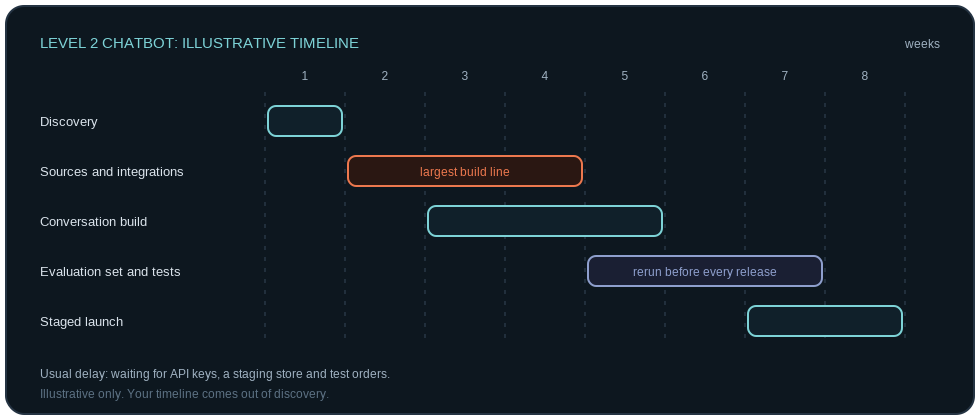
- Discovery (about 1 week). The questions in scope, the ones it must hand over or refuse, the sources and their owners, the systems to connect and how success is measured.
- Sources and integrations (1–3 weeks). Cleaning help content, getting API access to the shop and helpdesk, and building the lookups with real test data.
- Conversation build (1–2 weeks, overlapping). Prompts, retrieval, identity checks before any order data is shown, and handoff rules.
- Evaluation (1–2 weeks). A set of real questions with expected answers, including questions the bot should decline, run before every release.
- Staged launch (1 week or more). A share of traffic first, then more as the numbers hold.
The most common delay is not engineering. It is waiting a week or two for API keys, a staging store or test orders. Ask for those on day one.
What does an AI chatbot cost to run each month?
The running cost has four parts. Model usage is priced per token by providers such as Anthropic and OpenAI. Messaging channels can add their own fees; Meta, for example, publishes WhatsApp Business Platform pricing for business messages. Then there is hosting and review time.
monthly model cost = conversations per month
                   × average tokens per conversation
                   × price per token (input and output priced separately)

monthly running cost = monthly model cost
                     + channel fees (e.g. WhatsApp business messages)
                     + hosting, search or vector database, logs
                     + review time (failed conversations, content updates)
Measure tokens per conversation during the pilot rather than guessing. Long help articles pasted into every prompt, chatty system prompts and retries can multiply the model bill without improving answers. Review time is the line buyers forget: someone has to read failed conversations, fix the source content and rerun the evaluation after each change.
What pushes a chatbot quote up, and how to keep it down?
- Each integration. Shop, order system, helpdesk, CRM and booking tools each need access, error handling and test data.
- Actions. Reading an order status is cheap to make safe. Refunding, cancelling or changing an order needs limits, confirmations and an audit trail.
- Channels and languages. Each extra channel or language multiplies the test cases.
- Messy content. Contradictory or outdated help articles produce confident wrong answers, so they have to be fixed before the bot can be trusted.
- Accuracy target. Measuring and managing AI behavior is real work, which is why frameworks such as the NIST AI Risk Management Framework exist. A higher bar means a larger evaluation set.
To keep the cost down, start at level 1 or 2 on one channel, keep a human handoff for anything sensitive, and add actions only after the evaluation numbers justify them.

"A chatbot is only as good as the help content behind it and the handoff after it. Budget for both, or you are paying for a faster way to give customers the wrong answer."
How Devoun prices AI chatbots
Every Devoun chatbot starts with a Discovery valued at $400, 50% free (you pay $200, credited to the build). It fixes the scope, the integrations and the evaluation set, and ends with a fixed quote split into milestones. Our development projects typically fall within $200–$20,000, and ongoing improvements run on a retainer from $2k a month that you can stop any week. A milestone that is not accepted is refunded under our money-back guarantee. Model, channel and hosting fees are paid to those providers under your own accounts.
Questions to ask before you sign a chatbot quote
- Which questions will it answer, which will it hand over, and which will it refuse?
- Which systems does it connect to, and what does the customer see when one of them is down?
- How is the customer identified before any order or account data is shown?
- How many test questions are in the evaluation set, and what score counts as done?
- What is the expected model cost per conversation at our volume, and how was it measured?
- Whose accounts hold the model, channel and hosting contracts, and who owns the code?
- What does it cost to add a channel, a language or a new action after launch?
Frequently Asked Questions
How much does it cost to build an AI chatbot?
It depends on how many systems the chatbot connects to, how many channels it runs on, and whether it only answers questions or also takes actions such as starting a return. A chatbot that answers from your help content is the cheapest kind; each integration, channel and action adds build and test work. A paid discovery phase turns those choices into a fixed number.
How long does it take to build an AI chatbot?
A narrow chatbot grounded in your help content can be live in a few weeks. One with order lookups, returns and helpdesk handoff takes longer, mostly because of integration access and testing. Waiting for API keys, test data and channel approvals is the most common cause of delay.
What does an AI chatbot cost per month to run?
Model usage, channel fees (for example WhatsApp business messages), hosting, any search or vector database, and time to review failed conversations and update content. Model usage scales with the number of conversations and the tokens each one uses, so measure it during the pilot.
Is an AI chatbot the same as an AI agent?
Not quite. A customer-facing chatbot mainly answers and hands over, with a few tightly limited actions. An agent plans and acts across several tools on its own. The cost drivers overlap, but an agent needs more guardrails and evaluation.
Final thoughts
Price a chatbot by what it connects to and what it is allowed to do, not by the model. Start narrow, measure tokens and answer quality in a pilot, and add integrations and actions once the numbers hold. That keeps both the build quote and the monthly bill predictable.
