In this piece
RAG vs Fine-Tuning: Which One Your Product Needs
When a founder asks us whether to fine-tune a model on their company’s data, the honest answer is usually no, at least not first. Most products that need AI to “know” their data need retrieval-augmented generation (RAG): find the right documents when the question arrives and give them to the model. Fine-tuning solves a different problem. Our rule of thumb is short: RAG for knowledge, fine-tuning for behavior. Knowledge changes every week, has permissions and needs sources; behavior, such as a format, a tone or a narrow decision, is stable enough to train in. This piece explains where that rule comes from, when fine-tuning does win, when to combine the two, and how to tell which problem you actually have before you spend money on either. When you are ready to build, see our RAG development service.
We reviewed the external references on 19 November 2026. Model platforms change quickly; check each provider’s current documentation before you plan a fine-tuning project.
Not sure which approach your product needs?
Scope your RAG systemWhat is the difference between RAG and fine-tuning?
RAG, introduced in a 2020 paper by Lewis and colleagues, pairs a model with a searchable index of documents. At question time, the system retrieves the most relevant passages and the model answers from them. The paper’s authors pointed out a property that still matters most in practice: you can update the model’s knowledge by updating the index, without retraining. Fine-tuning instead changes the model’s weights by training it on example inputs and the outputs you want.
| RAG | Fine-tuning | |
|---|---|---|
| Changes | What the model can see for each question | How the model behaves on every question |
| Best for | Facts, documents, policies, product data | Format, tone, classification, narrow repeated tasks |
| Keeping current | Re-index changed documents | Retrain and re-evaluate |
| Permissions and sources | Filter by user; cite the passages used | Not possible inside the weights |
| Needs | Clean documents, chunking, search, evaluation | Hundreds or thousands of good examples, evaluation |
Why do most products need RAG first?
Three reasons, and each one is about the data rather than the model. First, your knowledge changes: prices, policies, help articles and tickets change weekly, and a fine-tuned model is frozen at its training date. Second, your data has permissions: a support agent may see one customer’s records, not all of them, and you can filter retrieved documents by user but cannot filter what is baked into the weights. Third, users and auditors want sources, and RAG can show the passage behind each answer.
The research points the same way. A 2023 study comparing knowledge injection methods found that while unsupervised fine-tuning offered some improvement, RAG consistently outperformed it, both for knowledge the model had seen before and for entirely new facts. Fine-tuning is a poor way to teach a model what is true about your business.
RAG is not free of problems, and most of them are retrieval problems, not model problems. Documents split into the wrong chunks, search that matches keywords but misses meaning, stale copies in the index, and permission filters applied after retrieval instead of before. When a RAG system gives a bad answer, check first whether the right passage was retrieved at all; if it was not, no amount of model tuning will fix it. That is why the evaluation set should score retrieval and answers separately.
When is fine-tuning the right call?
Fine-tuning earns its place when the problem is behavior, not knowledge:
- The output must follow a strict format or style every time, and prompting alone is not reliable enough.
- A narrow decision repeats at high volume, such as routing or classifying tickets, where a small fine-tuned model can be faster and cheaper than a large general one. Our write-up of Airbnb’s small-model fine-tuning walks through how to judge that trade-off.
- The domain language is unusual enough that a general model keeps misreading it, even with good context.
Two practical notes. Parameter-efficient methods such as LoRA train a small set of added weights instead of the whole model, which makes fine-tuning open-weight models far cheaper than it used to be. And hosted fine-tuning is a platform dependency: OpenAI’s own fine-tuning guide is the place to check which models and plans currently support fine-tuning, because providers change this often. Keep your training data and evaluation set in your own hands so you can retrain elsewhere. The same guide’s advice holds everywhere: build evaluations before you fine-tune.
Count the maintenance, too. A fine-tuned model is a small product of its own: a training dataset to curate, training runs to repeat when the base model is retired or your rules change, and an evaluation to rerun every time. A RAG index needs upkeep as well, but updating it is a data job your team already understands, not a machine learning project.

"Fine-tuning a model on your documents is like making a new hire memorize the wiki. RAG is giving them search access. Only one of those still works after the wiki changes."
Can you use RAG and fine-tuning together?
Yes, and mature products often do. A fine-tuned model can follow your format and tone reliably while answering from documents that RAG retrieves. The mistake is starting with both. Start with a strong model, a good prompt and RAG; build an evaluation set from real questions; and add fine-tuning only when that evaluation shows a behavior problem the prompt cannot fix.
Signs you are reaching for the wrong tool:
- You want to fine-tune so the model “knows” this month’s prices or policies. That is a RAG problem.
- Your RAG prompt has grown pages of formatting rules the model still ignores. That may be a fine-tuning problem.
- You cannot say how accurate the current system is. That is an evaluation problem, and it comes first.
- The cost per request is too high on a narrow task that runs millions of times. A smaller fine-tuned model is worth testing.
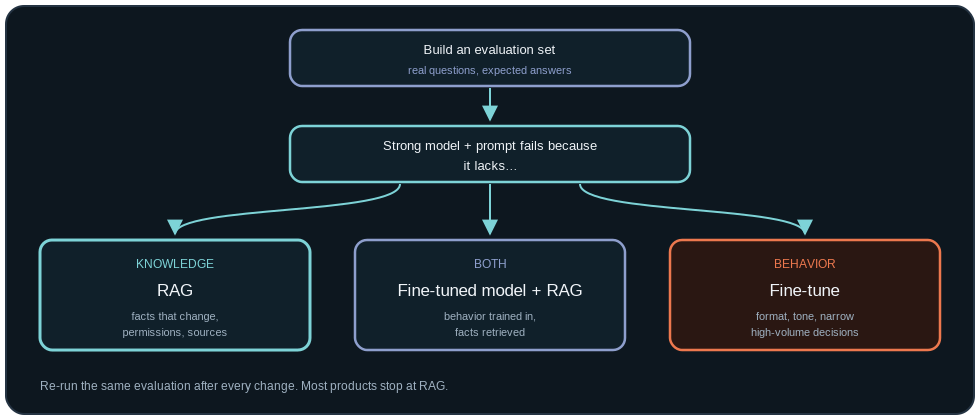
That evaluation set is where most of the value is, whichever technique you choose. Devoun builds RAG systems with the evaluation set from day one, and tells you honestly when fine-tuning would help. We start with a Discovery valued at $400, 50% free (you pay $200), and every build milestone is covered by our money-back guarantee.
Frequently Asked Questions
What is the difference between RAG and fine-tuning?
RAG retrieves relevant documents at question time and gives them to the model, so the model answers from your current data. Fine-tuning trains the model on examples so its behavior changes permanently, such as following a format, a tone or a classification rule.
Is fine-tuning a good way to teach a model my company’s knowledge?
Usually not. Research comparing the two found that retrieval consistently beat unsupervised fine-tuning for adding knowledge, and fine-tuned knowledge goes stale as soon as your documents change. Use RAG for facts and fine-tuning for behavior.
Is RAG cheaper than fine-tuning?
RAG is usually cheaper to start and to keep current, but each request carries retrieved text, which adds tokens. A fine-tuned small model can be cheaper per request for a narrow, high-volume task. Compare total cost on your own traffic, including the evaluation work.
Can I use RAG and fine-tuning together?
Yes. A common pattern is a fine-tuned model that follows your format and tone reliably, answering from documents retrieved by RAG. Add the second technique only when evaluation shows the first is not enough.
Final thoughts
The RAG vs fine-tuning debate is mostly a category error. If the model does not know something, give it the documents. If it does not behave the way you need, and a better prompt cannot fix it, train the behavior in. Measure both with the same evaluation set, and you will rarely have to argue about it.
