In this piece
AI Phone Agent vs Human Receptionist: Cost per Call
A human receptionist in the US costs roughly $54,300 a year once benefits are included, so their cost per call is that figure divided by the calls they actually answer. An AI phone agent’s cost per call is a different shape: a small usage charge for every minute, plus fixed build and upkeep costs spread across all calls, plus the cost of the calls it hands to a person. With the illustrative inputs below, an AI agent lands at about $1.50 to $6 a call and one receptionist at about $2 to $15, depending on volume. The more important difference is not the price per call but the hours: a receptionist covers about 40 hours of a 168-hour week, and an AI agent covers all of them. This guide gives you both formulas so you can fill in your own numbers before you talk to anyone about an AI voice agent.
We reviewed the external references on 19 November 2026. Pay data comes from the US Bureau of Labor Statistics; every AI input is illustrative, because voice platform and model prices change too often to quote. Check current prices on each vendor’s own pricing page.
Want this calculation done with your own call logs?
Model my call costsHow much does a human receptionist cost per call?
The Bureau of Labor Statistics puts the median pay for receptionists at $18.27 an hour, or $38,010 a year, in May 2025. Pay is only part of the cost. In the BLS Employer Costs for Employee Compensation survey for June 2026, wages and salaries were 70.0% of what private employers spent on compensation; the rest was benefits such as paid leave, insurance and payroll taxes. Dividing the median pay by 0.70 gives a loaded cost of about $54,300 a year, or about $26.10 an hour, before desk space, phones, training and cover for sick days and vacations.
Receptionist cost per call =
    (median pay ÷ wage share of compensation) ÷ 12 ÷ calls per month

  $38,010 ÷ 0.70   = about $54,300 a year, about $4,525 a month
  At 1,000 calls a month: $4,525 ÷ 1,000 = about $4.53 per call
That per-call figure assumes answering the phone is the receptionist’s whole job. It rarely is: most also greet visitors, book rooms, sort mail and handle small admin tasks. If calls take half of their day, only half of the cost belongs to calls. Be honest about that split, or the comparison will flatter the AI.
How do you calculate an AI phone agent’s cost per call?
An AI phone agent has three cost parts. The first is usage: telephony minutes, speech-to-text, the language model and text-to-speech, usually billed per minute or per token. The second is fixed: building the agent, connecting it to your calendar or CRM, testing it, and then monitoring and improving it every month. The third is the handoff: the share of calls the agent passes to a person, and what those minutes cost.
AI cost per call =
    (average minutes per call × usage rate per minute)
  + (fixed monthly cost ÷ calls per month)
  + (handoff rate × cost of one human-handled handoff)

Illustrative inputs (not vendor quotes):
  average call            3 minutes
  usage rate              $0.15 per minute, all-in (telephony, speech, model)
  fixed monthly cost      $1,500 (build spread over 24 months, upkeep, monitoring)
  handoff rate            20% of calls
  cost of one handoff     $1.74 (4 minutes of staff time at $26.10 an hour)

At 1,000 calls a month:
  0.45 + 1.50 + 0.35 = $2.30 per call
Swap in your own numbers. Your call length and handoff rate come from your phone system’s reports; the usage rate comes from the pricing pages of the vendors you choose; the fixed cost comes from your build quote. For the build itself, our AI agent development cost guide breaks the line items down, and our guide to an AI receptionist for small business covers setup and ROI.
At what call volume does an AI phone agent win?
Here are both formulas at four monthly volumes, with the illustrative AI inputs above and one full-time receptionist whose whole job is the phone:
| Calls a month | Receptionist, per call | AI agent, per call (illustrative) |
|---|---|---|
| 300 | about $15.08 | about $5.80 |
| 500 | about $9.05 | about $3.80 |
| 1,000 | about $4.53 | about $2.30 |
| 2,000 | about $2.26 | about $1.55 |
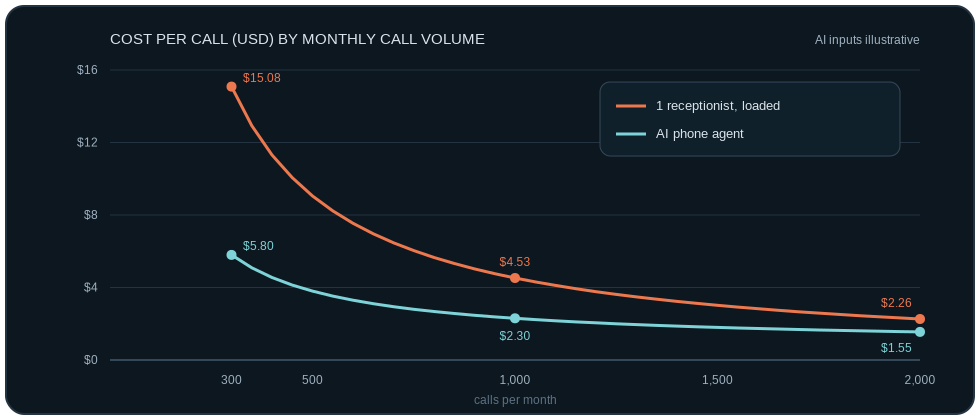
Both lines fall as volume rises, because both are mostly fixed costs. The gap narrows at higher volumes, and at some point one person simply cannot take more calls, so you hire a second. The table also hides three things that often matter more than the price per call:
- Coverage. 24/7 human cover needs more than four full-time people (168 hours ÷ 40). An AI agent answers evenings, weekends and holidays at the same rate per minute.
- Missed calls. A call that rings out may be a lost booking. If you do not answer after hours today, the AI is not replacing a receptionist; it is replacing voicemail.
- Peaks. A receptionist can take one call at a time. An AI agent can take several at once, which matters on Monday mornings and after a marketing campaign.
What hidden costs change the answer?
Neither formula is complete until you add the costs people forget. On the human side, those are hiring and training when someone leaves, temporary cover for vacations and sick days, and the manager’s time spent scheduling and checking quality. A receptionist who leaves after a year can cost you weeks of missed or rushed calls while you hire and train a replacement.
On the AI side, budget for the work that keeps the agent accurate:
- Updates. Every change to opening hours, prices, services or staff needs to reach the agent’s instructions and knowledge, and be tested.
- Monitoring. Someone should read a sample of transcripts every week, check the handoff reasons and fix the questions the agent gets wrong.
- Integrations. Booking calls only save money if the agent can write to your calendar or CRM. Each connection adds build time and occasional fixes when the other system changes.
- Bad calls. A wrong answer about a price or an appointment can cost more than a month of usage fees. Keep the agent to tasks where a mistake is cheap and easy to correct.
All of these belong in the fixed monthly cost of the formula. If a vendor or agency quotes only the per-minute rate, ask who does this work and what it costs.

"I would not sell an AI phone agent as a way to fire the receptionist. The honest case is the calls nobody answers today: after six, at lunch, and when the line is already busy."
When should you keep a human receptionist?
Keep a person when the role is mostly in-person work, when callers are often upset or vulnerable, or when most calls are complex and unusual. In those cases the AI will hand off so many calls that the handoff line in the formula eats the saving. The strongest setup for many small US businesses is both: the receptionist owns the front desk and difficult calls during the day, and the AI agent takes after-hours calls, overflow and simple requests such as opening hours, directions and bookings, passing anything else over with a written summary.
Two practical checks before you switch anything on. First, call recording and AI disclosure rules vary by state, so confirm what your callers must be told with your adviser. Second, test with real calls: record a week of common questions, run them through the agent, and measure how many it resolves without a handoff. That number is the input that moves your cost per call the most.
How Devoun can help: our AI voice agent work starts with a Discovery (valued at $400, you pay $200, credited to the build) where we run this calculation on your own call data and fix the price of the build. Milestones are fixed price and covered by our money-back guarantee.
Frequently Asked Questions
How much does a human receptionist cost per year in the US?
The BLS median pay for receptionists was $18.27 an hour, or $38,010 a year, in May 2025. Wages are about 70% of total compensation cost for private employers, so the loaded cost is roughly $54,300 a year before office space, equipment and management time.
How do I calculate an AI phone agent’s cost per call?
Multiply the average call length in minutes by your all-in usage rate per minute (telephony, speech and model), add your fixed monthly costs divided by monthly calls, and add the share of calls handed to a person times what each of those costs.
Is an AI phone agent always cheaper than a receptionist?
No. If you keep the receptionist for the front desk anyway, the AI is an extra cost, and the saving only comes from after-hours or overflow calls you would otherwise miss or pay someone to answer. It is cheapest when it replaces coverage you do not have today.
What calls should still go to a person?
Upset callers, complex or unusual requests, anything involving payment disputes or sensitive personal information, and any caller who asks for a human. A good voice agent hands these over with a summary so the caller does not have to repeat themselves.
Final thoughts
Cost per call is a useful number, but it is the wrong place to stop. Work out what a receptionist really costs for the calls they take, fill in the AI formula with your own call length and handoff rate, and then look at the hours nobody covers today. That is usually where an AI phone agent pays for itself.
