In this piece
Case Study: Building Multiple MVPs at Northbound VC, a Venture Studio
Before and alongside Devoun, our founder Atta Ur Rehman worked as a Core Founding Engineer with Northbound Ventures (Northbound VC), an operator-led venture studio developing businesses across healthcare, financial services, workforce and digital infrastructure. A studio like this does not build one product; it builds several, often with unclear requirements and little technical groundwork. His job was to turn early ideas into working products, one MVP after another, from first requirements to deployment, and to build the studio’s own digital platform along the way. This case study describes that role, the problems it involved and what came out of it, using only what we can state accurately. It is the same end-to-end work we now do for clients through our fixed-price MVP development service. If you are about to build your first version, the lessons at the end apply whether you are a studio or a single founding team.
We reviewed the external references on 19 November 2026. This case study has none: it is based on our founder’s own account of a prior role, and it contains no metrics because none were published for this work.
Have an idea that needs to become a working product?
Plan my MVPAt a glance
| Item | Detail |
|---|---|
| Organization | Northbound Ventures (Northbound VC), an operator-led venture studio |
| Sectors | Healthcare, financial services, workforce, digital infrastructure |
| Role | Core Founding Engineer (founder’s prior role, before and alongside Devoun) |
| Scope | Multiple MVPs and early-stage applications, plus the studio’s own digital platform |
| Work covered | Requirements, architecture, frontend, backend, integrations, deployment |
| Technology | React.js, Node.js APIs, CMS functionality, database design, cloud infrastructure (AWS) |
| Published metrics | None |
Why does a venture studio need a founding engineer?
A venture studio starts companies itself. Instead of waiting for founders to arrive with a product, it finds the problem, forms the team and provides shared services, including engineering. That means the studio’s engineers face the hardest part of every new company at the same time: the stretch between an idea that stakeholders find promising and a product people can actually use.
A founding engineer in that setting is not a specialist who receives a finished specification. They help shape the specification, choose the architecture, write the code across the stack and get it deployed, then move to the next venture while keeping the earlier ones maintainable. At Northbound, the role also included work on the studio’s own digital platform.
The studio model also changes what “done” means. A single startup can afford to learn its codebase slowly; a studio cannot, because the same engineering effort has to serve the next venture soon after. In our view that puts a premium on code that someone else can read, products that deploy the same way, and decisions that are written down rather than held in one person’s head.
What was the challenge?
The role came with four early-stage engineering problems, each of which recurs in almost every MVP:
- Unclear requirements. New ventures start from a thesis, not a specification, so the first engineering task is often to help decide what the product must do.
- Limited technical foundations. A new venture has no existing codebase, infrastructure or team conventions to build on.
- Rapid product validation. The point of an MVP is to learn quickly whether the idea holds, so speed matters more than completeness.
- Scalability planning. At the same time, a venture that works will need to grow, and an MVP that cannot be extended forces a costly rebuild at the worst moment.
The second and fourth problems pull against the third. Moving fast on a thin foundation is how many first versions end up being thrown away, while planning too much for scale delays the learning an MVP exists to produce. Much of a founding engineer’s judgement goes into holding that balance for each product.
How were the MVPs built?
Each product was taken from initial requirements through architecture, frontend and backend development, integrations and deployment. The building blocks were consistent across the work:
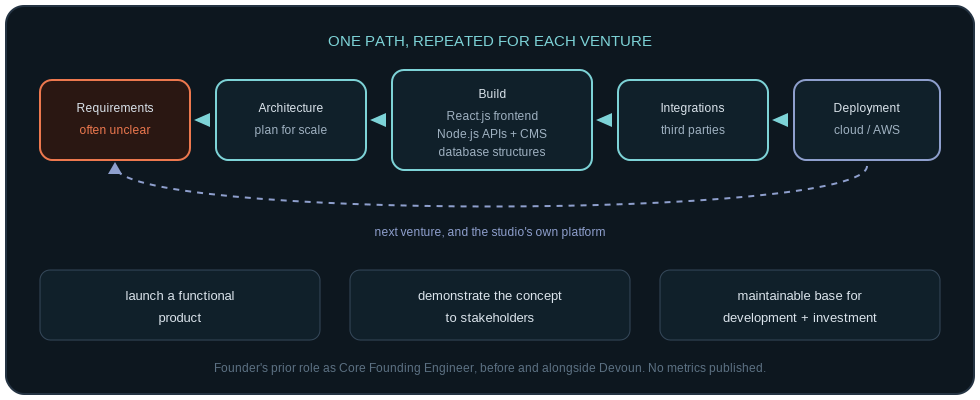
- Responsive React.js applications for the parts users and stakeholders see.
- Node.js APIs behind them.
- CMS functionality for managing content.
- Database structures for each product.
- Cloud infrastructure to deploy and run the products, including on AWS.
In our view, a shared set of building blocks is a real advantage for a studio: engineers can move between products without relearning the basics, and patterns proven in one MVP can be reused in the next.
What came out of it?
In our founder’s words, the work helped the studio’s founders launch functional products, demonstrate concepts to stakeholders, and establish maintainable foundations for further development and investment. Those three outcomes are what an MVP is for: something real in users’ hands, something convincing to show the people who decide on funding, and a base the next engineer can build on rather than replace. Northbound did not publish user or revenue figures for this work, so we do not quote any.

"An MVP has two audiences: the users who test the idea and the people who decide whether to fund the next step. If the code cannot survive the second conversation, it was a demo, not an MVP."
What does this mean for your MVP?
These are our founder’s lessons from building MVPs in a studio, offered as opinion rather than results:
- Write the requirements down, even when they are unclear. A one-page list of what the first version must prove keeps the scope honest. Our view on scope is in The MVP Is Dead. Build a Minimum Credible Product.
- Pick a boring, common stack. React and Node.js are not exciting choices, and that is the point: the next engineer can pick them up.
- Keep logic on the server. It is the difference between a product you can extend and one you have to rebuild when investors ask about security.
- Plan for scale, build for now. Note where the product will need to grow, but do not build it until the idea is proven.
- Agree the contract model early. See fixed-price MVP vs time and materials for how that choice changes who carries the risk.
If you already have a first version, built by an agency, a freelancer or an AI app builder, the same questions make a quick health check: are the requirements written down, does the stack have enough people who know it, does the server own the business logic, and could a new engineer deploy it without help? A “no” to any of them is worth fixing before you raise or hire.
How Devoun builds MVPs today: our MVP development work is led by the same founder. It starts with a Discovery at $200 that produces the architecture, a milestone plan and a fixed price for the build, and that fee comes off the build invoice. Each milestone is fixed-price and covered by our money-back guarantee.
Frequently Asked Questions
What is a venture studio?
A venture studio is an organization that starts several companies itself, supplying the idea validation, operators and shared services such as engineering, instead of only investing in founders who arrive with a company already formed.
What does a founding engineer do at a venture studio?
They turn early ideas into working products: clarifying requirements, choosing the architecture, building frontend and backend, connecting integrations and deploying, often for several ventures and for the studio’s own platform at the same time.
Was Northbound VC a Devoun client?
No. This case study describes our founder’s prior role as a Core Founding Engineer with Northbound Ventures, before and alongside Devoun. It shows the kind of MVP work he now leads for Devoun clients.
Which technologies were used for the Northbound MVPs?
The MVPs and the studio’s own platform were built with responsive React.js applications, Node.js APIs, CMS functionality, database structures and cloud infrastructure, including AWS.
Final thoughts
Building several MVPs in a venture studio is a concentrated version of what every founder faces: unclear requirements, no foundations, pressure to validate fast and the need to grow later. The work at Northbound meant owning each product end to end, from requirements to deployment, so it could launch, be shown to stakeholders and be built on.
