In this piece
Rescue vs Rebuild: What to Do With an AI-Built App
If you are deciding whether to rescue or rebuild a vibe coded app, judge what is underneath, not how messy the code looks. AI-built code is often untidy and still worth keeping. The deciding question is whether the foundations match your business: the data model, where access rules are enforced, and whether the stack can carry the next year. If they do, a rescue fixes security, payments, deployment and tests in place, typically in weeks. If they do not, every fix is temporary and a rebuild, usually done piece by piece, is cheaper over time. This guide gives eight criteria, a scoring table you can fill in with your team in an hour, and what each path means for time and risk. It is the same assessment we run at the start of every vibe coding rescue.
We reviewed the external references on 19 November 2026. The scoring thresholds below are our rule of thumb from reviewing AI-built apps, not an industry standard.
Want a second opinion before you decide?
Get an honest assessmentWhy is this decision so hard with AI-built apps?
Because the surface and the structure tell different stories. An app built with Lovable, Bolt, Replit or Cursor can look finished and demo well while the parts users never see are fragile. Independent testing backs up the concern: Veracode’s 2025 GenAI Code Security Report tested over 100 language models and found that 45% of the code samples they produced failed security tests and introduced OWASP Top 10 vulnerabilities.
That does not mean AI-built apps should be thrown away. Most security problems we see, such as broad Supabase RLS policies, exposed keys or unverified webhooks, can be fixed in place. Founders tend to make one of two mistakes: rebuilding because the code looks ugly, or patching for months because a rebuild feels like failure. A scoring sheet takes some of the emotion out of it.
What are the signs you should rescue, not rebuild?
- The main tables, such as customers, orders or bookings, match how your business actually works.
- Access rules live in the database or the server, even if some of them are wrong.
- The problems are a list you can name: security rules, payments, environment variables, deployment, tests.
- The code is in a repository you own and runs outside the builder’s preview.
- Real users are already on it, so a migration would carry its own risk.
If most of these are true, the app is closer to finished than it feels. A rescue then follows a familiar order: lock down data access, verify payments and webhooks, move secrets out of the client, set up proper deployment and add tests around the flows that make money. Our Lovable production fixes show what that list looks like in practice.
What are the signs you need a rebuild?
- The data model is wrong at the core: duplicated entities, data stored in text blobs, no clear owner per row.
- Authorization is decided in the browser, so any user with developer tools can see or change other data.
- The product has changed so much since the prototype that most screens would be rewritten anyway.
- The platform cannot do what the next year needs, such as background jobs, an API for partners or scale.
- Every fix breaks something else, and nobody can explain why.
How do you score an AI-built app?
Score each criterion 0 (healthy), 1 (real problems, fixable in place) or 2 (wrong at the foundation). Be honest rather than kind; the total is only useful if the scores are. Ideally, the person scoring has read the code and the database, not just used the app: several of these criteria are invisible from the screens. If nobody on your team can read the code, a short paid review is cheaper than guessing, because the two paths differ by months of work.
| Criterion | 0 – healthy | 2 – wrong at the foundation |
|---|---|---|
| 1. Data model | Tables match the business | Core entities duplicated or missing |
| 2. Access control | Enforced in database or server | Enforced only in the browser |
| 3. Payments and integrations | Webhooks verified, idempotent | Money flows depend on the success page |
| 4. Code structure | Readable, some duplication | Same logic copied across dozens of files |
| 5. Tests and change safety | Key flows tested | Every change breaks something else |
| 6. Stack fit for 12 months | Can carry the roadmap | Blocks a core roadmap item |
| 7. Product drift | Product still as built | Most screens will change anyway |
| 8. Ownership and portability | Own repo, runs anywhere | Tied to one builder, cannot export |
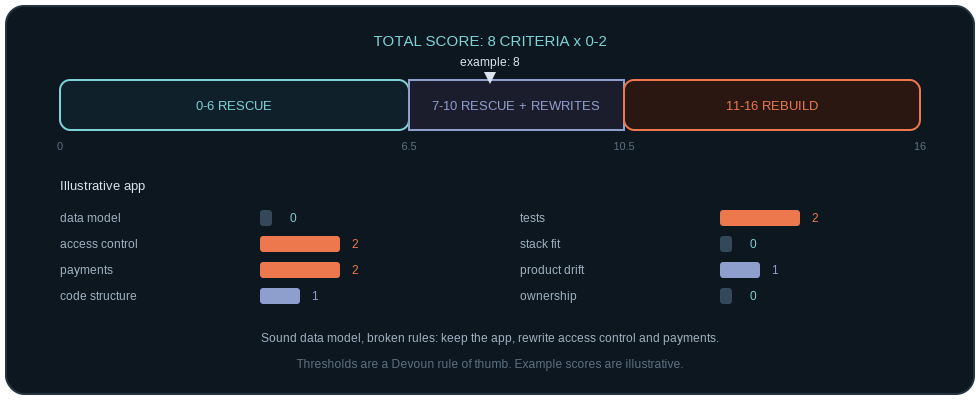
Reading the total (our rule of thumb):
- 0–6: rescue. Fix security, payments, deployment and tests in place, then keep building on it.
- 7–10: rescue with targeted rewrites. Keep most of the app, and rewrite the one or two areas scoring 2, often access control or payments.
- 11–16: rebuild, piece by piece. Keep the app running while new code replaces it one area at a time.
Any single 2 on data model or access control deserves extra weight: those two are the hardest to fix in place.

"Ugly code is a cleaning job. A wrong data model is a foundation problem. Founders often rebuild for the first reason and patch for the second, which is exactly backwards."
What does each path mean for time and risk?
| Rescue | Rescue + targeted rewrites | Rebuild, piece by piece | |
|---|---|---|---|
| Typical duration | Weeks | Weeks to a few months | Months |
| Users affected | Barely | One area at a time | Gradual migration |
| Main risk | Missing a hidden problem | Edges between old and new code | Data migration and scope creep |
| Keep the AI builder? | Yes, with review | For interface work | Usually not for core logic |
Durations are illustrative and depend on the size of the app.
Live users change the arithmetic. If people already pay for the product and their data sits in its database, a rebuild has to carry that data across, keep accounts and payment history intact and avoid breaking anyone’s workflow on the switch-over day. That migration is often the riskiest part of a rebuild, and it is one more reason to prefer a rescue, or targeted rewrites, when the scores allow it.
If you do rebuild, avoid the big-bang rewrite. Martin Fowler’s strangler fig approach describes building new parts alongside the old system and moving behavior over gradually. For an AI-built app that often means moving accounts and payments to a reviewed backend first, then the screens. Our Bolt.new production checklist covers the hosting side.
How Devoun helps: a vibe coding rescue starts with this scoring done on your real code, so you get a written recommendation before you commit to either path. If the answer is a rebuild, a Discovery at $200 sets the plan and a fixed price, and that fee comes off the build invoice. Both paths are covered by our money-back guarantee.
Frequently Asked Questions
Is it cheaper to fix a vibe coded app or rebuild it?
Fixing is usually cheaper when the data model is sound, because security rules, payments and deployment can be repaired in place. Rebuilding is cheaper in the long run only when the foundations are wrong, since every fix on a wrong data model has to be redone later.
How do I know if my AI-built app needs a rebuild?
Look underneath the screens. A rebuild is likely if the core tables do not match how your business works, if access rules are enforced only in the browser, or if most screens would change anyway. Score the eight criteria in this guide to make the call less subjective.
Can I rebuild an AI-built app without stopping the product?
Yes. Replace it piece by piece: put the new code alongside the old, move one area at a time, such as payments or accounts, and switch traffic over when each part is tested. This is the strangler fig approach, and it avoids a risky big-bang launch.
Should I keep using Lovable, Bolt or Cursor after a rescue?
You can, if the code lives in your own repository and changes go through review and tests. Many teams keep the AI builder for interface work and move payments, access rules and data changes to reviewed code.
Final thoughts
Most AI-built apps deserve a rescue, not a rebuild, because their problems are fixable rules and missing checks rather than wrong foundations. Score the eight criteria honestly. If the data model and access control are sound, fix in place; if they are not, rebuild one piece at a time while the product keeps running.
