In this piece
Why We Refund the Last Week: The Case for Guarantees in Software
Most software contracts pay for time. An agency that bills hours, or holds a retainer with a month’s notice, earns the same whether a week moved your product forward or not. We think that is the root of most bad agency relationships, so we changed what we are paid for: on a weekly retainer, you can stop any week, and the last paid week is refunded if it did not move your product forward. This piece is not a checklist of what a guarantee should say; we wrote that in what a software money-back guarantee should cover. It is the argument for why a software agency guarantee, built this particular way, makes the agency behave better, and why we refund a week rather than a whole project. The exact terms are on our money-back guarantee page.
We reviewed the external references on 19 November 2026. This is an opinion piece by Devoun’s founder, and the argument is ours.
Want to work with a team that puts its fee at risk every week?
Book a free callWhy do most software contracts reward time instead of results?
Because time is easy to measure and results are not. An hour is an hour; whether a feature is “done” is an argument. So the industry settled on contracts that measure the easy thing, and then added protections for the seller: notice periods, minimum terms, change requests. Each one is reasonable on its own. Together they mean the agency is paid for being present, and the buyer carries almost all the risk that the presence produced nothing.
That risk is not small. The Consortium for Information and Software Quality estimated the cost of poor software quality in the US at $2.41 trillion in 2022. Most of that cost lands on the people who paid for the software, not on the people who wrote it. When the seller is paid the same either way, quality depends on the seller’s conscience. Most engineers have one; incentives still matter.
| Contract model | The agency is paid for | Who carries a wasted week | Cost of leaving |
|---|---|---|---|
| Hourly, monthly notice | Time spent | The client | A month’s fees |
| Fixed price, whole project | Reaching the end | Shared, hidden in the quote | Often the whole contract |
| Fixed price per milestone, refund if not accepted | Accepted milestones | The agency | Nothing beyond the current milestone |
| Weekly retainer, last week refunded | Weeks that moved the product | The agency | Nothing |
Why refund the last week and not the whole project?
A promise to refund a whole project sounds generous and is almost always dishonest. Nobody can price that risk, so it is quietly added to the quote, or the conditions are written so tightly that the refund never happens. Either way, the buyer pays for a promise that was never meant to be kept.
A week is different. It is short enough that both sides can say what it was for and whether it happened. It is small enough that a refund is a decision, not a negotiation. And because it repeats, a weekly refund covers the whole engagement, one week at a time. The bet is small, frequent and bounded, which is exactly what makes it a bet we can afford to keep.
It also puts the cost of leaving in the right place. In most contracts, leaving a bad agency costs the client a notice period, a termination fee or a half-finished milestone, so clients stay longer than they should and the agency is paid for the extra time. When the client can stop any week and the last week comes back if it moved nothing, staying is a choice the client renews every Friday. An agency that has to be chosen again every week behaves very differently from one that only has to avoid being fired.
There is a price for us, and we think it is the right one. A refund is real money out of a small company’s pocket, so we plan more carefully, scope more narrowly and turn down work we do not understand yet. Clients sometimes read that as caution. We read it as the guarantee doing its job before anyone ever claims it.
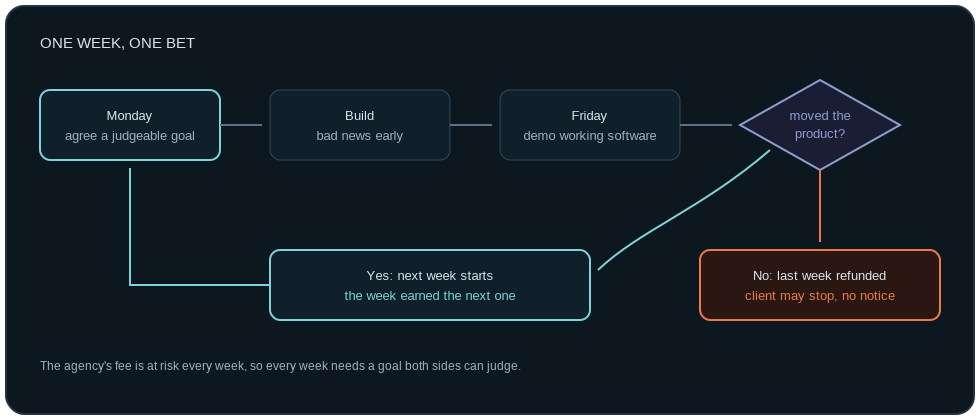
What does a refund change inside the team?
The guarantee is aimed at clients, but most of its effect is on us. When every week has to earn the next one, a few habits stop being optional:
- Every week starts with a goal the client can judge. Not “work on the dashboard”, but “a user can filter orders by status”.
- Every week ends with working software, not a status report. A demo is hard to argue with, in either direction.
- Bad news travels on Monday, not on Friday. If a week is at risk, saying so early and cutting scope is cheaper than refunding it.
- We stop counting hours. We do not track hours for clients at all; the unit we sell is a week that moved the product, so measuring time would only measure the wrong thing.
- We say no to work we cannot judge. If neither side can tell whether a week succeeded, the scope is not ready, and we would rather fix the scope than start the clock.

"A guarantee you never expect to pay out is marketing. One you might pay out next Friday changes how you plan Monday, and that is the whole point of it."
Can’t clients abuse a guarantee like this?
Some could. A client could take a good week of work and claim it moved nothing. We accept that risk with open eyes, for three reasons. First, the exposure is one week’s fee, and claiming it ends the engagement, so it is not a way to get ongoing work for free. Second, the weekly goal and the demo make the judgement concrete; a dispute about whether something works is resolved by running it. Third, and most important, the clients who would abuse it are not the clients we want, and the guarantee helps both sides find that out in a week rather than a quarter.
The other objection is that a guarantee makes an agency timid: it will only promise easy weeks. That is a real risk, and the answer is honesty about uncertainty. Research and experiments can have a week’s goal too: “we will know whether this approach works, and show you the evidence.” Learning that something will not work is progress, as long as it was the agreed goal.
At Devoun the same idea runs through every way of working with us. A weekly retainer can be cancelled any week, with the last week refunded if it had no impact. Fixed-price work starts with a Discovery valued at $400, 50% free (you pay $200, credited to the build), and each milestone that is not accepted is refunded. With Fast Lane, a surcharge on top of the fixed price for hard deadlines, all of the surcharge comes back if we miss the date. The details are on our money-back guarantee page, and you can see how it applies to a build on our software development service.
Frequently Asked Questions
Why refund only the last week and not the whole project?
Because a promise to refund everything cannot be priced honestly; the risk ends up hidden in a higher quote. A week is small enough to judge clearly and to refund without drama, and because it repeats every week, it covers the whole engagement one week at a time.
Who decides whether a week moved the product forward?
The client, against what was agreed for that week and what was shown at the end of it. That is why every week starts with a written goal and ends with a demo of working software, not a status report.
Can a client abuse a software agency guarantee?
In theory, yes. In practice the exposure is one week’s fee, and a client who claims it also ends the engagement. We think that small risk is a fair price for proving, every week, that we are paid for progress rather than presence.
Where can I read the exact terms?
The terms are on the money-back guarantee page. For a buyer’s checklist of what any agency guarantee should cover, read our guarantee checklist.
Final thoughts
Guarantees in software are usually either empty or impossible. Ours is deliberately small: one week, judged against a goal set in advance. Small enough to keep, frequent enough to matter, and uncomfortable enough to make us plan, demo and talk honestly every week. That is the case for it.
