In this piece
When Not to Build an AI Agent
Our honest view: most businesses asking for an AI agent in 2027 need something simpler first. Do not build an agent when a fixed workflow or a plain rule would do the job, when a mistake is costly and cannot be undone, when you cannot measure whether the agent was right, when the process or data underneath is a mess, when an existing product already does it, or when nobody will own it after launch. In each of those cases there is a cheaper, safer option that delivers most of the value: a workflow with one AI step, a chatbot with human handoff, a well-configured tool, or a process fix. Agents are genuinely useful when the path changes from case to case and the outcome can be tested. We build them, and we would rather tell you when not to than sell you one. That is how we approach AI agent development.
We reviewed the external references on 19 November 2026. This is an opinion piece; the facts it relies on are linked to their sources.
Want a second opinion before you commission an agent?
Get an honest recommendationWhy is “build an agent” so often the wrong first move?
Because an agent is the most expensive way to automate a task, and the hardest to test. Anthropic’s own engineering guide, Building effective agents, recommends finding the simplest solution possible and adding complexity only when it is needed, noting that agentic systems often trade latency and cost for better task performance. When the company selling the models tells you to start simple, it is worth listening. If you are not sure where the line between a chatbot, a workflow and an agent sits, our comparison of the three explains it.
When should you not use an AI agent?
These are the six situations where, in our view, an agent costs more than it returns:
| Situation | Why an agent is the wrong tool | Do this instead |
|---|---|---|
| The steps are the same every time | You pay for flexibility you never use, and lose predictability | Workflow automation, with an AI step where judgment is needed |
| Mistakes are costly and irreversible | A confident wrong action cannot be taken back | Agent drafts, human approves; or no agent at all |
| You cannot measure “right” | You cannot test it, so you cannot improve or trust it | Define success and build an evaluation set first |
| The process or data is broken | An agent automates the mess and hides it | Fix the process and clean the data, then automate |
| A product already does it | You build and maintain what you could rent | Buy and configure the existing tool |
| Nobody will own it | Models, prompts and connected systems drift; quality decays | Wait until there is an owner and a maintenance budget |
Two of these deserve more than a table row, because they are the ones we see ignored most often. The first is the broken process. When a team says “the agent will sort it out”, they often mean the process has no clear owner, the rules live in people’s heads and the data disagrees between systems. An agent will not fix that. It will produce confident answers on top of it, and the mess becomes harder to see. Writing the process down, agreeing the rules and cleaning the key data is cheaper, and it usually reveals that most of the work can be handled by a fixed workflow anyway.
The second is measurement. If nobody can say what a correct outcome looks like, you cannot build an evaluation set, you cannot compare models or prompts, and you cannot tell whether last week’s change made things better or worse. Before any agent work starts, collect a few dozen real cases with the outcome a good employee would have reached. If that collection is hard to make, that difficulty is your answer for now.
What are the real risks of giving an agent too much freedom?
The risks that matter most are not science fiction. The OWASP Top 10 for LLM Applications puts prompt injection first and lists “excessive agency”, giving a model more functions, permissions or autonomy than the task needs, among the main risks. An agent that reads emails or documents and can also send money, change records or email customers combines both. The NIST AI Risk Management Framework makes the same broader point: AI risk has to be measured and managed, and that work has a cost. If an agent cannot be given narrow tools and an approval step, that is a sign not to build it yet.
So when is an agent worth building?
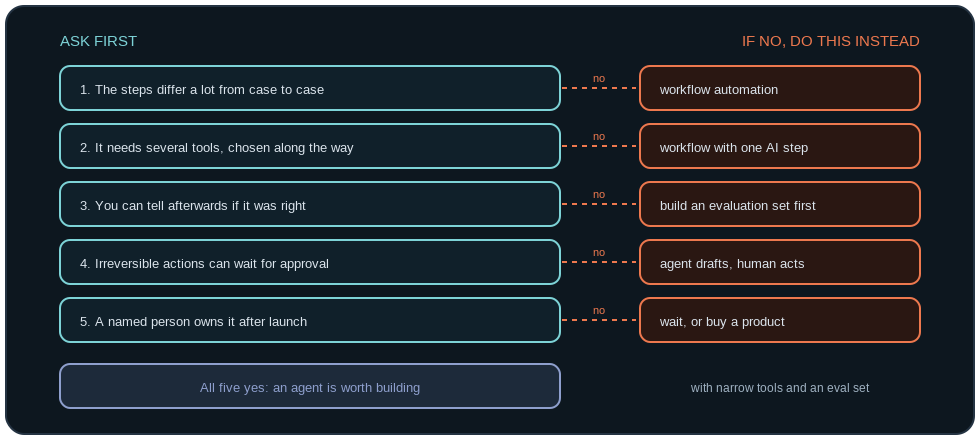
When the answer to all five questions below is yes. If any answer is no, start with the simpler option in the table above and revisit the agent when the missing piece is in place:
Before building an agent, answer yes to all five:
[ ] The steps differ a lot from case to case
[ ] The task needs several tools, chosen along the way
[ ] We can tell afterwards whether the result was right
[ ] Irreversible actions can wait for a human approval
[ ] A named person owns the agent after launch
Buying is often the right answer too. Our build vs buy vs agency guide covers when an off-the-shelf agent product beats a custom one.

"The most useful sentence in an AI Discovery is often ‘you do not need an agent for this’. It saves the client money, and it is the reason they trust us when we say they do."
How Devoun decides whether to build an agent
Our founder has built agents before and alongside Devoun, including an airline booking agent prototype that required human approval before any payment-sensitive step, which is exactly the kind of guardrail this article argues for. Every Devoun AI project starts with a Discovery valued at $400, 50% free (you pay $200, credited to the build). It maps the process against the five questions above, and if the answer is a workflow, a chatbot or an existing tool, that is what we recommend. Build milestones have written acceptance criteria, and one that is not accepted is refunded under our money-back guarantee.
Frequently Asked Questions
When should you not use an AI agent?
When the steps are fixed, when mistakes are costly and irreversible without review, when you cannot measure success, when the process or data is broken, when a product already does the job, or when nobody will maintain the agent after launch.
What should I build instead of an AI agent?
Usually a workflow automation with one AI step, a chatbot with human handoff, or an existing tool configured well. Sometimes the right answer is to fix the process first and automate it later.
Are AI agents too risky for business use?
Not inherently. The risk comes from giving an agent more permissions than it needs and letting it act without checks. Narrow tools, human approval for irreversible actions and an evaluation set make agents usable in many businesses.
How do I know if my use case is right for an agent?
Write down the steps a person takes for ten real cases. If the steps differ a lot, need several tools, and you can tell afterwards whether the result was right, an agent may be worth it. If not, start simpler.
Final thoughts
AI agents are a real advance, and they are also the most expensive and least predictable way to automate work. Use them where the path genuinely varies and the result can be tested, keep a human on anything irreversible, and for everything else choose the simpler tool. Not building an agent is often the best AI decision a business makes this year.
